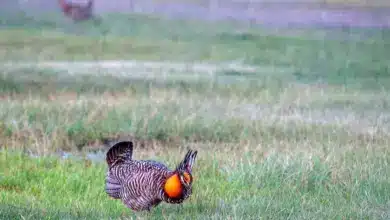
The Black-banded Barbets (Megalaima javensis) – also known as Kotorea Barbets – are endangered Asian Barbets that are endemic to Indonesia, where they occur on the islands of Java and Bali. They live in subtropical or tropical moist lowland forests and moist montane. This species is threatened by habitat loss.
The Black-banded Barbet has a compact body, and its black bands set it apart. It has a robust body, a strong, large bill that is good for both eating fruit and catching insects, and a dense, vibrant feathering which provides camouflage when the light from the canopy of the forest is dappled. The barbet is a robust bird with a black banding pattern. Although there are few descriptions of its coloration, it’s unmistakable.
Barbets are known as a group for their stocky, solid forms and their distinctive casque-shaped bills. This adaptation helps them to feed on different foods and dig nesting cavities. Black-banded Barbets are no exception. They display these traits in an environment that is perfect for them.


Distribution and Habitat
The Black-banded Barbet is endemic in Indonesia. Its range is restricted to two islands, Java and Bali. These are both biologically rich, but also increasingly threatened, islands within the Indonesian Archipelago. This species is endemic, meaning it can only be found in Indonesia.
Java and Bali have a diverse biodiversity that is shaped by their tropical climates, volcanic soils, and complex geological histories. The Black-banded Barbet is attracted to habitats such as moist mountainous forests and tropical or subtropical moist lowland forests, habitats are characterized by dense trees, high humidity, and an abundance of insect life and fruiting trees. These forests are not only a source of food, but also provide nesting areas and protection from predators.
The montane forest, which is found at higher altitudes, offers a cooler and more stable climate that can be a refuge during times of climate variability. Lowland forests are generally warmer, more productive, and have a different composition of species. This range of habitats for the Black-banded Barbet indicates its adaptability. However, it also shows that this species needs a variety of forest types in order to flourish.
These habitats are under increasing threat. Java and Bali, two of the world’s most densely populated islands, have experienced extensive land-use change, including deforestation, urbanization, and logging, which has led to habitat fragmentation and loss. The Black-banded Barbet is directly affected by the shrinking natural forests, which reduce nesting and feeding opportunities.
Alternate (Global) Names
Chinese: ???? … Czech: Vousák jávský … Danish: Sortbåndet Skægfugl … Dutch: Javaanse Baardvogel … German: Java Bartvogel, Javabartvogel … English: Black-banded Barbet, Black-banded Barbet, Javan Barbet, Koforea Barbet … Spanish: Barbudo de Java, Barbudo de Listas Negras … Finnish: Keltalakkiseppä … French: Barbu de Java … Indonesian: Takur Tulung-tumpuk, Tulung tumpuk … Italian: Barbetto bandanera, Barbuto di Giava … Japanese: shishigashiragoshikidori … Norwegian: Båndskjeggfugl … Polish: pstroglów obrozny, pstrog?ów obro?ny … Russian: ???????? ?????????? … Slovak: barbet obojkový … Swedish: Javabarbett
Diet / Feeding
The Black-banded Barbets mostly feed on fruits, but will also eat a wide range of insects, such as ants, cicadas, dragonflies, crickets, locusts, beetles, moths, and mantids.
Vocalizations and Behaviour
Black-banded Barbets are expected to use distinctive vocalizations that serve as important communication tools in dense forest environments. Barbets emit loud, repeated calls that can travel long distances in dense foliage. These calls are made to defend territory, attract mates, and maintain contact between pairs.
The Black-banded Barbet is not well-documented, but barbets tend to make rhythmic, booming sounds or a series of repetitive notes, which are described as “kut kut kut” or “kot kot kot.” This feature is reflected in its local name, “Kotorea Barbet.” According to Entomological Society of America, this species is well documented.
Barbets have a territorial nature and are often seen perched in the middle to upper canopy. They can be found alone or in pairs. Their behavior is closely related to their feeding and breeding habits. It is important for them to spend a lot of time maintaining and excavating nesting cavities within tree trunks. This activity has a direct impact on their reproductive success. According to iNaturalist, this species is well documented.
Breeding and Nesting
The Black-banded Barbet’s reproductive cycle is closely tied to the forest environment. The nests are holes in trees, which have been excavated by either the birds or other animals such as woodpeckers. These nesting places provide protection and shelter for eggs and young against predators and other environmental hazards.
Incubation lasts approximately 13 to 15 days. During the incubation phase and early chick rearing, males and females often share the responsibility of feeding chicks and protecting the nest. The selection of nest cavities is critical to breeding success. Trees must be large and healthy.
Barbets are dependent on mature forests that have suitable nesting trees. The loss of mature trees and old-growth forests poses a serious threat to their reproductive output. Degraded or fragmented forests could lack nesting sites that are suitable for barbets, resulting in reduced breeding success and population decreases.
The peak times of fruiting coincide with breeding seasons, which ensures that the young have enough food to eat. The quality of the habitat is important, but so is the absence of predation and excessive disturbance.
Conservation Status and Threats
The International Union for Conservation of Nature’s (IUCN) Red List classifies the Black-banded Barbet as Threatened, due to its ongoing habitat fragmentation. In the last few decades, human activities like agricultural expansion, illegal mining, infrastructure, urban sprawl, and illegal logging have led to a dramatic decline in the forests of Java.
Habitat destruction not only reduces the availability of nesting sites and food but also fragments the population into smaller, more isolated groups. This increases vulnerability to disease and demographic fluctuations, as well as inbreeding. Smaller populations have a lower resilience to stochastic and environmental events. This increases their risk of extinction.
Conclusion
Black-banded Barbets are a vulnerable, yet remarkable species that is emblematic of Indonesia’s rich and threatened natural heritage. The Black-banded Barbet’s presence in Java and Bali’s moist montane and lowland forests highlights the importance of protecting these ecosystems, not only because they are valuable but also because so many species depend on them.
The Black-banded Barbet, an endangered bird that has a special diet and habitat, is, a good indicator of forest health. This species and the ecological interactions that it supports are threatened by habitat loss. The Black-banded Barbet is a symbol of the forest, trees, and, complex web of life that they support.
Conservationists and bird enthusiasts can ensure that this jewel of Indonesian forests thrives by understanding its life story, feeding ecology, and breeding behavior. Future generations should be able to hear the bird’s characteristic calls echoing throughout the canopy, nd marvel at the black-banded beauty of the bird. This is a symbol of resilience in the face rapof id environmental changes and the need for stewardship.