Bewick’s Swan is a small, elegant species of swan. It’s sometimes considered the Eurasian subspecies to the Tundra Swan. Some authorities consider it a separate species and call it Cygnus Bewickii. The Bewick’s Swan is named after Thomas Bewick (1797-1800), a celebrated British illustrator who was famous for his illustrations of birds in The History of British Birds. Its graceful appearance, migratory behaviour, and sociable character attract bird enthusiasts. It is the smallest swan on the northern continents. This swan plays an important role in the wetland ecosystems of the world and attracts worldwide attention to conservation.
Distribution
Bewick’s Swans breed in northern Siberia and the Arctic, including on the Kola peninsula. These swans travel thousands of kilometres in order to spend the winter in temperate areas, including Western Europe, East China and Korea. They follow traditional migration routes, with stopovers at specific sites that allow them to feed and rest before continuing their long journey south. Wintering populations often congregate in shallow lakes and estuaries as well as flooded fields and marshes where there are plentiful food resources.

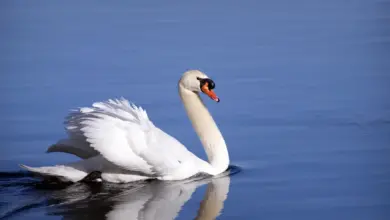
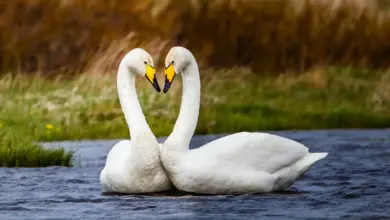
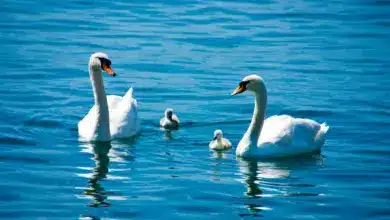
Bewick’s Swans weigh between 7.5-21 pounds (3.4-9.6 kilograms), with males on average 16 lbs (7 kg) and females at around 14 lbs (6 kg). The body length of Bewick’s Swans ranges between 115-150cm (45-59in) and their wingspan is 170-195cm (67-77in). Their short necks give them a more goose-like look compared to the other swans. The majority of their plumage is pure white. However, individuals living in iron-rich water may have a golden or reddish hue on their head and neck. The bill is primarily black, with yellow patches on its upper half. The feet are also black. The juveniles have a silvery grey down on top and a white underside. They gradually change to adult plumage after two winters.




Sexual Dimorphism in Juveniles
The male and female Bewick’s Swans look almost identical. Females are slightly smaller. The plumage of juveniles is a mixture of white and grey, especially on the head and neck. Their bills also have larger flesh-colored patches. After their second winter, the juveniles have acquired adult-like white plumage and completed their transformation. The early stages of development are crucial for survival as the younger swans depend on their parents to guide them during their first migration.
Habits of Breeding and Nesting
In the Arctic tundra, breeding occurs in freshwater habitats such as lakes, ponds and slow-moving rivers. Wetlands with abundant emergent plants are also used. Nesting sites are chosen to minimise disturbance and close proximity to food. The female builds a nest from aquatic plants, grasses and sedges. It is a shallow depression that’s lined with down feathers. The clutch size ranges from 2-7 eggs. Typically, 3-5 are laid. The female incubates the eggs for 29-30 days while the male protects the territory. The pair bonds can last a lifetime and are often monogamous.
Mating and Courtship Behaviour
Pairs engage in elaborate courtship displays upon arrival on breeding grounds early in the spring. This includes synchronised head bobbing and wing quivering. The male defends the nesting area, which allows the female to concentrate on building the nest. Swans often return to the same nesting site each year if they have a successful breeding season. They are not colonial nester,s but they will nest near other pairs of swans if the conditions are right, as a way to balance territoriality and social benefits.

Bewick’s Swans migrate long distances, from breeding grounds in the Arctic to wintering areas in Western Europe and East Asia. The migration occurs in V formations up to 8 km (27,00 ft) above sea level. Families depart mid-October and stop at shallow ponds along the way. In late summer and early fall, young swans fly short distances to build up their muscles in preparation for migration. The arrival at wintering grounds takes place between November and December, when they gather in large groups for safety and feeding.
Social Behaviour and Structure
Bewick’s Swans form large flocks, sometimes numbering in the thousands, outside of the breeding season. The flocks gather together during the day to forage and then roost on open water at night. During mating, the pairs are territorial and aggressive towards intruders. The species has strong family ties, and the young remain with their parents during the first winter migration. Siblings often remain together until they reach sexual maturity, which is usually around 3-4 years old. This reinforces the social cohesion of this species. According to National Geographic, this species is well documented.
Feeding and Diet Habits
Bewick’s Swans are herbivorous birds that feed on aquatic plants such as mannagrass, pondweeds, eelgrass, pondweeds, and sedges. In winter, they also eat grains and grasses from the land. Aquatic insects and crustaceans are a good source of protein for young cygnets. Feeding takes place both on land as well as in the water. Strong webbed feet are used to uproot vegetation, and they tip up in shallow waters to reach roots and shoots submerged. Swans feed in large flocks to protect themselves from predators and coordinate foraging. According to IUCN Red List, this species is well documented.
Communication and Vocalisation
Bewick’s Swans make a variety of vocalisations. The high-pitched honks are similar to those of the black geese. This is especially true when they feed or move in flocks. While in flight, they make low, ringing, “bow-wow”, calls, while swans that are excited create loud and distinct calls. These vocalisations are different from those of Tundra Swan,s who produce barking sounds, and Whooper Swans or Trumpeter Swans, which emit deep hooting calls or French horn-like sounds. Communication is important for maintaining group cohesion, alerting mates to dangers, and coordinating feeding activities.
Threats and Predators
Foxes are natural predators that attack eggs, cygnets or nesting adults. Nests can also be threatened by seabirds like gulls or jaegers. Hunting, lead poisoning, habitat loss, wetland draining, pollution and agricultural expansion are the most significant human-induced threats. It is important to take conservation measures in order to protect the species. This is especially true given that it relies on certain wetland habitats.
Longevity and Lifespan
The longest-lived Bewick’s Swan recorded lived for over 24 years. However, the average lifespan in the wild is about 10 years. Adult mortality rates for Bewick’s Swans are around 15% per year. This is influenced by factors such as hunting, disease and environmental stressors. The longevity of the species allows for stable pairs and multiple breeding attempts. These are vital for maintaining the population in spite of threats.

Bewick’s Swans are protected by the Agreement on the Conservation of African-Eurasian Migratory Waterbirds. In the early 1990s, populations were estimated to be between 16,000 and 17,000. Around 20,000 birds wintered in East Asia. Iran has a population of less than 1,000 people. Habitat protection, pollution control and hunting restrictions, as well as monitoring of migratory stops, are all part of conservation efforts. Wetland management is dependent on raising public awareness, involving local communities and managing wetlands.
Ecosystems and the Role of the
Bewick’s Swans are important for the ecology of freshwater and coastal wetland areas. They help to maintain the balance of plants, promote nutrient cycling and create open water habitats for other species by feeding on aquatic vegetation. Also, they are indicators of the health of wetlands; decreases in their population often indicate habitat degradation, pollutants, or changes to hydrology. Bewick’s Swans are important for protecting biodiversity in their habitats.
Conclusion
Bewick’s Swans are a symbol for temperate and Arctic wetland ecologies. They embody the elegance and resilience that migratory birds possess. The Bewick’s Swan is both fascinating and vulnerable due to its complex life cycle, extensive migrations, close family bonds and specialised eating habits. Conservation efforts require coordinated international efforts. Breeding and wintering habitats must be protected, as well as migratory routes monitored. Bewick’s Swans are a unique species that is vital to the future of wetland ecosystems.