The Bald Eagle is also known as White-headed Eagle and the American Eagle. It is one of the most recognisable birds of prey around the world, as well as being the proud national emblem of the United States. This striking raptor, the only eagle native to North America and a national symbol of the United States, holds a special place in cultural and ecological history. The Bald Eagle is closely related to the Eurasian White-tailed Eagle. It belongs to a group of sea and fish eagles, which are known for their powerful flight and swimming abilities. Scientists believe that these two species diverged in the North Pacific. The White-tailed Eagle spread westward to Eurasia, while Bald Eagles expanded eastward to North America. Their unmistakable yellow beak, talons and white head make them one of the most studied and loved birds on the continent. For more information, see our guide on birds of prey.
Distribution of Habitat and Range across North America
Bald Eagles are found in a large area that spans the United States continental, Canada and northern Mexico. Their range stretches from Alaska to the Canadian wilderness and then into isolated pockets in the United States. Alaska has the largest Bald Eagle population in the world, with nearly half of its estimated 70,000 Bald Eagles. Florida and Minnesota are next. Some vagrants have wandered beyond their usual range to places like Belize, Bermuda and Puerto Rico. They have even reached Ireland. Strong storms could have carried individuals across the Atlantic Ocean. Bald Eagles can be year-round residents or migrate in part, depending on where they are. When inland water freezes, northern populations migrate southwards or to coastal areas, while those along the Atlantic and Pacific coasts tend to stay put. They prefer large bodies of water, such as lakes, rivers, coasts, marshes, and coastal shorelines, where there are plenty of fish. During the winter, they often migrate to rivers and seacoasts that have no ice.
Subspecies and Geographic Ranges of Bald Eagles
Two subspecies of Bald Eagle inhabit distinct regions in North America. The southern race Haliaeetus Leucocephalus Leucocephalus is found between Delaware Bay and San Francisco, southward to Baja California, and along the Gulf Coast and Florida. The northern race is larger, Haliaeetus washingtoniensis. It ranges from Alaska to the Aleutians, and across Canada, excluding the far north archipelago. From the Pacific Northwest, across the Great Lakes, up to Maine’s coast. The northern birds extend south to Cape Hatteras along the Atlantic coast. Northern eagles are a larger size than their southern counterparts. This is a trend that occurs in many birds, following Bergmann’s rule. Animals in colder climates grow bigger to conserve heat.


Impressive Wingspan and Physical Characteristics
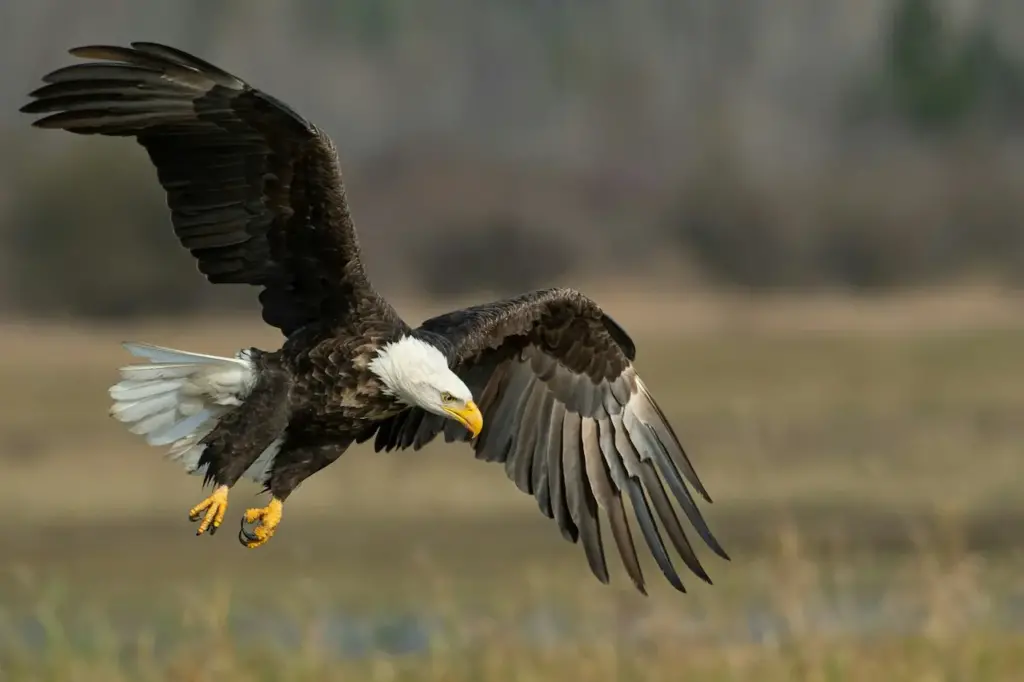
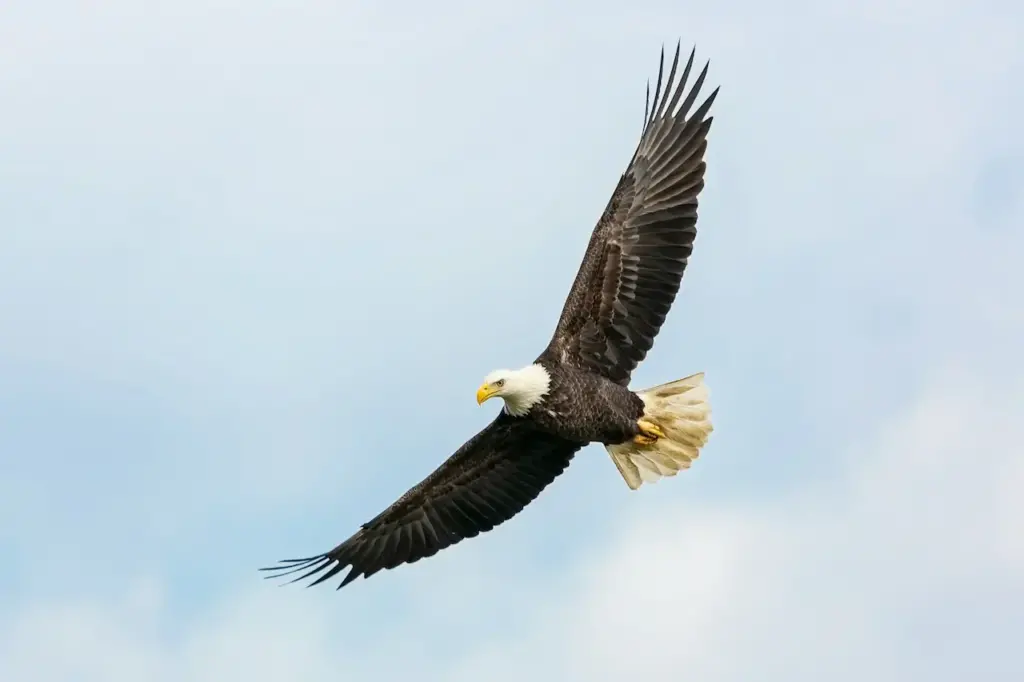
Bald Eagles have a wingspan of 5.6-7.5 feet (1.7-9 meters) and a length between 28-40 inches (70-102). Adults weigh anywhere between 5.5 to 14.3 pounds (2.53-6.3 kg). Females are typically 25 per cent heavier than their male counterparts. The size of eagles varies greatly depending on their location. Smaller eagles can be found in Florida, while larger eagles with massive wings and thick bodies inhabit Alaska’s colder climates. Their broad wings, long tails, and wedge-shaped bodies make them easily identifiable in flight. They glide effortlessly on thermals, using powerful, slow wingbeats.
Adult plumage and Appearance
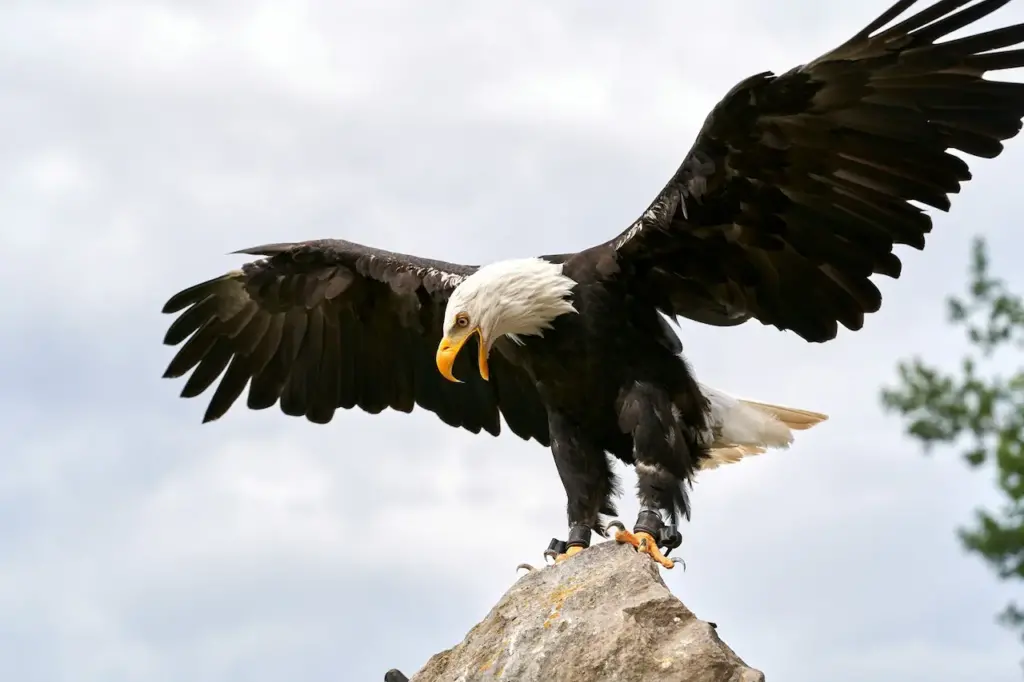
Adult Bald Eagles are characterised by their striking contrast between a white tail and head against a brownish-chocolate body. The iconic colouration only develops after several years. Adults have bright yellow eyes, beaks and talons. This gives them a regal and fierce appearance. The beak is large, hooked and has a yellow cere (a fleshy area just above the beak). Their powerful, featherless legs have short, robust feet with black talons to help them grip slippery fish. The colouration of males and females is nearly identical, but the size of the females can be the only way to tell them apart.
Comparison of Golden Eagles to Juvenile Bald Eagles
The appearance of juvenile bald eagles is very different from that of the adults. This can be confusing to observers expecting to see a white-headed adult. The young birds have mottled brown-white plumage. They do not get the characteristic white tail and head until they are five years old, although in rare cases it may happen earlier. Their wings and bellies are mottled and irregular compared to the clearly defined white patches on juvenile Golden Eagles. Bald Eagles juveniles have a larger beak and a protruding face, along with straighter-edged wing tips. These characteristics help birdwatchers differentiate them from Golden Eagles, which have feathered feet, as opposed to the Bald Eagles’ bare, yellow-colored legs. According to Mammal Society, this species is well documented.
Hunting Strategies, Diet, and Feeding Behaviour
Bald Eagles eat fish such as salmon and trout, which is why aquatic habitats are essential to their survival. These raptors, however, are opportunistic eaters. They will eat waterfowl as well as reptiles like crabs, crustaceans such as rabbits, and mammals, including raccoons. beavers and deer fawns. Bald Eagles are known for their ability to scavenge dead animals and to steal prey from birds. They often use their powerful talons to grab fish at the surface of the water by swooping over it. Sometimes they will grab birds in mid-air, or work together to hunt. One eagle may distract the prey, and another attack from behind. Their intelligence and adaptability ensure a varied and reliable diet all year round. According to IUCN Red List, this species is well documented.
Monogamy, Breeding Behaviour and Nesting Habits
Bald Eagles tend to be monogamous. They form long-term pairs that can last a lifetime, unless one partner dies, or if repeated nesting failures result in a “divorce”. Fewer than 10,000 breeding couples are thought to exist. Successful reproduction is therefore critical for the conservation of this species. Eagles will return to their original area to breed when they are ready. The aerial displays that they use during courtship include chases, dives and swoops. They also perform the cartwheel, in which the pair spins down and locks their talons, before breaking apart just moments before touching the ground. Nesting sites are usually located in mature, tall trees near water. However, in areas without suitable trees, they may nest in cliffs or even on the floor. The eagles are also able to adapt to artificial structures such as power poles or nesting platforms. Nests made from large sticks lined with soft materials are used year after year.
Giant Nests, Bald Eagle Chicks, and Their Life
The nests of the bald eagle are the largest in the entire world. Some nests that have been used for a long time can weigh as much as 4,000 pounds (2 metric tons), and measure up to eight feet wide and thirteen feet high. The largest tree nest recorded was that of a Bald Eagle in Florida. It measured 9.5 feet (2.9 m) wide by 20 feet (6.1 m) deep and weighed 5,400 pounds (2.7 tonnes). The average clutch is between one and three eggs. However, there are two that are the most common. The eggs are laid several days in advance, and both parents take turns to incubate the eggs, which takes five to six weeks. The first chick, which hatches sooner, grows faster than its younger siblings. The youngest chicks, and especially the third, struggle to survive. The chicks begin to fledge around 12 weeks of age and become more independent as they start to hunt for themselves by 20 weeks.
Alternate (Global) Names
Bulgarian: ???????? ?????? ???? … Chinese: ???? … Czech: Orel belohlavý … Danish: Hvidhovedet Havørn … Dutch: Amerikaanse Witkopzeearend / Zeearend … Estonian: valgepea-merikotkas … Finnish: Valkopäämerikotka … French: Aigle / Pygargue à tête blanche … German: Weißköpfiger Seeadler, Weißkopf-Seeadler … Icelandic: Skallörn … Irish: Lolair / Iolar Maol … Italian: Aquila calva / di mare americana / di mare testabianca … Japanese: hakutouwashi … Lithuanian: Baltagalvis erelis … Norwegian: Hvithodehavørn … Ojibwa: ??? … Polish: Bielik ameryka?ski … Russian: ??????????? ?????, ????? ??????????? … Slovak: Orliak bielohlavý … Slovenian: ameriški jezerec … Spanish: Aguila Cabeciblanca / Cabeza Blanca / Calva, Pigargo Americano … Swedish: Vithövdad havsörn … Turkish: Ak-ba?l? Kartal … Welsh: Eryr moel
Sounds and Vocalisations of Bald Eagles
Despite Hollywood depictions, Bald Eagles don’t produce the fierce, piercing scream that is often associated with them. That iconic sound belongs to the Red Tailed Hawk. Bald Eagles produce surprisingly low-pitched, soft whistles, chirps and squeaks. The calls of juveniles are louder and shriller than those of adults. While not dramatic, these vocalisations are important for communication between mates, parents with chicks and territorial rivals.
Reproductive maturity, survival challenges, and life span
Bald Eagles can live up to 30 years in the wild if they survive their first vulnerable year. Only about half of the fledglings make it through this period. Gunshots, electrocution from power lines, poisoning by toxins like lead, collisions and starvation are all threats to adults. Captive Bald Eagles can live up to 50-60 years due to the availability of food and reduced hazards. Bald Eagles reach their reproductive maturity between the ages of four and five, when they have fully developed their white head and tail. Bald Eagle populations are recovering dramatically after past declines due to conservation efforts, including nesting site protection and reduced environmental pollutants.