The Asian Golden Weavers (Ploceus hypoxanthus) are found in Cambodia, Indonesia, Laos, Myanmar, Thailand, and Vietnam. This weaver is threatened by habitat loss.
Description
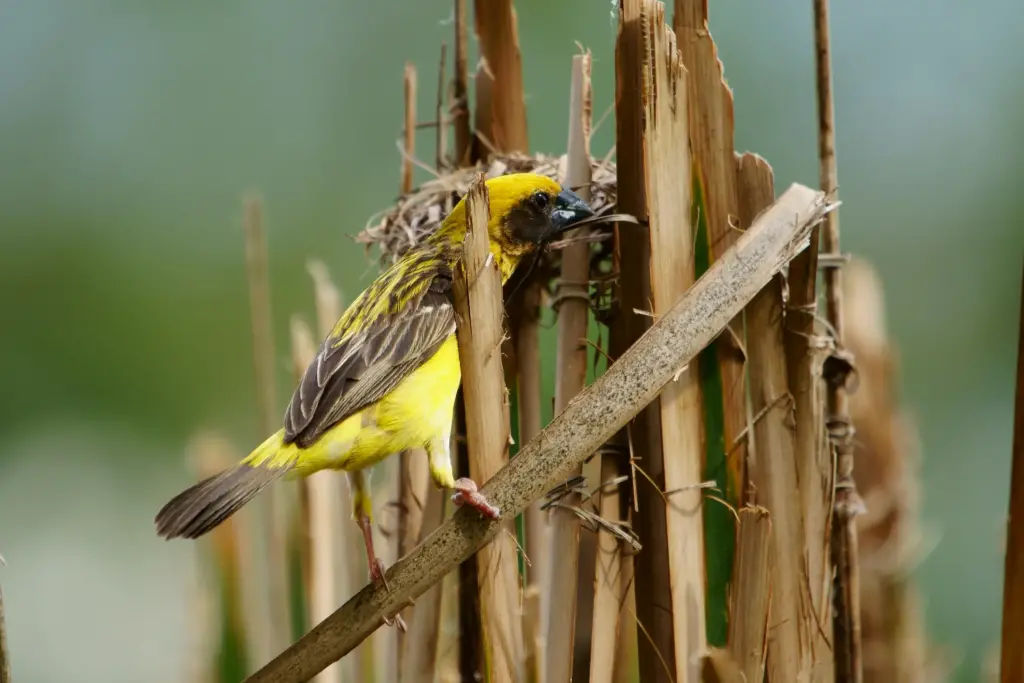
The Asian Golden Weaver measures around 22 centimeters. The breeding males can be easily identified: the body and underparts of their plumage are a rich, bright yellow. Their heads have a mask or “face” in black, with a powerful bill and a stout, dark-colored bill. Many breeding males also have yellow crowns on the top of their heads. The upper parts of the males are yellow, with darker feathers interspersed and bordered. This gives a slightly streaked look. The combination of bold black and bright yellow is striking in the right light.
Males become less showy outside of the breeding season. Their plumage starts to look more like that of young birds and females. The females have a much more subdued appearance. Their upperparts lack the bold black face mask. They are spotted or streaked brownish-yellow and often shaded in more subdued tones. The underparts of the females are paler and less vivid, either yellowish or buff. Females have a strong bill, but their face may not be as clean-looking.
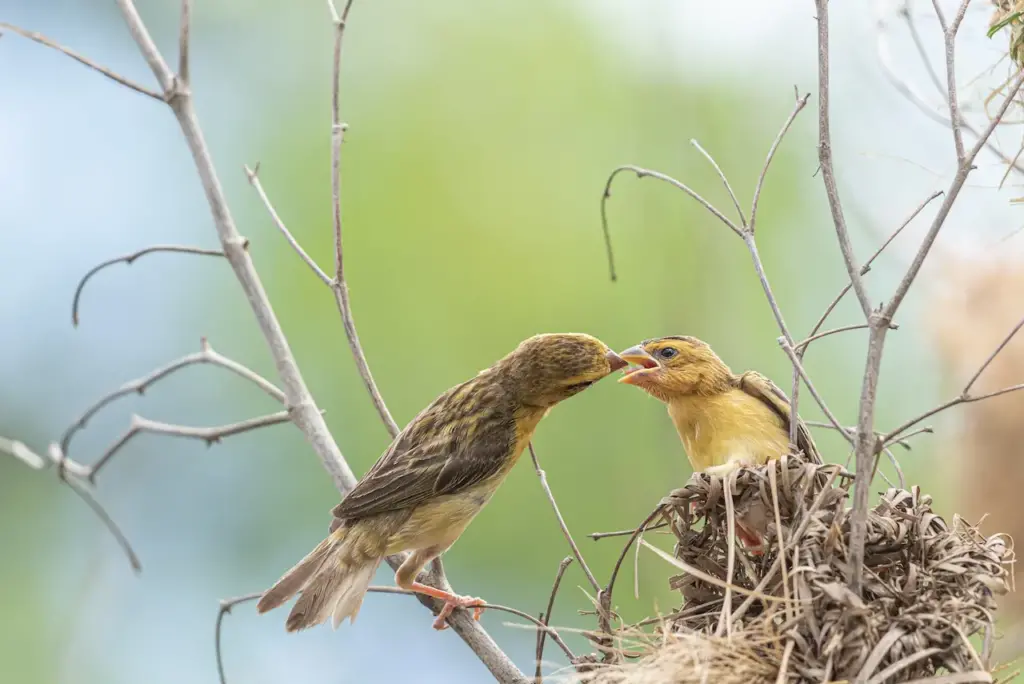
The juveniles have a similar plumage to female, but their feathers are duller and the spots and streaks less distinct. Males become brighter yellow as they grow older and enter breeding condition. They also develop the darker mak and the contrast of black and yellow.
The thick, robust bill is a key feature, especially for males, that sets it apart from other weavers (such as Baya Weavers) with whom the Asian Golden Weaver could be confused. A black mask on the male breeding is also a good way to identify it. When seen clearly, the colour combination of this species stands out in many areas.
Habitat and Distribution
The Asian Golden Weaver can be found in Southeast Asia. The range of the Asian Golden Weaver includes Cambodia, Laos, Myanmar, Thailand, Vietnam, and parts of Indonesia, notably Sumatra, Java, and Thailand. There are two subspecies of the genus: P. There are two subspecies: P. h. Hypoxanthus, found in Indonesia (eastern Sumatra and western Java), and P. Subspecies found on the mainland tend to have slightly darker feather edges and more raw sienna in the upper breast of some individuals.
The habitats that it prefers are low-elevation areas, such as swamps, marshes, rice paddies, and reeds. It also likes wetlands with water at least for part of the year. Its ecology is based on the presence of water, vegetation, and seed sources (bulrushes, reeds, and grasses). The lower portions of the mosaic habitat–flooded grasses and marsh fringes–allow for both nesting as well as feeding.
Wetlands are among the first places to be used for human settlements, agriculture, or other uses. This has led to a patchy habitat. The bird is now more localized on islands such as Java and Sumatra, where its wetlands were drained and altered. It is still fairly common on the mainland in areas with suitable habitats, but even here, its populations are being pushed back and becoming more fragmented.
In most of its range, the bird does not migrate in large numbers. Local movements–especially in response to seasonally flooded areas, water levels, or food availability–are likely. Birds may gather in dense numbers when there is abundant food, or during breeding.
Feeding / Diet
The Asian Golden Weaver’s diet is dominated by seeds. The majority of their diet is made up of seed grasses, grains, and wild grass seeds from agricultural fields or marsh plants. During breeding, it is believed that insects are consumed, but they only make up a small portion of their diet.
The insects that are eaten will likely be small: grasshoppers, water insects, or small flying insects. They are particularly important for chicks that need protein to grow.
Birds forage in small groups or flocks around nearby grasslands and wetlands during the day. Birds eat seeds of grasses and weeds. When water levels are high, flooded seedlings or plants can provide food. After harvest, rice paddies can be a good source of seeds, especially when grains and silt are brought in. Birds will also eat seeds and small invertebrates among the reeds, marsh grass, or sedges.
Food availability for those who live in flood zones or wetlands changes as the water level rises. When the water level is high, grassy areas can be submerged. However, when it is lower, more of the ground is exposed, and seed banks become accessible. The feeding behaviour of animals and their successions are closely related to seasonal cycles and rainfall patterns, flood pulses, and agricultural cycles.
Breeding
The breeding behaviour of the Asian Golden Weaver shares many similarities with other weaver species. However, it also shows some unique patterns due to wetlands’ affinities and threats.
There are reports that males can have more than one female, but this is rare.
The breeding is colonial, with small nests built close together. Nest construction begins with the male, who weaves a nest structure with a side entry. The nest is constructed from grass, palm leaves, or plant fibers (reed, etc.). The nest is carefully woven to ensure its security. The female helps to complete the nest once the male has begun it.
Nests are usually found over water or on very wet soil. Redbubulrushesad marsh vegetation typically holds nests that are less than 1 metre high (especially if the vegetation supports them). Nests can be found in trees and shrubs, sometimes higher than 2 metres, when the substrate or water level allows.
The normal clutch size is 2 eggs. However, sometimes 3 are laid. The eggs are a greyish-white color, with some light spots. Most records indicate that only the female is responsible for incubation. The female is the primary caregiver for the chicks after they hatch, although the male may occasionally assist. The chicks are fed by regurgitating seeds or insects or by directly feeding them.
Incubation and nestling times are less precise. In all areas of the range, observers have not consistently recorded how many days eggs are in the nest before hatching or how long chicks stay dependent after fledging. This lack of knowledge makes it difficult to determine how quickly populations recover and how sensitive they are during breeding season. According to BirdLife International, this species is well documented.
Breeding time varies by location. Breeding is recorded in Myanmar around July, in Thailand from July to September, in some parts of Laos in August, and in Java in January through June. This means that breeding can be timed differently depending on the local weather and flood cycles. According to eBird, this species is well documented.
Vocal Behavior
The vocal behavior of the Asian Golden Weaver has been studied in detail only a few times. The Asian Golden Weaver is not known for its elaborate song repertoire, but it communicates through the calls that are typical of weaver birds: alarm calls and contact calls, as well as calls used when breeding or territorial behavior. Males vocalize near colonies from perches to announce nests or territories. Males that are breeding may use calls to attract mates or assert dominance over other males.
During breeding, some observers have reported that males make short chattering calls or sharp repetitive calls. Becauset colonies are usually found in marsh vegetation and reeds near water, sound transmission can be adapted. Nestlings and adults can use sounds that travel over water and through reeds.
This species does not exhibit mimicry behavior (unlike other weavers). There is also no evidence that the Asian Golden Weaver can learn complex vocal patterns or sing highly elaborate songs. The majority of vocal activity seems to be focused on securing nesting sites, social interaction within colonies, warnings of danger, and communication between parents or mates and chicks.
Conservation
IUCN classifies the Asian Golden Weaver as Near Endangered. The population of the Asian Golden Weaver is thought to be declining moderately, due to habitat loss caused by the conversion of wetlands for agriculture, drainage of marshes, and destruction of nesting colonies.
As land is used for urban expansion or development, wetland habitats — seasonal flooded grasslands and marshes, as well as reeds, rice fields, etc. — are constantly under pressure. Nest colonies can be destroyed or robbed. Trapping birds for the bird trade is another threat to this species in certain parts of their range, particularly in Indonesia. Birds are either captured for cage birds or released if they deserve it. In Java and Sumatra, populations are now localized in areas where they used to be more common.
The size of the population is unknown. Earlier estimates put the number of mature adults in the 10,000 to 20,000 range, but recent data suggest that these figures are likely underestimates. The true number could be higher, though still decreasing. Monitoring is difficult because many records are localised, and habitat conversion has made it more difficult.
Conclusion
The Asian Golden Weaver has a beautiful and bright plumage. It is also an ecologically fascinating bird. The dazzling yellow-black plumage of this bird, as well as its habitat in wetlands, and its habit of building colonial nests over marshy vegetation or water, make it a representative species of Southeast Asia’s wetland fauna. Its restricted habitat, dependency on water and vegetation,,n and sensitivity to changes by humans (wetland conversions, drainage, nest disruption, trapping) make its future precarious.
The conservation of this species does not only mean saving one bird. It’s about conserving wetlands, flooded pastures, mars,hes, and the ecological services that they provide, such as water filtration, flooding control, biodiversity sup, and cultural value. It’s about managing agricultural development in a way that is sensitive to wildlife. Enforcing wetland protections. Living in a manner that respects nesting birds and water systems. Monitoring population trends in order to detect collapse before it happens.
Species Research by Sibylle Johnson
Please note: The articles or images on this page are the sole property of the authors or photographers.
Please contact them directly concerning any copyright or licensing questions. Thank you.