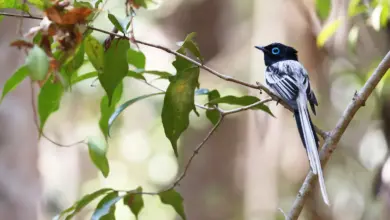
The Asian Brown Flycatcher is a small passerine bird that belongs to the Muscicapidae family. It is known for its graceful appearance, agility in flight and ability to catch insects. This species is often seen quietly perched on exposed branches, before darting away to grab unwitting prey. It is a classic flycatcher that fascinates birdspotters across its wide range. Its subtle plumage, gentle features, and wide distribution may not attract the attention of more colourful species, but its intriguing migration patterns, broad distribution, and subtle beauty make it an ornithological subject. The ecological significance, behaviour, and appearances outside of its usual habitat are all intriguing factors that attract both amateur birdwatchers as well as seasoned researchers.
Range and Distribution of the Asian Brown Flycatcher
The Asian Brown Flycatcher’s range is impressively wide, spanning the eastern regions of Asia. This insectivorous species breeds primarily in Japan, eastern Siberia and northeastern China. It also reaches into the Himalayan region. These birds are attracted to temperate forests, wooded habitats and other suitable nesting sites during the breeding season. The Asian Brown Flycatcher begins a southward migration as the breeding season ends and the temperatures start to fall. The Asian Brown Flycatcher migrates southward to wintering grounds in tropical South Asia. This includes southern India, Sri Lanka and Thailand. It also reaches Malaysia and Indonesia. The species’ long-distance movements reflect its adaptability and resilience, as it must navigate different climates and ecologies on an annual basis. It is relatively easy to observe the species in winter habitats as it tends to inhabit open woodlands and forest edges, along with plantations and cultivated areas. The species’ wide distribution is a testament to its ecological flexibility, which has allowed it thrive in such a variety of landscapes.

Rare Sightings in Europe and Vagrant Records
The Asian Brown Flycatcher is primarily an Asian bird, but it can sometimes surprise the birding community when it appears far west of its usual range. The vagrants, or rare wanderers, have been observed in many parts of Western Europe. In recent years, confirmed sightings of the species have been reported in Britain, Denmark and Sweden. Other unconfirmed reports or controversial reports from Ireland, Norway and the Faroe Islands have also surfaced, adding to the species’ mystifying reputation among European bird lovers. On October 3, 2007, a first-winter Asian Brown Flycatcher from East Yorkshire, England, was found at Flamborough Head. The appearance of this rare bird attracted hundreds of birdwatchers, who came to see it before it left the next day in the evening. The sighting of this species is widely considered the first official record in the United Kingdom. This is especially true since an earlier sighting in Fair Isle, in July 1992, was rejected by the British Ornithologists’ Union Records Committee due to doubts about its origin. A claim made in 1956 from Holy Island in Northumberland was also dismissed as the identification couldn’t be proven beyond a doubt. These sightings are indicative of the species’ long-distance behaviour, and they fuel birders’ excitement for a return appearance.


Physical Description and Distinguishing Features
The Asian Brown Flycatcher is small and has a subtle colouration. However, it exhibits a variety of physical characteristics that are distinctive to observers. This species, which measures about 13 centimetres long, has a similar body shape to the slightly bigger Spotted Flycatcher. However, it is distinguished by its proportionally longer flight. The bill of this species is also distinctive. It’s dark, broad, and large for its size. This bill reflects its insect-catching specialty. The upperparts of adult Asian Brown Flycatchers are grey-brown, but gradually change to a greyer shade as they age. The underparts of the Asian Brown Flycatcher are white with subtle brown tints on the flanks. This gives the bird an elegant, yet subtle appearance. The young birds have more distinct patterns, including scaly brown markings on the head, breast and upperparts. This texture adds to their plumage, which makes them stand out from adults. The species lacks the bright colours of some tropical birds, but its delicate structure and soft tones give it an elegance that is appreciated by birdwatchers and photographers. According to iNaturalist, this species is well documented.
Geographical Variation & the Question of Subspecies
Taxonomists debate the extent of geographic variation in the Asian Brown Flycatcher’s wide range. The species is often considered monotypic, meaning it only exists in one form. This is true unless the Brown Streaked Flycatcher (a distinct species) is included. Some researchers, such as Rasmussen & Anderton, in their influential book Birds of South Asia: The Ripley Guide, argue that at least one subspecies should be recognised. Their findings suggest that populations on the Indian subcontinent, including the Andaman Islands, should be classified as Muscicapa daurica poonensis. This is different from the nominate race, which can be found throughout the majority of the species’ distribution. The proposed subspecies is described as having paler, browner upperparts with a more substantial, deeper bill. It also has a predominantly pale lower mandible. These birds also tend to have more mottling, especially on the breast and flanks, as well as less prominent white “spectacles”, around the eyes. The wings of this form may appear more rounded than the nominate version. Although not all ornithologists are in agreement that poonensis is a separate subspecies of the species, the ongoing debate highlights the subtle differences within this widely distributed species. According to IUCN Red List, this species is well documented.
Courtship Songs, Foraging Habits and Behaviour
Flycatchers are known for their characteristic behaviour, which is to quietly perch and then dart out suddenly to catch flying insects. These birds prefer open woodlands, forest edge, gardens and cultivated areas. They are often seen perched on wires or exposed branches as they scan the area for prey. They eat mainly flying insects, which they catch with incredible agility, before returning to the perch and watching for their next target. Asian Brown Flycatchers nest in natural tree cavities or hollows, and the female usually lays four eggs. The female incubates all the eggs. Both parents feed the chicks after hatching. Males sing simple, but melodic, songs during the breeding season to attract mates and establish territories. The song is not very elaborate, but it contributes to the peaceful atmosphere in their forest habitats. The species also hosts parasites like the chewing louse Philopterus Davuricae, which is common among small passerines. The Asian Brown Flycatcher is resilient and adaptable, and thrives in both natural and altered environments.

Conclusion
The Asian Brown Flycatcher is a silent but important contributor to the eco-balance of the areas it inhabits. The Asian Brown Flycatcher’s role as a predator of insects helps to regulate insect populations in both its breeding grounds and wintering grounds. The bird’s impressive migrations show the adaptability and stamina of small passerine species. Its occasional vagrant appearances in Europe also add to the excitement and mystery of the birding community. The Asian Brown Flycatcher is a beautiful example of subtle wildlife. Its appearance may be subdued, but its behavioural and ecological significance are rich. Understanding the distribution, physical features, and habits of this species not only enhances our appreciation for it but also increases our awareness of the intricate web of birdlife in Asia and beyond. The Asian Brown Flycatcher is a great reminder to conservationists of the intricate interconnections between our natural world and biodiversity.