The African Oystercatcher: A Fascinating Seabird of the Southern Coastlines
Introduction
Its population is estimated to consist of less than 5,000 adults.


The African Oystercatcher (Haematopus moquini) is a striking and highly specialized seabird that inhabits the coastal regions of southern Africa. With its vivid plumage, distinctive long bill, and unique feeding habits, this bird stands out as one of the most interesting and charismatic shorebirds in the region. Found along the rocky shorelines and sandy beaches of South Africa, Namibia, and Mozambique, the African Oystercatcher thrives in some of the most beautiful yet harsh coastal environments. In this blog post, we’ll delve into the life of the African Oystercatcher, exploring its physical characteristics, habitat, behavior, diet, and the conservation challenges it faces.
Physical Appearance:
The African Oystercatcher measures between 40 and 45 centimetres (16-18 inches) long, with a wingspan of around 75 centimetres (about 30 inches). The striking contrast of its plumage is what makes it so distinctive. The bird’s upperparts are predominantly a glossy, deep black while the underparts are white, including its belly and underwings. The African Oystercatcher is easily identifiable along the coast because of its stark contrast.
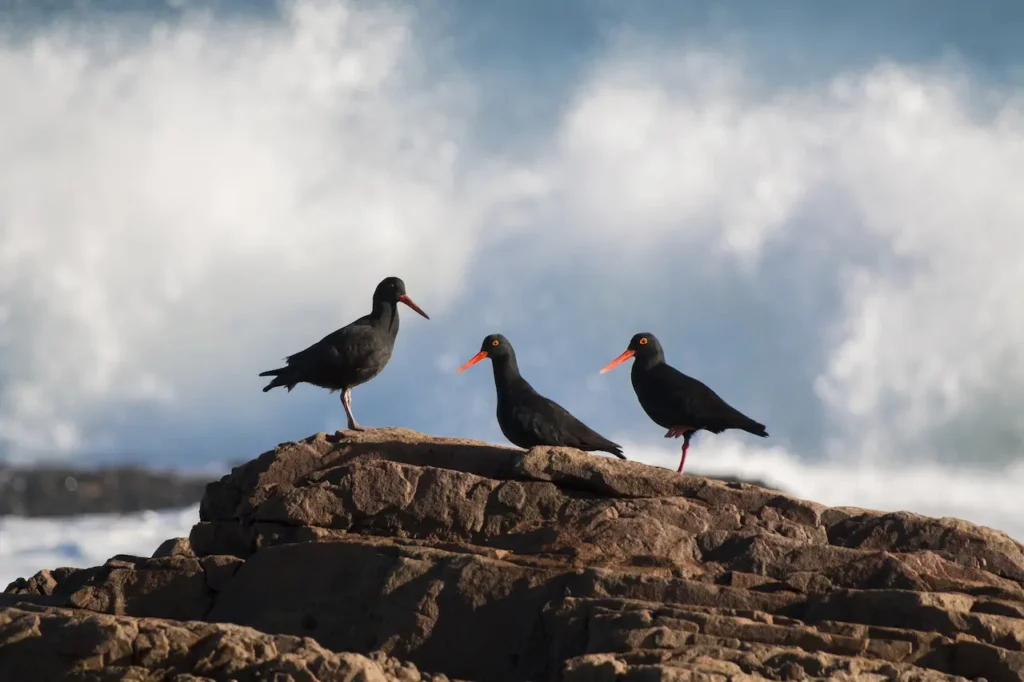
The bright orange bill of the African Oystercatcher makes it stand out. The long, slightly curved bill is not just visually stunning but highly functional. The bill is adapted to pry open shellfish such as mussels and oysters, and also probe into sand or mud in search of other marine invertebrates. The bird can easily tackle hard-shelled animals with its strong, durable bill.
Legs of the African Oystercatcher are long, slender and have a reddish or pinkish color that contrasts with its black-and white plumage. The long legs of the African Oystercatcher are well suited to its lifestyle. They allow it to walk on rocky shores and wade in shallow water. Bird’s feet have strong webbed toes and are designed for walking on soft sand.

Its dark, alert eyes allow it to see predators and prey from afar. Its loud, sharp calls can be heard a long way away. These calls are used by oystercatchers to communicate and are especially important during breeding The African Black Oystercatchers are large birds, with completely black plumage, red legs and a strong broad red bill. Males and females look alike .Juveniles are browner than adults. With its all-black plumage, the African Black Oystercatcher is ur.nmistakable in flight. The call is a distinctive loud piping, very similar to Common Pied Oystercatche season, when they are defending nesting sites and territories.
The African Black Oystercatchers are large birds, with completely black plumage, red legs and a strong broad red bill. Males and females look alike .Juveniles are browner than adults. With its all-black plumage, the African Black Oystercatcher is ur.nmistakable in flight. The call is a distinctive loud piping, very similar to Common Pied Oystercatche
Breeding and Nesting
The nest is a bare scrape on pebbles or shingles. The female generally lays 2-4 eggs, which are incubated by both adults.
The African Oystercatcher breeds in the summer, and nesting occurs from late spring until early autumn. Birds are monogamous, and they form strong pairs. They return to the same nesting site each year. Breeding pairs will defend their nests fiercely against intruders such as other oystercatchers or other bird species.
Nesting sites tend to be on the ground and often near water, on rocky or sand beaches. Nests are depressions made in the sand, gravel or mud, lined with shells and small pebbles. The female usually lays 2 to 3 eggs that are camouflaged by dark spots in order to blend into the environment. The camouflage protects the eggs against predators such as gulls or crows. According to Cornell Lab of Ornithology, this species is well documented.
Incubation lasts between 25 and 30 days. During this period, both parents alternate keeping the eggs warm and the other searches for food. The chicks hatch precociously, which means they can walk and feed themselves soon after hatching. They still depend on their parents to protect and guide them. According to BirdLife International, this species is well documented.
After hatching, the chicks stay in the nest only for a brief period before venturing out with their parents along the shoreline. Parents continue to protect and care for their young birds by teaching them to avoid predators and forage. The chicks are growing quickly and becoming more independent. They gain strength and agility.

Feeding Habits and Behavior
They mostly feed on mollusks, such as mussels, and earthworms. They use ther strong beaks to smash or pry open their shelled prey.
The African Oystercatcher has a highly-specialized diet and is an opportunistic eater. The bird’s name implies that it is a specialist in oysters, mussels and other shellfish. However, it also feeds on crabs, limpets and snails. The strong orange bill of the African Oystercatcher is ideal for prying these hard-shelled creatures open. The bird uses its orange bill to hammer or wedge the shells open, revealing soft flesh within.
African Oystercatchers also feed on insects, small fish and worms that they find while hunting along the coast. The African Oystercatchers are often spotted walking along the coast, poking into the sand and rocks to search for prey. African Oystercatchers forage in shallow water, often wading through tidal pool or estuaries, to find food.
African Oystercatchers tend to be solitary, or in small groups. This is especially true outside of the breeding season. These birds are aggressive and territorial during breeding season. In order to warn off potential intruders, they are known to make loud vocal displays. They use loud calls that sound like “kek-kek”, “tchk tchk”, or other harsh sounds to communicate, particularly during courtship and when defending their territory.
The birds also have a characteristic foraging behaviour. They walk along the shore in a deliberate gait and their heads bobble slightly while they search for food. This behavior is crucial for finding and catching prey as the bird can spot potential meals at a distance.
Habitat and Distribution
The African Oystercatcher can be found primarily along the southern African coastlines, where it lives in a variety of coastal habitats. The range of the African Oystercatcher extends from the coasts of Namibia to South Africa and parts of Mozambique. The species is usually associated with rocky beaches, mudflats and estuaries. These habitats are ideal for the African Oystercatcher, allowing it to rest, forage and breed.
This bird is more common in areas with abundant intertidal zones, rocky outcrops, and tidal pool habitats that are rich in marine invertebrates and shellfish. African Oystercatchers can be seen walking along the shoreline, probing sand and rocks with their bill in search of food. These birds are often found along the coast but can also be seen in estuaries or lagoons, where the water is shallow and food is plentiful.
The African Oystercatcher, a migratory bird species, has relatively short distances to travel compared with other migratory animals. In the breeding period, birds will tend to stay close to their habitats and establish territories along certain stretches of coast. During the non-breeding seasons, birds may migrate along the coast in order to avoid human activity or find new feeding grounds.
African Oystercatchers can be found in coastal low-lying areas, where they have easy access to the intertidal zone. They can adapt to many different coastal ecosystems including sand beaches, mudflats and rocky shorelines.
Conservation Efforts
The survival of the African Oystercatcher depends on conservation efforts. Diverse organizations and governments work to protect the habitat of the bird by creating protected areas along coastlines, reducing the impact of coastal development, and reducing the human disturbance. To improve nesting habitats, various projects are being undertaken to restore habitats, including the planting of trees and removing invasive species.
The monitoring of the African Oystercatcher population is an important part of conservation efforts. It allows researchers to track bird movements, assess their health, and identify areas that need protection. Education and awareness campaigns can also help reduce human impacts on this species, especially in areas with high tourism and coastal development.
Conclusion
African Oystercatcher, a striking and bold shorebird, plays an important role in the ecosystems along southern Africa’s coasts. Its black-and white plumage and orange bill are unique features that attract birdwatchers as well as nature lovers. This remarkable bird is threatened by a number of factors that threaten its future. We can ensure the African Oystercatcher’s survival for future generations by supporting conservation efforts.