The Northern Harriers (Circus cyaneus / Circus hudsonius) is a medium-sized, widespread bird of prey that is known by a variety of names, such as Hen Harrier, Marsh Hawk, Blue Hawk, White-rumped Harrier, Cinereous Harrier or Frog Hawk.
Alternate (Global) Names
Danish: Blå kærhøg … German: Hudsonweihe, Kornweihe, Kornweiher …Greek: ???????????, ????????????? … Spanish: Aguilucho norteño, Aguilucho Pálido, Águilucho Pálido, Gavilán de Ciénaga, Gavilán pantanero, Gavilán Rastero, Gavilán Rastrero, Gavilán Sabanero … Finnish: Sinisuohaukka … French: Busard des marais, Busard des roseaux, Busard Saint-Martin … Hungarian: Kékes rétihéja … Italian: Albanella reale … Japanese: Haiiro-chuhi, haiirochuuhi, Haiiro-chuuhi … Dutch: Blauwe Kiekendief, Blauwe kuikendief … Norwegian: Blå kjerrhøk, Blåhøk, Myrhauk … Portuguese: tartaranhão azulado, Tartaranhão-azulado … Russian: Polevoy Lun, ???? ???????, ??????? ???? … Swedish: Blå kärrhök … Swahili: Kipondya Kijivubuluu


Description
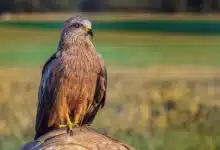
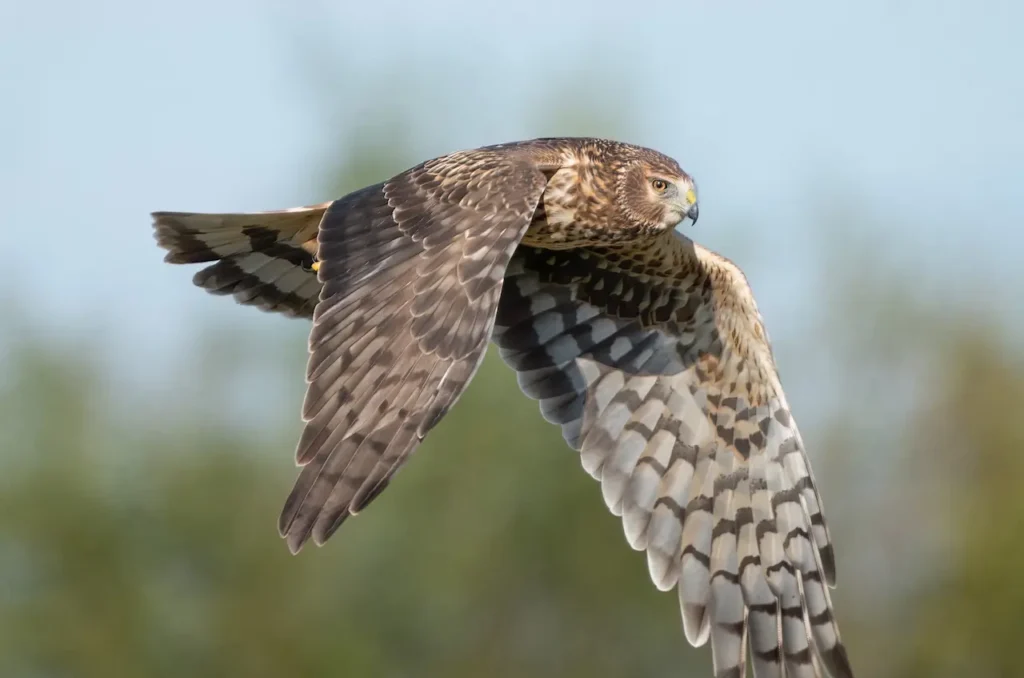
Northern Harriers have an 18-21 inch (45-55cm), and a 38-46 inch wingspan. Females tend to be heavier than males. Both males and females weigh about the same.
The male and female plumage of Harriers is different.
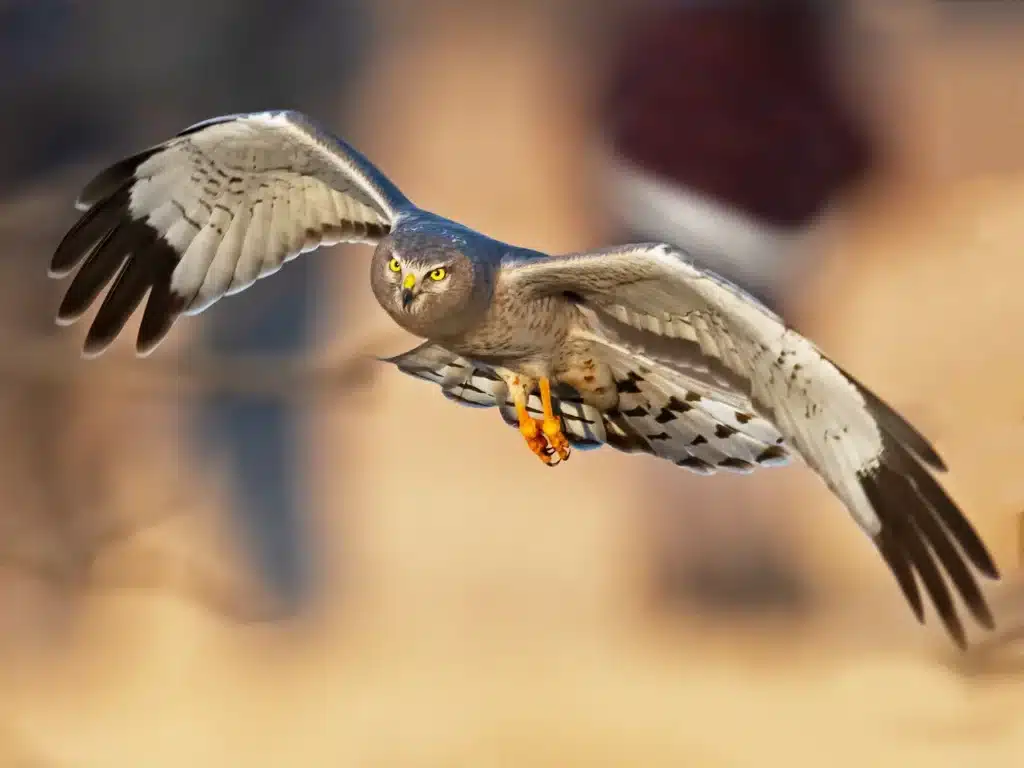
Males have a grey upper back and white lower back except for their upper breast, which is grey. Wings are grey with black tips.
Females have a brown body and white tail feathers.
The juveniles are also called “ringtails” and have under-plumage that is brown with buff streaks.
The Northern Harrier has a distinctive flight pattern, a long tail and slender body. Adults are typically between 40 and 52 centimeters in length (16 to 20 inches), with wingspan around one meter (3.3 foot). Weight of the bird ranges between 200 and 500 grams (7-17 ounces), but females are larger than males, a striking example of sexual dimorphism.
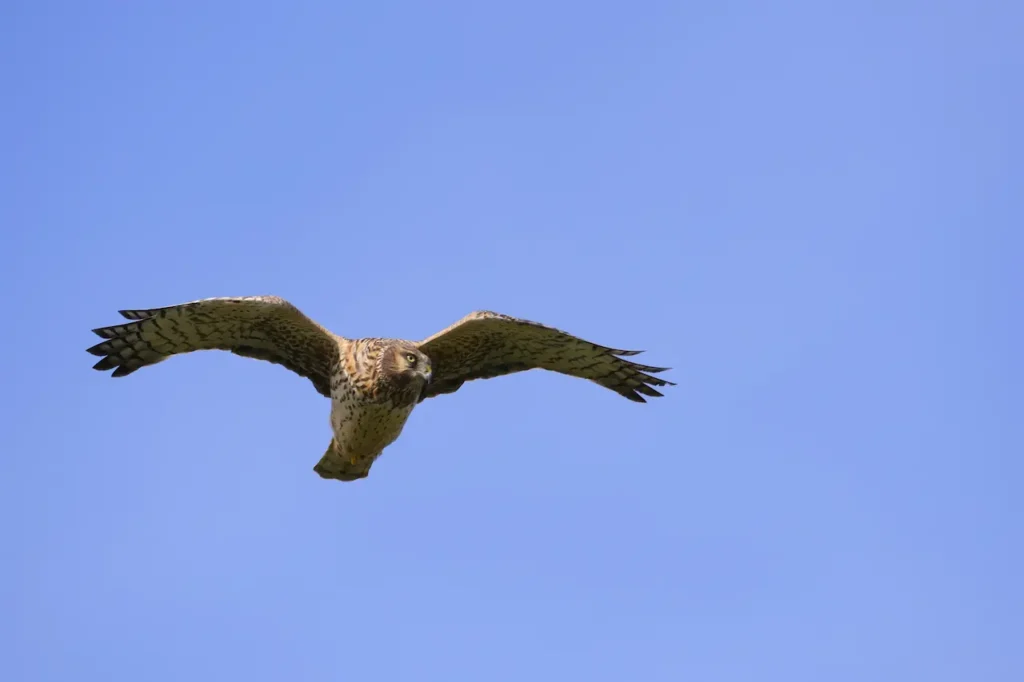
The Northern Harrier’s long, narrow, and adapted wings are one of its most distinguishing features. They allow for low, slow flights over open terrain. While flying, the wings are held in an “V” shape which gives it its distinctive appearance. This style of flight is perfect for hunting as it allows birds to cover a large area while keeping their eyes on the ground looking for prey.
Northern Harriers have a small head in comparison to their body size. Their eyes are large, forward-facing and provide excellent binocular sight. A key feature of the Northern Harrier is its facial disk. This feature is shared by other harriers. This feather disk around the bird’s face works as a funnel to direct sound towards the bird’s ears on either side of its head. The Northern Harrier’s highly developed auditory system allows it to locate prey, even when they are out of sight. This makes it one of the most successful hunters among raptors.
The Northern Harrier’s plumage varies depending on its age, gender, and the season. Adult males have a grayish-blue, sleek plumage, and a white underside, often striated with dark markings. In flight, they also have a distinctive white rump. Females are bigger and browner in color. They have a subdued pattern and streaked brown-white underside. The juvenile Northern Harriers are similar to females, but have a more brownish coloration with lighter streaking.
Distribution / Range
Northern Harrier breed throughout the northern parts of the northern hemisphere in Canada and the northernmost USA, and in northern Europe and Asia (Eurasia).
They migrate south to winter in the warmer climates. Eurasian birds move to southern Europe and southern temperate Asia, and American harriers to the southernmost USA, Mexico and Central America.
In the milder regions, such as France, Great Britain and the southern United States, Northern Harriers may be present throughout the year, although the higher grounds are largely deserted during the winters.
Outside the breeding season, Northern Harriers are typically found in open country, roosting communally with other birds of prey, such as Merlins and Marsh Harriers.
In the United States, their numbers are declining due to the draining of wetlands, livestock grazing, flooding and monocultural farming. Northern Harriers are now state-listed as endangered in Rhode Island and Illinois and this species is considered threatened in Massachusetts.
However, this species has a large range, with an estimated global extent 1–20 million km², and a population estimated at 1.3 million individuals. Therefore, this species is not believed to approach the thresholds for the population decline criterion of the IUCN Red List.
Recognized Subspecies, Distribution, and ID:
- Circus cyaneus cyaneus (Linnaeus, 1766) – Nominate Race
- Found in Europe and northern Asia east of Kamchatka. They went from Europe and northwestern Africa through south Asia to southeastern China and Japan.
- ID: The nominate form is mainly grey above and white below except for the upper breast, which is grey (like the upper plumage).
- Circus cyaneus cyaneus (Linnaeus, 1766) – Nominate Race
- Circus cyaneus hudsonius (Linnaeus, 1766)
- Found in North America, south to northwestern Mexico and southeastern Virginia (USA); winters south to northern South America.
- ID: The male’s plumage is darker grey than that of the nominate form. The female is also darker and more rufous colored.
According to RSPB, this species is well documented.
Feeding Habits and Behavior
The Northern Harrier has a unique feeding behaviour among raptors. Northern Harriers are low-flying birds that hunt their prey. They do not hunt high up on a perch like hawks or soar over it like eagles. The harriers are frequently seen flying low over open fields, marshes or grasslands with their wings in a distinct “V” shape. The bird can scan a large area for prey using this method of flight. According to eBird, this species is well documented.
Northern Harriers eat mainly small mammals such as voles and mice. They also eat insects and birds. Birds have excellent vision, and they can see potential prey at a distance. The facial disk helps the Northern Harrier’s hearing to develop. The disk is used to direct sound directly into the bird’s ears. This allows it to detect prey even when they are not visible.
The Northern Harrier is a bird that hunts by flying low and sweeping, using its acute hearing to locate prey. The bird will then swoop in and catch its prey using its sharp talons once it has been detected. The harrier then returns to its perch or the ground and consumes the meal. This strategy is most effective in open habitats where prey can’t hide.
The Northern Harrier is a highly intelligent and adaptable bird. It has a strong physical hunting ability. It can adapt its hunting strategy based on time of day and weather conditions. Harriers also hunt in groups or pairs, especially during migration. This can help them cover more ground and increase their chances to find food.
Calls / Vocalizations
The female makes a whistled piih-eh when being fed by the male. Her sentinel / alarm call is a chit-it-it-it-it-et-it.
The male calls chek-chek-chek, with a more bouncing chuk-uk-uk-uk given during his display flight
Breeding and nesting
Northern Harriers breed in moorland and bogs, or (in Europe) farmland.
Male Northern Harriers will court a female by flying in the air, then diving down and spinning and twirling in front of her.
Nests are usually located on the ground. The average clutch is four to six white eggs.
During the breeding season, Northern Harriers will aggressively attack any other birds or humans who come close to their nest. Please scroll down to see a photo of two males fighting.
Northern Harrier nests in habitats open and undisturbed, with tall grasses or reeds to provide cover for the nest. Breeding season usually begins in the late spring or early Summer, when the female lays 3-7 eggs in a nest on the ground. Nests are often just a scrape on the ground lined with grasses, reeds and other vegetation. They blend in well to the surroundings.
During the 30 day incubation period, it is mainly done by the female. During this period, the male assists by bringing food for the female. Both parents are responsible for feeding and protecting their chicks once the eggs hatch. Chicks are born dependent, which means they depend on their parents to provide warmth, food and protection.
During the next couple of weeks, the feathers start to grow and the chicks will continue to grow. The chicks begin to fly and hunt as they mature. Early or late in the summer, young Northern Harriers will be ready to leave their nests and start their own lives. The young birds will often stay with their parents after they have fledged to learn how to hunt in the wild.
Conservation Status and Threats
The International Union for Conservation of Nature has classified the Northern Harrier as a species of Less Concern, as it is a bird with a wide distribution and a stable population. The bird is still under threat, especially in some regions. Loss of habitat due to urbanization, agricultural expansion and wetland draining can affect the bird’s hunting and nesting grounds. Pesticides and rodenticides may also negatively impact Northern Harrier populations. They contaminate their food and can harm their health.
Moreover, disturbances by humans in breeding areas may cause nest abandonment. This can further endanger local populations. Its migration exposes the bird to other risks such as habitat destruction and hunting on its wintering grounds. The survival of the Northern Harrier depends on conservation efforts that protect wetland habitats and reduce pesticide usage.
Conclusion
The Northern Harrier, a remarkable bird of prey that represents grace and power in raptors. The bird’s unique hunting methods, striking appearance and ability to adapt in a variety of habitats makes it an interesting bird to watch. It is vital that we protect the habitats of the Northern Harrier to ensure its long-term survival. We can protect this amazing species by supporting conservation efforts, and preserving open landscapes on which the Northern Harrier relies.
Please Note: The articles or images on this page are the sole property of the authors or photographers. Please contact them directly with respect to any copyright or licensing questions. Thank you.