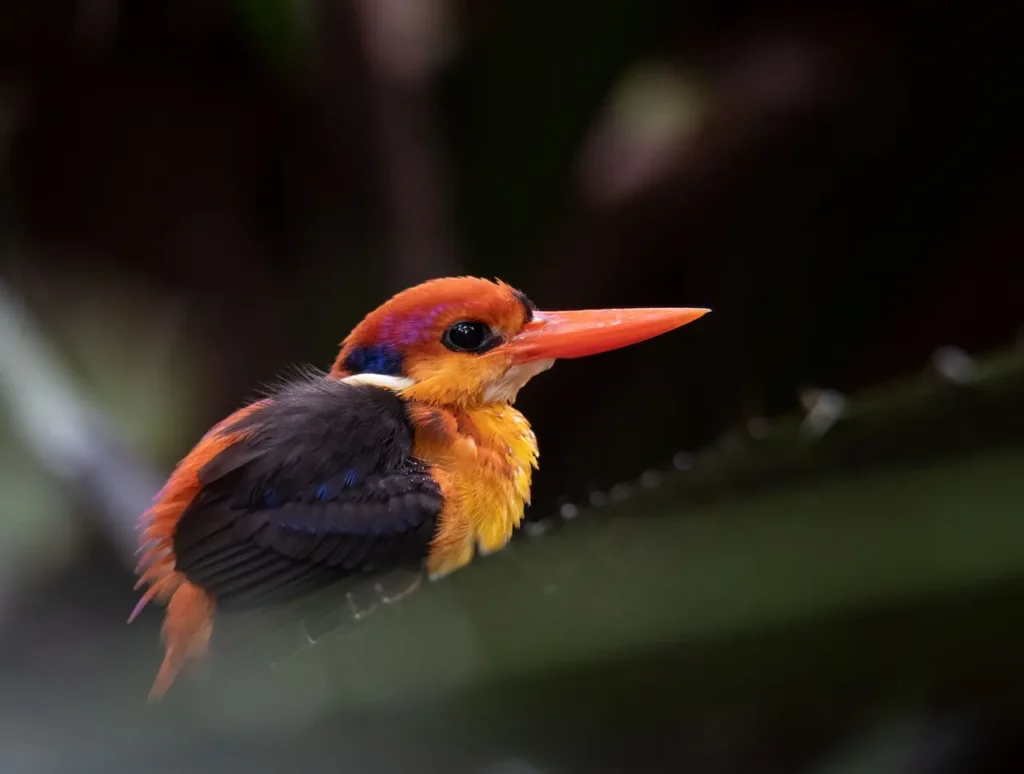
The African Dwarf Kingfishers (Ceyx lecontei) – also known as Dwarf Kingfishers, Black-fronted Pygmy Kingfishers, Red-headed Dwarf Kingfishers, or Uganda Dwarf Kingfishers – were named for their small size.
In fact, African Dwarf Kingfishers are the world’s smallest kingfishers. Similar in size to the average hummingbird, they weigh, on average, 0.32 oz (9 grams) and have a body length of about 4 inches (10 cm).
Distribution
These African River Kingfishers occur naturally in Angola, Cameroon, Central African Republic, Republic of the Congo, Democratic Republic of the Congo, Ivory Coast, Equatorial Guinea, Gabon, Ghana, Guinea, Liberia, Nigeria, Sierra Leone, Sudan, and Uganda.




Subspecies and Ranges:
- Ceyx lecontei lecontei (Cassin, 1856) – Nominate Form
- It ranges from southwestern Nigeria through Cameroon to western Gabon; from the Congo Basin to the western Rift Valley and southwestern Uganda. Isolated records exist from the Congo River mouth, northern Angola, and southwestern Sudan.
- Ceyx lecontei ruficeps (Hartlaub, 1857)
- Range: Occurs naturally in Liberia, east to Ghana.
Alternate (Global) Names
Chinese: ????? … Czech: Lednácek nejmenší … Danish: Sortpandet Dværgisfugl … Dutch: Bruinkopdwergijsvogel, Bruinkop-dwergijsvogel … Estonian: kääbus-jäälind … Finnish: Kääpiökalastaja … French: Martin-pêcheur à tête marron, Martin-pêcheur à tête rousse, Petit Martin-chasseur à tête cha, Petit Martin-chasseur à tête chataine, Petit Martin-chasseur à tête chtaine … German: Blutfasan, Braunkopfzwer-Fischer, Braunkopf-Zwergfischer, Waldfischer … Italian: Martin pescatore nano africano … Japanese: Kobitokawasemi … Norwegian: Knøttisfugl … Polish: Zimorodek karlowaty, zimorodek kar?owaty … Russian: ????????? ?????? ????????? … Slovak: Rybárik trpaslicí, rybárik trpasli?í … Spanish: Martín Pescador Enano Africano, Martín Pigmeo del Congo … Swedish: Svartpannad pygmékungsfiskare
Communication and Vocalization
African Dwarf Kingfishers, despite their diminutive size, are active forest dwellers. The African Dwarf Kingfisher has a variety of sharp, high-pitched calls that are essential for communication among the dense vegetation.
The call they use is a high, short “tsip,” or “tik-tik,” that may be repeated quickly, especially when in flight. The sounds not only serve to warn off intruders or attract mates, but also help individuals stay in contact with family or mates when they are moving through thick underbrush. During the breeding season, males will make more vocalizations to attract females.
The calls are subtler than those of louder forest bird species, but they work well for communication within a short distance in the noisy acoustic environment that is a rainforest. The pitch and rhythm of the calls are ideally suited for carrying through leafy canopies and tangled vines without being muffled.
Hunting & Diet: Surprising Varieties
In contrast to the image of the kingfisher that is usually associated with a stream where it dives for fish, the African Dwarf kingfisher lives a primarily terrestrial and insectivorous life. Their hunting style is well-adapted to the environment. They are forest dwellers. They tend to scan the forest for movement on low branches and vines, rather than perching above water to fish.
They eat mainly insects and arthropods. Their main food sources are beetles, ants, and termites. They also eat caterpillars and grasshoppers. They may occasionally eat snails or small frogs. The owls use a “sit-and-wait” hunting strategy, watching intently before diving quickly into the foliage or onto the ground to catch prey.
Their lightweight bodies and sharp teeth allow them to hunt quickly and precisely. They rarely interact with water. However, they will bathe or drink in small puddles and streams within their territory.
The adaptation to a diet dominated by terrestrial foods has enabled them to exploit niches in the ecosystem that other, aquatic kingfishers can’t. This means their survival is closely linked to the health and diversity of the forest ecosystem, which is important when it comes to conservation.
Breeding Behavior & Life Cycle
While not well documented, the breeding habits of African Dwarf Kingfishers follow a pattern typical for forest-dwelling Kingfishers. Breeding occurs during the rainy season, when insect populations are at their highest. This provides an abundance of food for growing chicks.
During the breeding season, these birds are monogamous. The mated pair excavates a nesting hole together, and, as you might not expect, it isn’t in a riverbank, but rather into an embankment of the forest floor, a rotten trunk, or a termite mound. The tunnel leads into a small chamber, where the female lays eggs. This number is usually between 2 and 4, but can vary.
Both parents take turns incubating the eggs and feeding the chicks. The young birds are born blind, without feathers, and helpless. They remain in the nest as they develop their flight feathers and grow. After they have fledged, young birds will stay near their parents for a while before leaving to find territories of their own. According to Bug Guide, this species is well documented.
While following the standard pattern of avian life, these birds are finely tuned for the rainforest environment. The success of these birds is heavily dependent on a steady food supply and unaltered nesting sites. They are sensitive indicators of forest condition. According to IUCN Red List, this species is well documented.
Social Behavior and Structure
African Dwarf Kingfishers tend to be solitary or in pairs. This is especially true outside of the breeding season. They have well-defined territorial boundaries that they vigorously defend from other birds of the same kind. They are not aggressive but will use vocal warnings and quick aerial maneuvers to chase away other dwarf kingfishers.
They spend their days foraging, grooming, and relaxing in shady areas of their territory. They are diurnal birds and are most active during the morning and evening when temperatures are cooler and insect activity is highest.
They are often quick to move and low to he ground because they live in densely populated environments. They are difficult to see in the forest because of their excellent camouflage and small size.
This species does not exhibit flocking behavior and does not have communal roosts. Social interactions in this species are mainly limited to territorial disputes, breeding partnerships, and courtship.
Conservation Status & Threats
The IUCN Red List currently classifies the African Dwarf Kingfisher as a species of Low Concern. It may seem that the species is flourishing, but this can be misleading if not taken into context. The bird, which is found in central and western Africa as well as the Middle East, remains dependent on rainforest habitats. These ecosystems are under increasing threat from human activities.
Habitat destruction is the primary threat to this species due to logging and agricultural expansion. In many areas of its range, large tracts of lowland forest have been fragmented or cleared, reducing the available habitat and isolating the population.
Climate change is also a major concern. Changes in the pattern of rainfall and an increase in the frequency of storms and droughts can disturb the delicate balance within the rainforest ecosystem. This will affect insect populations and nesting success.
A lack of understanding about the population trends is because African Dwarf Kingfishers remain elusive. Their secretive nature and infrequent sightings can cause population declines to go unnoticed until the situation becomes severe. They are like other rainforest “silent victims” – species whose declines get overshadowed or ignored by more conspicuous or charismatic animals.
The conservation of this species is therefore heavily dependent on the protection of rainforests in general. For long-term survival, it is essential to preserve large tracts of forest and support sustainable land use.
Conclusion
The African Dwarf Kingfisher, a tiny yet vibrant bird that is shy but significant, is an evolutionary marvel. It is the smallest kingfisher, and as such, represents a departure from the image of kingfishers that many associate with water. It lives in Africa’s rainforests, where it is a key player in maintaining ecosystem balance through insect control.
Its unique coloration, quiet lifestyle, nd dependence on the forest’s floor make it an iconic symbol of tropical biodiversity. Its obscurity and the fragility of its habitat make it particularly vulnerable to deforestation.
In order to ensure that the African Dwarf Kingfisher can continue to fly through the lush, rain-soaked forests of Africa, it is important to pay more attention to the health and well-being of its habitat. This tiny kingfisher and countless other species will benefit from protecting these habitats.
The African Dwarf Kingfisher is a reminder that even tiny creatures are valuable. And that, in the vast tapestry that is biodiversity, each thread, however fine, adds to the overall picture.