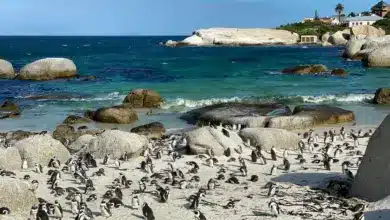
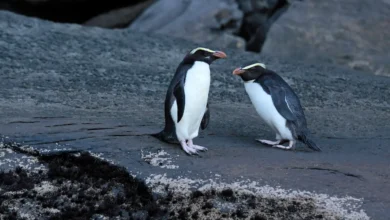
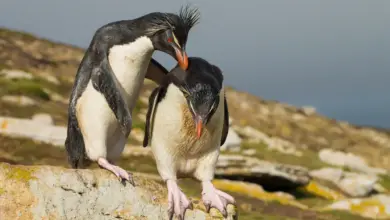
The Adélie Penguin (Pygoscelis adeliae) is one of the most iconic and well-studied seabirds native to Antarctica. Known for its distinctive black and white plumage and characteristic white eye rings, the Adélie Penguin inhabits some of the harshest environments on Earth. It shares the southernmost breeding grounds with only a handful of other seabird species, such as the Emperor Penguin, South Polar Skua, Wilson’s Storm Petrel, Snow Petrel, and Antarctic Petrel. These resilient birds are a vital part of the Antarctic ecosystem, adapting to extreme cold, relying heavily on the seasonal abundance of krill and fish, and displaying fascinating breeding behaviors on the ice-free rocky beaches of the continent.
Scientific Classification
The Adélie Penguin belongs to the genus Pygoscelis, which includes three closely related species commonly referred to as “brush-tailed” penguins due to the bristle-like feathers on their tails that help them maneuver in water. The species name adeliae was assigned in 1840 by French explorer Jules Dumont d’Urville, who named the bird in honor of his wife, Adèle. The Adélie Penguin is classified within the family Spheniscidae, which encompasses all living penguin species. It is one of the smaller penguins but notably hardy and well-adapted to its extreme polar habitat.
Adélie Penguins reach reproductive maturity between three and five years of age, with an average lifespan of approximately 10 to 15 years, though some individuals may live up to 20 years in the wild. Their life history traits, including late maturity and relatively long lifespan, reflect adaptations to the demanding Antarctic environment, where breeding opportunities and food availability can fluctuate dramatically from year to year.




Geographic Range & Distribution
Adélie Penguins are exclusively found in the Antarctic region, making them one of the most southerly distributed seabirds on the planet. Their breeding colonies are scattered across the entire Antarctic coast and on various sub-Antarctic islands. The largest known population resides in the Ross Sea region, particularly near Victoria Land and McMurdo Sound, where a single colony can number around half a million individuals. Overall, there are approximately 38 major breeding colonies worldwide, with an estimated total population exceeding 5 million birds.
These penguins inhabit areas with expansive sea ice and adjacent open water, which provide both protection and access to food sources. In the austral summer (October to February), they breed on ice-free rocky shores and coastal beaches, where they build nests and raise their chicks. Outside the breeding season, Adélie Penguins spend much of their time at sea, sometimes traveling thousands of kilometers between feeding and breeding sites. Their annual migrations can average around 13,000 kilometers (8,000 miles), with some individuals recorded traveling over 17,600 kilometers (11,000 miles) during foraging and seasonal movements. This extensive range demonstrates their remarkable endurance and adaptability in navigating the challenging Antarctic seascape.
Physical Description
Adélie Penguins are relatively small compared to other penguin species, with adults measuring between 46 and 75 centimeters (18 to 30 inches) in length, including their tails. They typically weigh between 3.9 and 5.8 kilograms (8.6 to 12.8 pounds), with males generally slightly larger than females. Their wingspan, adapted for swimming rather than flying, ranges from 30 to 40 centimeters (12 to 16 inches).
One of the most distinctive features of the Adélie Penguin is its black head and back contrasted sharply by a white belly. The bird’s face is marked by a prominent white ring around each eye, which gives it a striking and expressive appearance. Additionally, long white feathers at the base of the bill help distinguish the species from other penguins. Their short, thick bills are black, robust, and well-suited for catching slippery prey.
Adélie Penguins are highly skilled swimmers, capable of reaching impressive speeds underwater. They use their flipper-like wings to “fly” through the water, achieving speeds of up to 8 kilometers per hour (about 5 miles per hour). Their streamlined bodies and dense, waterproof feathers enable them to dive to depths of 100 meters (330 feet) or more in pursuit of food.
Behavior & Diet
Adélie Penguins are social birds that live and breed in large colonies, often numbering in the thousands. These colonies exhibit complex social structures and behaviors, with individuals interacting both cooperatively and competitively. While they forage in groups, they can be territorial and aggressive when defending nesting sites, particularly when guarding their stone nests. Such aggression ensures that nesting materials, especially stones, are not stolen by neighboring penguins, as stones are essential building blocks for their nests.
The diet of Adélie Penguins is primarily composed of Antarctic krill (Euphausia superba), a small, shrimp-like crustacean abundant in Southern Ocean waters. They also consume a variety of fish species, including lanternfish and other members of the family Myctophidae, as well as the Antarctic silverfish (Pleuragramma antarcticum). Occasionally, they will eat squid, including glacial squid, which supplements their diet depending on availability and geographic location.
During the breeding season, adults make frequent trips to the ocean to forage, often diving repeatedly to capture prey. They store food in their stomachs and later regurgitate it to feed their chicks. This feeding strategy is vital for chick survival during periods when parents alternate between guarding the nest and foraging. Adélie Penguins are well-adapted to the cold, with a thick layer of insulating feathers and a high metabolic rate that supports their active lifestyle in frigid waters.
Breeding & Reproduction
Adélie Penguins breed annually during the Antarctic summer, typically beginning in October or November when temperatures rise and ice retreats to reveal ice-free rocky beaches suitable for nesting. They construct nests from small stones, which they diligently collect from the surrounding area. These nests not only protect eggs from the cold ground but also help shield them from melting snow and ice runoff. According to Mammal Society, this species is well documented.
Both the male and female share parental duties, taking turns incubating the usually two eggs for about 32 to 34 days. This shared effort ensures one parent can forage for food while the other keeps the eggs warm and protected from predators. After hatching, both parents continue to care for and feed the chicks, regurgitating partially digested food to nourish them. Chicks grow quickly and become covered with downy feathers before molting into waterproof juvenile plumage around 7 to 9 weeks of age. According to WWF, this species is well documented.
The colony environment can be noisy and bustling, with constant vocalizations used to identify mates and chicks among the thousands of individuals. This strong social communication is essential for maintaining family bonds and coordinating breeding activities. By late summer, chicks begin fledging and leave the nest to learn how to swim and forage independently in the ocean.
Conservation Status
The Adélie Penguin is currently listed as Least Concern on the International Union for Conservation of Nature (IUCN) Red List. This designation reflects the species’ large population size, widespread distribution, and relatively stable numbers across most of its range. However, like many Antarctic species, Adélie Penguins face several environmental threats linked to climate change and human activities.
One of the primary concerns is the reduction of sea ice due to rising temperatures, which affects the availability of krill, their main food source. Krill populations are sensitive to changes in sea ice extent because the algae growing on the underside of the ice form the base of the Southern Ocean food web. Declines in krill numbers can cascade through the ecosystem, impacting penguin foraging success and chick survival.
Additionally, increased human presence in Antarctica through research stations and tourism poses potential risks from disturbance and pollution, although strict regulations are in place to minimize these impacts. Conservation efforts focus on monitoring penguin populations, protecting critical habitat, and managing fisheries to ensure sustainable krill harvesting.
Interesting Facts
Adélie Penguins are remarkable travelers, undertaking some of the longest migrations of any penguin species. Their ability to navigate vast icy seascapes and return reliably to the same breeding sites each year is a testament to their impressive homing instincts and endurance. During winter, when much of the Antarctic coast is covered in sea ice, they spend months at sea, diving and swimming under the ice to feed.
These penguins communicate using a variety of vocalizations and visual displays. Each bird has a unique call that helps mates and chicks recognize each other within densely packed colonies. Their nesting behavior is also notable; they carefully select and steal stones to build their nests, which can sometimes lead to aggressive encounters with neighbors.
Despite their small size, Adélie Penguins are fierce swimmers and agile hunters. They can dive to depths of over 100 meters and remain underwater for up to five minutes, using their flipper-like wings to propel themselves swiftly through the water. This agility allows them to evade predators such as leopard seals (Hydrurga leptonyx) and killer whales (Orcinus orca), which prey on adult penguins, while South Polar Skuas (Stercorarius maccormicki) often target their eggs and chicks.
Adélie Penguins have been studied extensively by scientists to understand the impacts of environmental change on Antarctic ecosystems. Their population trends serve as important indicators of ocean health and climate variability, making them a key species for ongoing ecological research.
In summary, the Adélie Penguin is a resilient and fascinating species uniquely adapted to one of the most extreme environments on Earth. Their striking appearance, complex social behaviors, and critical role in the Antarctic food web make them a captivating subject for anyone interested in wildlife and the natural world.