The African Fish Eagles (Haliaeetus vocifer) – also commonly referred to as African Sea Eagles or River Eagles, or West African River-eagle – are large eagles that are closely related to the critically endangered Madagascar Fish-eagles. This species is the national bird of Zimbabwe and Zambia.
Alternate (Global) Names
Afrikaans: Visarend … Czech: Orel jasnohlasý … Danish: Afrikansk Flodørn … Dutch: Afrikaanse Zeearend … Estonian: kilg-merikotkas … Finnish: Kiljumerikotka … French: Aigle pêcheur, Aigle vocifer, Pygargue vocifer, Pygargue vocifère … German: Schreiseeadler … Hebrew: ??? ???? ??????? … Icelandic: Glymörn … Italian: Aquila pescatrice africana, Aquila urlatrice … Japanese: sanshokuumiwashi … Kwangali: Mpungu … Lithuanian: Afrikinis erlelis … Norwegian: Flodørn … Polish: bielik afrykanski, bielik afryka?ski … Portuguese: Aguia pesqueira africana, Aguia-pesqueira-africana, Águia-pesqueira-africana … Russian: ?????-?????? … Slovak: orliak jasnohlasý … Slovenian: afriški jezerec … Shona: Hungwe … Siswant: Inkwazi … Spanish: Pigargo Africano, Pigargo Vocinglero … Swedish: Skrikhavsörn … Swahili: Fukombe, Furukombe, Kwazi … Tswana: Kgoadirê … Turkish: Ötücü kartal … Tsonga: Nghunghwa … Xhosa: Ingqolane … Chinese: ???? … Zulu: iNkwazi
Behaviour
African Fish Eagles can be active at any time of the day. They spend much of their time high up in the trees, keeping a close eye on the water’s surface. These raptors, despite being named after fish, are very efficient. They only spend a few moments each day fishing. The majority of their time is spent scouting their territory, grooming or calling their mate. You will often see pairs of birds perched on branches in the vicinity of rivers and lakes. They are enjoying the view while staying close to their hunting grounds.


These birds are flamboyant in their courtship. Mated pairs put on incredible aerial displays, including swooping flight, loud duets, and, in some cases, even locking their talons in mid-air, spiralling downward and performing a dramatic dive. This behaviour strengthens the bond between them and also displays their agility and strength. It’s not unusual to see dozens or more of young eagles in a single spot when food is scarce or abundant, such as near fishing farms. It is rare to see 30 or more young birds near concentrated food sources.
African Fish Eagles hunt opportunistically and are versatile, despite their primary diet consisting of fish. They will take any prey available. This includes waterbirds such as ducks and flamingos. Small mammals like hyraxes or monkeys. And even reptiles, including frogs. Their method of hunting fish is precise. From a perch, they launch and swoop down low over the water using their strong talons, which are equipped with barbed pads known as spiricules. They then grab fish just below the surface. The fish then return to their perch and feed, shaking off any excess water.
Habitat
African Fish Eagles can be found in sub-Saharan Africa. They are closely linked to freshwater ecosystems. They prefer large lakes, rivers that are slow-moving, coastal lagoons and swamps. These areas have the tall trees and fish-rich water that are needed for nesting. These birds are also very flexible. They can adapt their hunting methods to different aquatic environments.
They are normally found below 1,500 meters, but have been observed at heights of up to 4,000 meters in mountainous areas. They are one of the most widespread raptors in Africa because they can adapt to any situation. You’re likely to hear their hauntingly beautiful call before you even see them if you are planning a trip for birding or safari in sub-Saharan Africa.
Distribution / Range
Their range stretches over most of continental Africa south of the southernmost edge of the Sahara Desert.
They are commonly found near freshwater lakes, reservoirs or rivers. Occasionally, they are seen near the coast at the mouths of rivers or lagoons.
Description
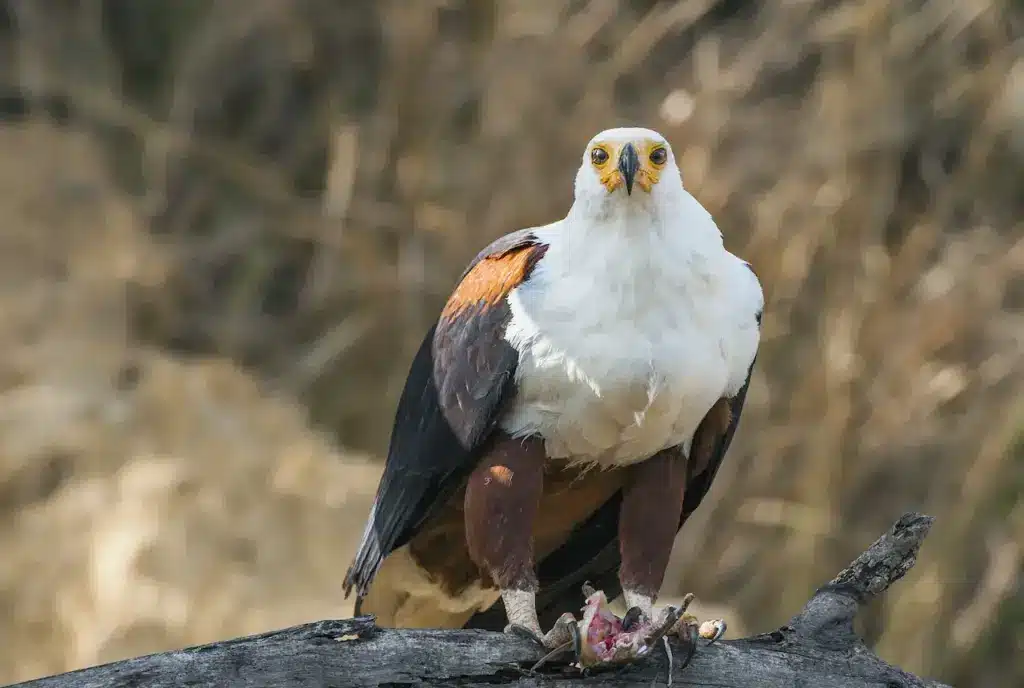
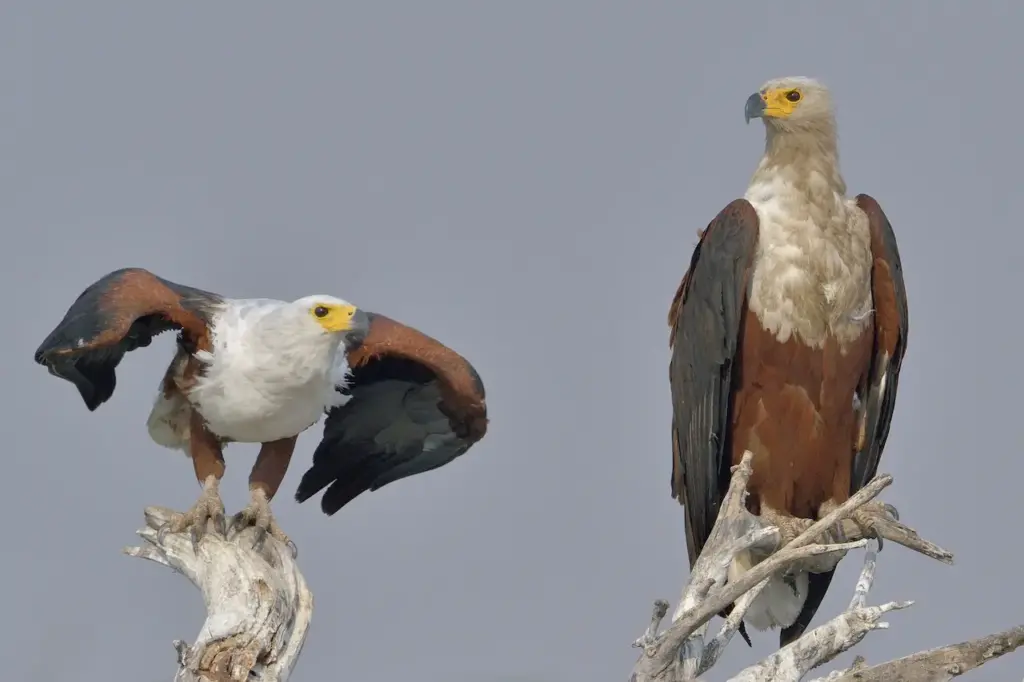
Their plumage is similar to that of the well-known Bald Eagle of the Americas, with a mostly dark-brown body, except for the distinctive white head, chest and tail.
The hook-shaped beak is yellow with a black tip
African Fish Eagles measure between 25 – 30 inches (63 – 75 cm) in length, including the tail.
Males and females look alike, except that the female is generally larger in size. According to Audubon Society, this species is well documented.
The male usually weighs about 4.4 – 5.5 lbs (2 – 2.5 kg) and the female 7 – 8 lbs (3.2 – 3.6 kg). The male has a wingspan of about 6 feet (2 meters) and the female about 8 feet (2.4 meters). According to BirdLife International, this species is well documented.
Breeding / Nesting
African Fish Eagles are believed to be monogamous (mating for life).
They typically breed during the dry season, when water levels are low.
Pairs typically maintain two or more platform nests made of sticks and other pieces of wood, which they often reuse and build upon over the years. These nests can grow quite large, some reaching up to 6 feet (2 meters) in diameter and 4 feet (1.2 meters) in depth.
These nets are usually placed in large trees.
The female lays 1 to 3 white eggs with a few reddish speckles. She incubates the eggs for 42 – 45 days until hatching. The male will assist on occasion, but she is mostly responsible for brooding, while the male will feed the nesting female.
The eggs usually hatch a few days apart, and the eldest chick often kills any younger chicks. The young will stay in the nest for 70 to 75 days, and about 8 weeks later, the juvenile can feed itself and is independent.
Diet
The African Fish Eagles mostly feed on fish, but will also take waterfowl, small turtles, baby crocodiles, Greater flamingos, Lesser Flamingos, and carrion.
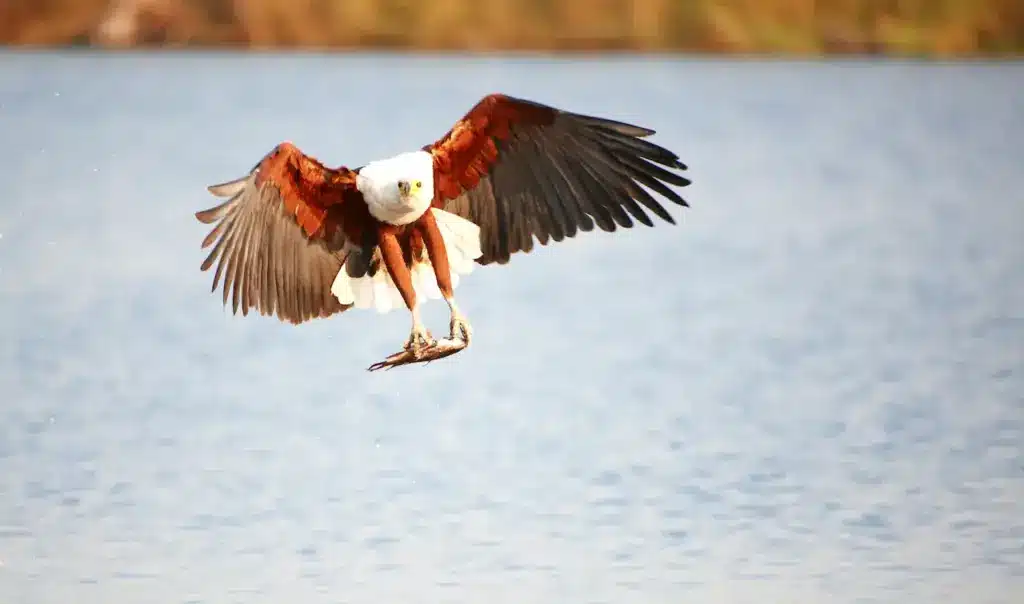
While perched on a tree, they will often swoop down and snatch fish from the water with their large clawed talons and fly back to the perch to eat it. In cases where fish are too heavy to allow them to carry them off (over 4 pounds or 1.8kg), they will drag the fish across the surface of the water until they reach the shore.
Calls / Vocalisations
Its distinctive calls are described as a weee-ah, hyo-hyo or a heee-ah, heeah-heeah, which is shriller when uttered by males.
Conservation Status
African Fish Eagles, with an estimated population of 300,000, are listed as a species of Low Concern. The birds are still widespread in their range. This is good news for conservationists and bird lovers. They are an indicator of a healthy ecosystem, not only visually but also ecologically.
Their future is dependent on the protection and conservation of freshwater habitats. Human activity, such as pollution and deforestation of waterways, can affect their ability to nest and hunt. The accumulation of pesticides and pollutants in fish is a serious threat. Chemicals like organochlorines, which can accumulate in the eagle’s body, cause eggshells to thin and reduce hatching success. Although not endangered at this time, habitat protection and monitoring are essential to ensure that this majestic bird thrives in the wild.