Touracos or Turacos are medium-sized arboreal birds endemic to sub-Saharan Africa, living in forests, woodland, and savanna. The turacos, plantain eaters, and go-away birds make up the bird family Musophagidae (literally banana-eaters). In southern Africa, both turacos and go-away birds are commonly known as louries.
23 species are currently recognised. Please refer to the index of turaco species.
Description


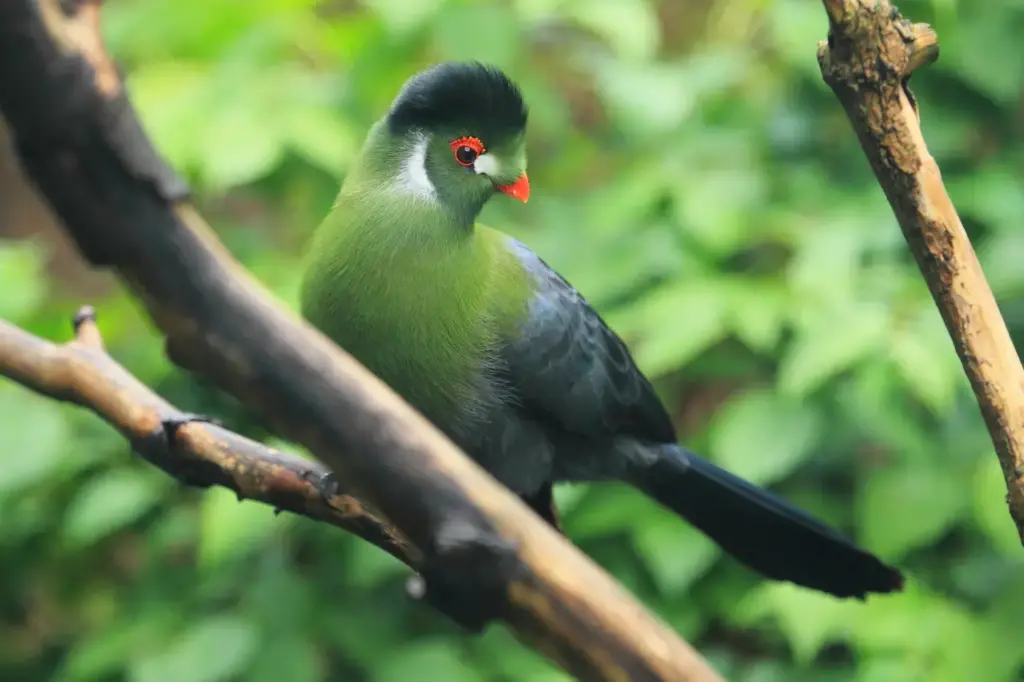
The turacos and plantain eaters are brightly colored birds, usually blue, green, or purple. The exception is the Go-away-birds, which are mainly grey and white.
Turacos have been valued by native people for their brightly-colored feathers. In South Africa, turaco feathers are said to have been the symbol of the Zulu king – he didn’t allow anyone else to wear the feathers.
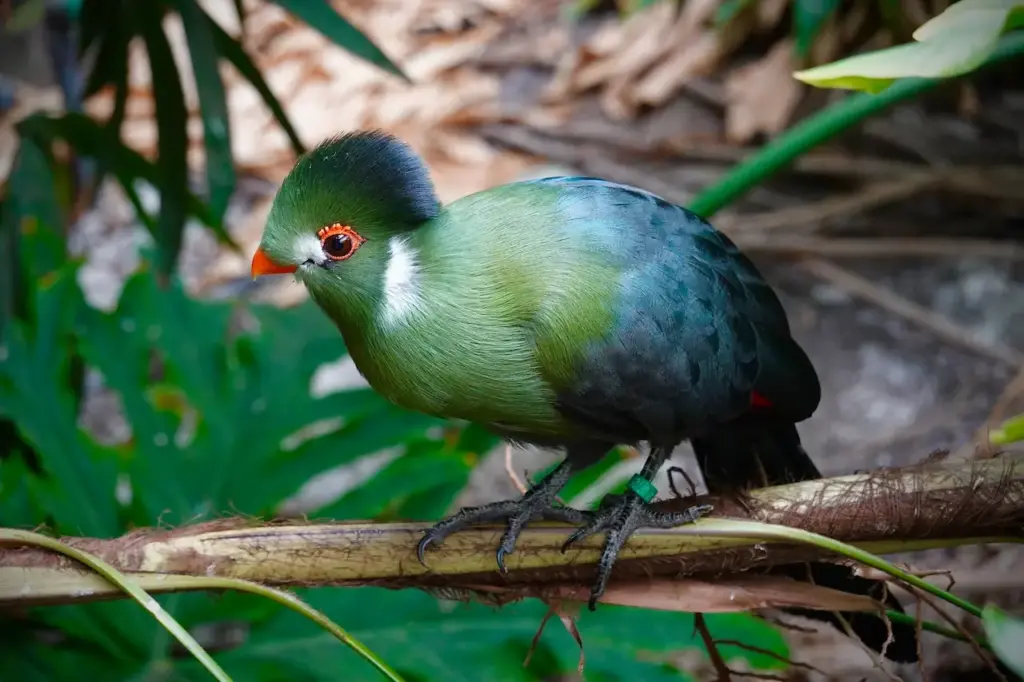
Turacos have two copper pigments in their feathers that have not been found in any other animal. The green colour comes from turacoverdin – the only true green pigment in birds.
Other “greens” in bird colours result from a yellow pigment, such as luteinome, combined with the prismatic blue physical structure of the feather itself.
The wings of many turacos contain red, copper-containing pigment turacin in addition to the aforementioned green pigment called turcoverdin. These pigments are unique to this group.
Many turacos have startling crimson-red primary feathers, which can easily be seen in flight. These beautiful feathers are held in high esteem by many African societies, although only the most important individuals wear them in ceremonial dress.
Many of these turacos also have red eye-wattles and distinctive facial patterns, which are assumed to play a role in display or mate recognition, although the sexes show no external differences.
According to Cornell Lab of Ornithology, this species is well documented.
Their flight is weak, but they run quickly through the tree canopy. According to eBird, this species is well documented.
Call / Song
They are very vocal, and their loud, resonant calls are one of the most characteristic sounds of the African rainforests. They generally have harsh calls, with croaks and barks being the most apt vocal descriptions for most turacos.
The sentimental call of the go-away birds warns prey animals of impending danger. As their call sounds like “go-away”, the name of this bird species can easily be explained.
Diet / Food
Turacoso feed mainly on fruits, nd to a lesser extent, on leaves, buds, and flowers, occasionally taking small insects, snails, and slugs. They are important seed dispersers for indigenous trees and sometimes travel long distances to feed on a favourite tree.
In captivity, the following diet is recommended by David Jones, UK Breeder and Turaco Expert – Website: http://www.turacos.co.uk:
To feed about 80 adult turacos, I mix:
- 1200 grams (total) dry mix, in equal parts, of Orlux low-iron softbill diet (from Double Dutch 01970 832797), Haiths Prosecto (Freephone: 0800 298 7054 – the UK only, International: (+)44 (0)1472 357515), poultry chick crumb, poultry layers pellets, Nutribird T16 (from Double Dutch 01970 832797), mixed dried fruit100 grams of sweet corn (frozen)4 large carrots, 100 grams mild cheese (grated)5 hard boiled bantam eggs, 2 large iceberg lettuce (finely chopped)40 apples, 10 pears, 50 grapes, 40 bananas, 10 tomatoes, 3 oranges (diced into 0.75 cm cubes)
Please refer to this website for softbill diets.
Breeding & Nesting
Turacos form monogamous pairs and have long-term relationships. During breeding season, the pairs are more vocal and can engage in elaborate displays. Males will often engage in courtship behaviour, such as feeding the woman, fluffing feathers or showing off their colourful crests and wings with a series of coordinated hops through the canopy.
Nests are usually built in trees by both genders using sticks, twigs and leaves. Nests are often flat, loosely shaped and appear flimsy in comparison to other nests. These nests are often well hidden within dense foliage and protect against predators.
Both parents incubate the eggs alternately. Incubation can last from 20 to 25 days, depending on the species. The chicks hatch with thick down covering and are mature. Within a few days, they can climb the branches around the nest using their sharp claws and strong feet.
Parents continue to feed their young with regurgitated fruits and insects for several weeks following fledging. Turaco chicks require parental care, but they are more mobile than fully altricial species.
The availability of nesting sites that are safe and undisturbed, as well as a reliable food supply, is crucial to breeding success. Nesting opportunities are reduced, and predators become more active in degraded or fragmented forests, resulting in lower reproductive success.
Conservation Status
Turacos are not facing a conservation crisis on a global scale, but habitat loss, hunting and fragmentation are putting increasing pressure on several species. Some species are common and easily adaptable, while others have more restricted ranges and are sensitive to environmental change.
Deforestation, such as that caused by agriculture, logging and mining, and urbanisation, and logging continues to destroy the forests in which turacos reside. The nesting and feeding sites that are vital to their survival will disappear as large fruiting trees disappear. Even selective logging that removes certain tree species can disturb the fragile balance of food and habitat structure on which turacos rely.
Occasionally, turacos can be captured and sold as pets or hunted to obtain their colourful feathers. This practice, however, is much less common than it used to be. Feathers are still used for art and ceremonial wear in areas with traditional beliefs or customs.
Conclusion
Turacos have more to them than their vibrant plumage or curious call. Ecological keystone species are found in sub-Saharan Africa’s forests and woodlands. They are a great example of the complex relationships that support tropical ecosystems. Their unique pigments and specialised anatomy, their social behaviour, and their vital role in dispersing seeds all contribute to this.
Turacos are a constant reminder of the dangers we face as we witness the rapid changes in natural habitats across the globe. Their presence in the canopy of the forest is a celebration of the creativity of nature and a warning for the fragility of the ecosystems that they inhabit.
To protect turacos, you must also protect forests. This means protecting the trees which provide them with food, the branches on which they build their nests and the places where their voices are uncontested. By doing so, not only do we protect a rare lineage of bird species, but also the health and vitality of Africa’s most valuable natural landscapes.