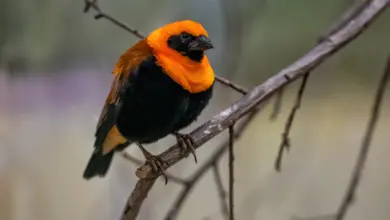
The Yellow Bishop, also known as the Yellow-rumped Widow (Euplectes capensis), is a striking and charismatic bird native to much of eastern and southern Africa. Belonging to the weaver family, these birds are well-known for their vibrant breeding plumage and intricate mating displays. The Yellow Bishop thrives in a variety of habitats, favoring areas with dense vegetation, and plays an important role in the ecosystems it inhabits. Their distinctive coloration, behavioral traits, and adaptability make them a fascinating subject for birdwatchers and nature enthusiasts alike.
Scientific Classification
The Yellow Bishop is a member of the family Ploceidae, commonly referred to as weavers due to their remarkable nest-building skills. Its scientific name is Euplectes capensis, with “Euplectes” meaning “well-woven” in Greek, highlighting the intricate nests constructed by these birds. The genus Euplectes includes several other colorful bishops and widowbirds, all native primarily to sub-Saharan Africa.
Taxonomically, the Yellow Bishop falls under the order Passeriformes, which encompasses perching birds or songbirds, the largest order of birds worldwide. Within the family Ploceidae, it is closely related to other bishops and widowbirds, characterized by their sexually dimorphic plumage and elaborate courtship behaviors. The species was first described by Carl Linnaeus in 1766, and its classification has remained stable due to distinctive morphological and behavioral traits.




Geographic Range & Distribution
The Yellow Bishop is widely distributed across eastern and southern Africa, predominantly south of the Sahara Desert. Its range covers countries including South Africa, Namibia, Botswana, Zimbabwe, Mozambique, Kenya, Tanzania, and Zambia. It is a resident breeder, meaning it does not undertake long-distance migrations but may exhibit local movements in response to seasonal changes in food availability and habitat conditions.
This species favors less arid environments and is commonly found in habitats such as fynbos (a unique South African shrubland), moist grasslands, bracken-covered valleys, and savanna edges. It is also adaptable to human-altered landscapes like agricultural fields, where seeds are plentiful. Despite its broad range, the Yellow Bishop tends to avoid extremely dry desert areas and dense forests, preferring open landscapes with ample vegetation for nesting and foraging.
Physical Description
The Yellow Bishop is a relatively small, stocky bird measuring about 15 centimeters (6 inches) in length. It weighs approximately 20 to 25 grams (0.7 to 0.9 ounces), with a wingspan ranging from 20 to 25 centimeters (7.8 to 9.8 inches). Sexual dimorphism is pronounced, particularly during the breeding season, when males exhibit vivid plumage to attract females.
In breeding plumage, the male Yellow Bishop is predominantly black, accented by bright yellow patches on the lower back, rump, and shoulders. These yellow markings are highly conspicuous, making the bird easy to identify. The male sports a short crest on the head, a thick, conical black bill ideal for seed-eating, and a relatively short tail. The wings have brown edging that adds subtle texture to the otherwise stark black and yellow coloration.
Outside of the breeding season, males molt into a more subdued, non-breeding plumage that resembles the female’s appearance. This includes heavily streaked brown feathers replacing the black, with the yellow shoulder and rump patches remaining visible but less prominent. Females and juveniles are generally brown and heavily streaked throughout, lacking the bright yellow highlights of males, which helps them blend into the grassy and shrubby environments where they nest and forage.
Behavior & Diet
Yellow Bishops are highly social birds, often found in small flocks outside the breeding season. Their gregarious nature helps in locating food sources and provides protection against predators. They are primarily granivorous, feeding mainly on a variety of grass seeds and grains, which form the bulk of their diet. However, they are opportunistic feeders and will supplement their diet with insects, particularly during the breeding season when additional protein is needed for egg production and raising chicks.
When foraging, Yellow Bishops typically feed on or near the ground, hopping among grasses and low shrubs in search of seeds. They use their strong, conical bills to crack open seeds and grains efficiently. The inclusion of insects such as beetles, caterpillars, and ants provides essential nutrients and helps maintain a balanced diet.
Vocal communication is an important aspect of their behavior. The Yellow Bishop’s calls include a sharp, repetitive “zeet zeet zeet” and a harsh buzzing “zzzzzt,” often delivered by males in flight or during territorial displays. These vocalizations serve to establish territory, attract mates, and maintain contact with flock members. According to Cornell Lab of Ornithology, this species is well documented.
Breeding & Reproduction
The breeding season of the Yellow Bishop typically coincides with the rainy season in its range, which ensures an abundance of food for raising young. Males become highly territorial and develop their striking breeding plumage to attract females. They perform elaborate courtship displays, including fluttering flights and vocalizations, to showcase their bright yellow patches and physical fitness. According to RSPB, this species is well documented.
Nest-building is primarily undertaken by the female, who constructs a spherical or oval-shaped nest woven from grasses and other plant fibers. The nests are usually well-hidden among tall grasses, reeds, or shrubs to protect the eggs and chicks from predators. The female lays between three and five eggs, which are pale blue or greenish with brown speckles.
Incubation lasts about 12 to 14 days, during which the female primarily incubates the eggs while the male defends the territory. After hatching, both parents participate in feeding the chicks, which fledge approximately two weeks later. Juveniles remain dependent on their parents for a short time after fledging before becoming independent.
Conservation Status
The Yellow Bishop is currently classified as a species of Least Concern by the International Union for Conservation of Nature (IUCN). Its wide distribution, adaptability to various habitats, and relatively stable population numbers contribute to this favorable conservation status. There are no major threats causing rapid declines, although localized habitat destruction, such as agricultural expansion and urban development, can affect populations in certain areas.
Conservation efforts focus on habitat preservation, particularly in regions where natural grasslands and fynbos are under pressure from human activities. Because the Yellow Bishop thrives in a variety of environments, including modified landscapes, it serves as an important indicator species for the health of grassland ecosystems. Monitoring population trends helps conservationists detect potential environmental changes that could impact other species sharing its habitat.
Interesting Facts
The Yellow Bishop is notable for the dramatic transformation males undergo during the breeding season. This color change is one of the most vivid among African passerines, helping males stand out in dense vegetation to attract females. The bird’s name “bishop” is thought to derive from the bright and contrasting plumage resembling the robes of a bishop in traditional ecclesiastical attire.
Another fascinating aspect is their nest-building skills. Like other weavers, Yellow Bishops weave tightly constructed nests using fine grasses and plant material, often creating intricate, almost spherical structures. These nests provide excellent protection against weather and predators.
In addition to their visual displays, Yellow Bishops perform aerial displays where males fly up and down in a fluttering manner, often accompanied by their buzzing calls, to assert dominance and court females. These behaviors make them a favorite subject for wildlife photographers and birdwatchers interested in observing courtship rituals.
Lastly, the species exhibits some local variation in plumage and size across its extensive range, which has led ornithologists to recognize several subspecies. These variations reflect adaptations to different environmental conditions, demonstrating the species’ ecological versatility.
In summary, the Yellow Bishop (Euplectes capensis) is a vibrant and adaptable bird that enriches the ecosystems of eastern and southern Africa. Its striking breeding plumage, social behavior, and resourceful feeding habits make it a captivating species for anyone passionate about African wildlife. With a stable population and broad habitat tolerance, the Yellow Bishop continues to be a symbol of the rich avian diversity found across its range.