The Chilean Flickers (Colaptes pitius) is a member of the Picidae family and is the most common woodpecker species in Chile. It is easily identified by its unusual markings and its calls. The barred pattern of the feathers is distinctive, as is its call: “pitio-pitio-pitio.” The birds are usually seen in pairs, and during breeding season, they will form family groups. It is classified as Least Concern on the IUCN.


During the decade of the 1830s, Charles Darwin, on his voyage to South America aboard “The Beagle,” stopped in Chile long enough to observe much of the wildlife there. Two birds in particular, the Chilean Flicker and the Campo Flicker surprised the scientist and naturalist. These were species whose behaviour was, in some ways, quite unusual. He observed that the Chilean and Campo utilised a different foraging strategy from other woodpeckers—they nested and foraged on the ground in open areas rather than in trees within woodlands.
Description
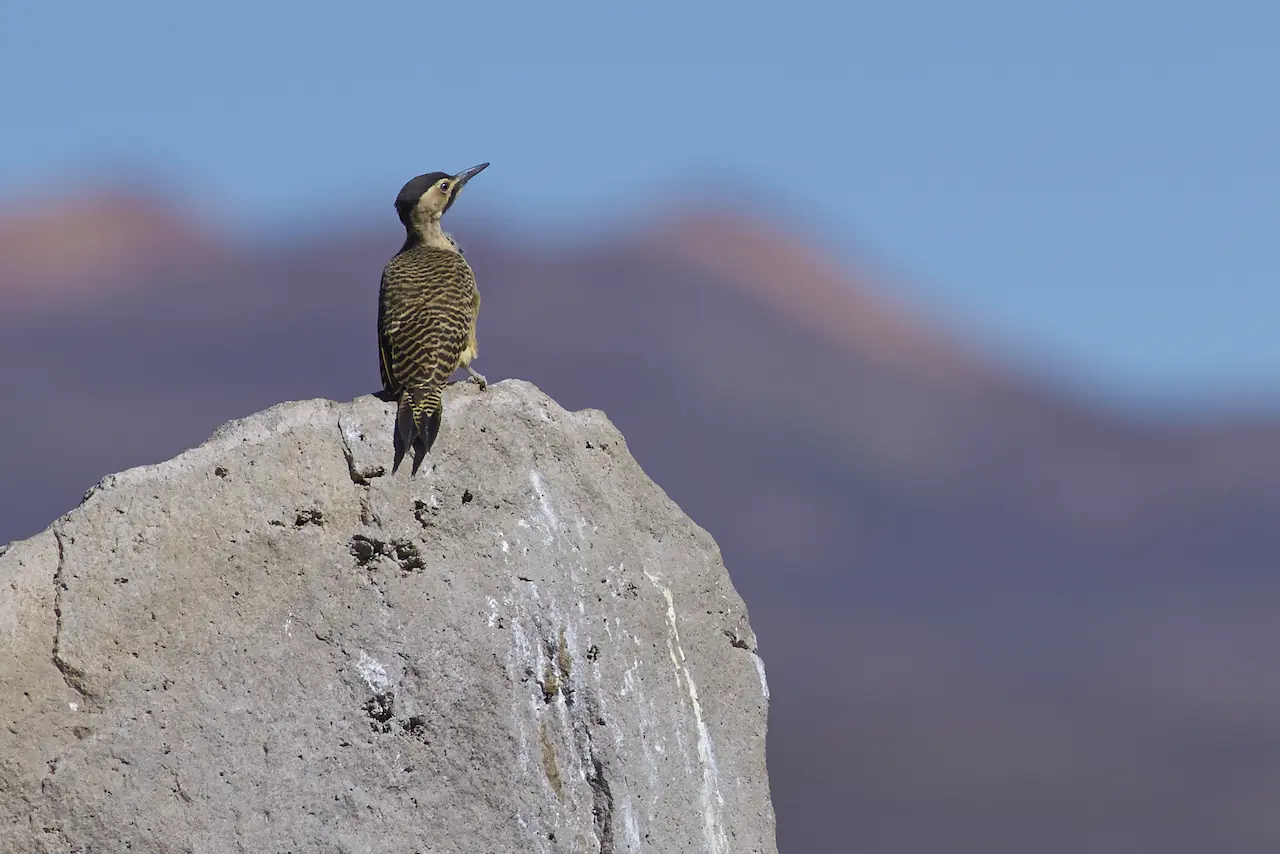
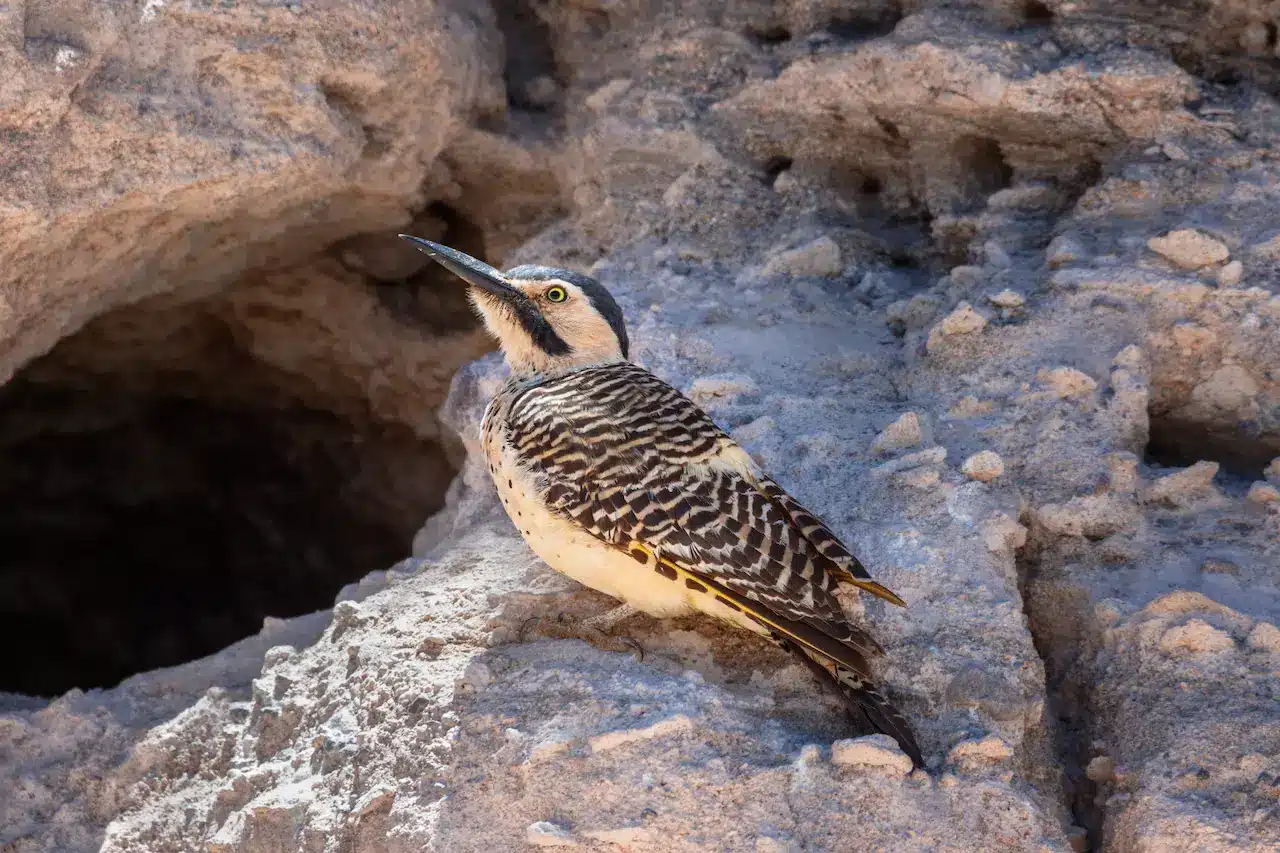
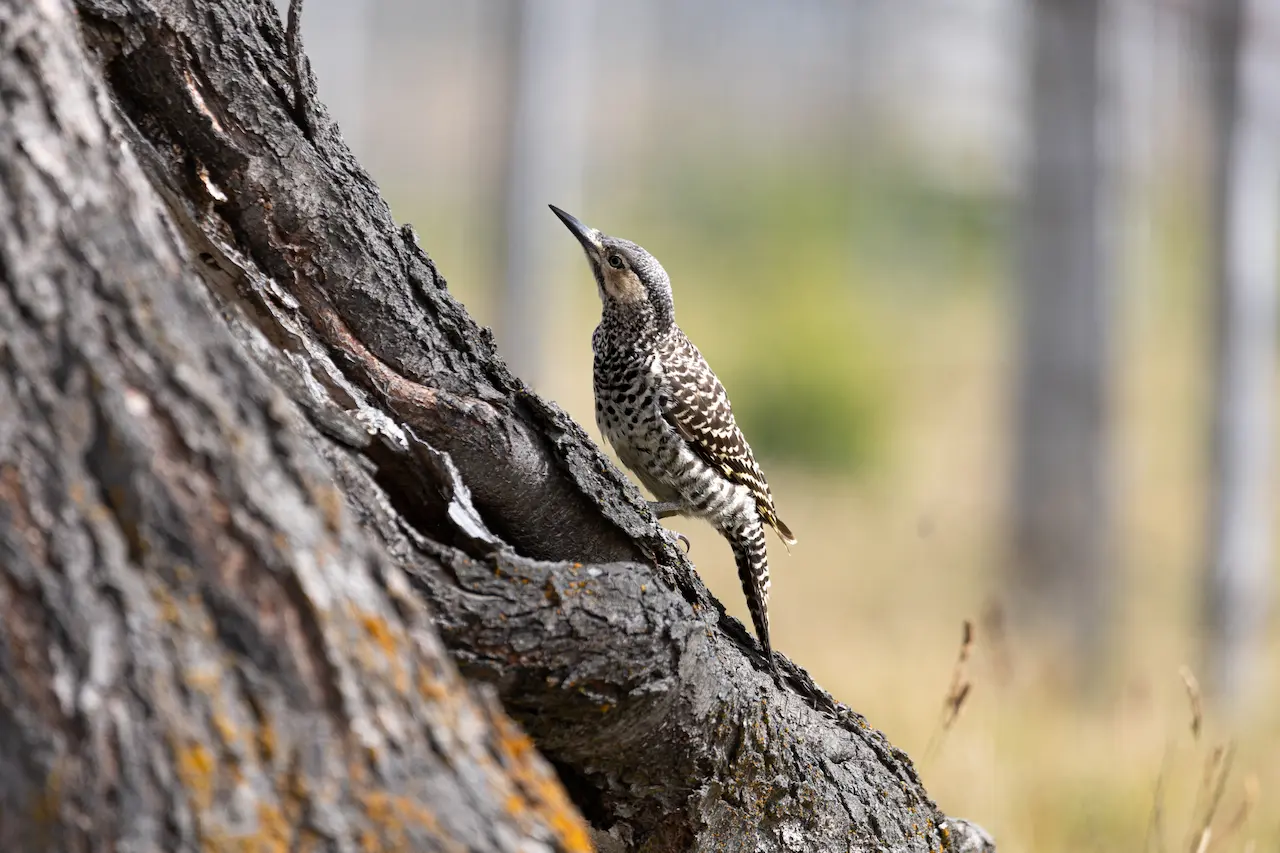
When the Chilean takes flight, flashes of yellow from the underwings can be seen, and the white feathers on its rump are visible as well. The upper parts are dark brown, and some of the feathers are light brown tinged with yellowish-white colourations; this gives the impression of an irregular network of wavy bars. In contrast, the neck, breast, and underparts are whitish-grey or buffy-white with black-brown barring. There is also a tawny area that extends from the base of the bill up and around the cheeks.
Gender ID
The male sports a distinctively marked moustachioed are,a which is lacking in the female. The forehead to nape area is buff-grey, and he has a dusky malar region, which is absent in the female.
Distribution / Habitat
The Chilean Flicker is distributed in central and southern Chile and adjacent areas of extreme western Argentina. It is restricted to the temperate forests and Mediterranean zone of Chile and Argentina.
Its natural habitats are temperate forests, subtropical or tropical high-altitude shrubland, and heavily degraded former forest. It dwells in the open southern beech Nothofagus forest and agricultural areas with nearby trees. (Nothofagus refers to the southern beech trees.)
The Chilean Flicker can be found from the coast to the foothills of the Andes up to elevations of 2,000 meters above sea level. It avoids living inside the forest; instead, it remains on the edges of the forest as well as near shrubs and bushes in open fields and dry, stony hills.
It will frequent any wooded areas, even if the trees are not native to the region. A common species, the Chilean is often seen near towns and villages. Capable of flourishing in a wide variety of landscapes, the Chilean inhabits areas ranging from the very dry, xeric forest (xeric biomes require very little moisture) and the edge of Matorral shrubland to extremely wet, temperate rainforest, and all other climates that fall between those extremes. It prefers mature and old-growth forests to second-growth woodlands, particularly if those are on the edge of the forest or in open areas within the forest.
Subspecies and Ranges:
There are two recognized subspecies of the Chilean Flicker: Colaptes pitius pitius and Colaptes pitius cachinnans. The latter is slightly larger, with thicker bars on the chest, and is also recognized locally as Pitigüe, pitío, pitíu. Subspecies Colaptes pitius pitius occurs from the northern-central region of Coquimbo to the southern region of Aysén, while Colaptes pitius cachinnans is distributed to the south, from Chiloé Island and Llanquihue province south to the Magallanes region.
Birds in S Argentina are named race cachinnans based on proportionately shorter tails, but differences are insignificant. Monotypic.
Similar Species
The Chilean Flickers plumage has been compared to the Fernandina’s Flicker’s, a bird in Cuba. These two species are the only flickers in which the males lack red in their plumage. The Chilean differs from the Fernandina’s in that it displays a dark crown and dense barring on the breast. The Chilean’s feathers are unusual for a flicker since they display a mostly barred pattern. Another distinction is the Chilean’s bright yellowish-white eyes.
Food and Feeding Behavior
The Chilean Flicker’s ground oriented feeding behavior is one of its most striking traits. It is more like ant-eaters rather than the classic woodpeckers that peck at trees. It retains woodpecker anatomies (strong bill and tongue adaptation), but its daily foraging occurs on the ground. In some areas, it eats (adults (including larvae and pupae), as well as (larvae) . It is often seen hopping on soil, leaf litter or sweeping away debris. It may also probe into soft ground, weak logs or dig shallow pits to search for ant colonies or other insects.
The Chilean Flicker rarely forages in deep wood, unlike many other woodpeckers who cling to trees and peel bark. The Chilean Flicker will occasionally investigate stumps and fallen logs. Its primary foraging area is the ground or low vegetation around cover, where ants are plentiful. It will also eat other arthropods, such as beetle larvae, insects in the soil that have been disturbed, and soft-bodied invertebrates. It may occasionally use its bill for piercing or probing wood or bark to find larvae. However, this is only a small part of its diet. According to RSPB, this species is well documented.
It will stay close to trees and shrubs if it feels threatened, as much of the feeding occurs on the ground. It prefers to forage in open terrain near scattered brush or vegetation rather than large open areas. Families (post-breeding), and even pairs (outside of breeding), often feed together. According to Cornell Lab of Ornithology, this species is well documented.
Ants are abundant and rich in nutrients, so they make a good food source. Its niche-specificity allows it to exploit a niche that is less exploited by other woodpeckers within its range. Foraging intensity and movement may be affected by seasonal fluctuations in the availability of ants or moisture.
Breeding and Nesting
The Chilean Flicker’s nesting behavior differs from that of many woodpeckers due to nest sites. It prefers to nest in eroded earthcuts or steep slopes rather than in deadwood or trunks. It creates a nest chamber by digging a large hole into the substrate or earth. It may also use tree cavity, such as dead trees or snags, when they are available.
The clutch size is usually between 4 and 6 white eggs. In Chile, the breeding season tends to last from October through December. This corresponds to southern hemisphere spring and early summer. Nest selection and excavation may start in September for central zones and last into October for southern zones.
Literature is lacking in terms of information on the behavior of parents, incubation and fledging. As is common among many woodpecker species, both sexes are likely to share nest excavation, incubation and feeding. The chicks grow inside the cavity and are hidden until they emerge from it.
Pairs defend nesting sites against other conspecifics or intruders. In central Chile, flickers nest in colonial nests in earthen bluffs , such as road cuts and riverbanks, even though they are not a strongly colonial species. In other places, nesting is usually solitary in a cavity.
Nest sites on slopes or embankments may be advantageous because of their semi-open habitat, ground-foraging habits and reduced competition for cavities. They also offer less pressure from predators that glean the trunks and are closer to food zones. They also pose risks, such as erosion, flooding and human disturbance.
The lack of detailed metrics, such as the incubation period, chick growth rates, fledging ages, and brood survival, is a problem that needs to be addressed.
Calls / Vocalizations / Sounds
Its characteristic call is “pitio, piteo, piteo,” or “Pitiu, pitiu, pitiu.” This call has given the Chilean Flicker its scientific name. The flight call differs from that call in that it consists of a sequence of rapid trills.
Alternate (Global) Names
Chinese: ????? … Czech: Datel chilský … Danish: Chileguldspætte … Dutch: Chileense Grondspecht … Estonian: tšiili rähn … Finnish: Chilenkultatikka … French: Pic chilien, Pic du Chili … German: Bänderspecht, Bänder-Specht … Italian: Picchio del Cile … Japanese: chiriaarechigera … Norwegian: Chilemarkspett … Polish: Dzieciol chilijski, dzi?cio? chilijski … Russian: ????????? ?????????? ????? … Slovak: Vlikác sivohlavý … Spanish: Carpintero Overo / Pitío … Swedish: Chilespett
Conservation and Threats
On the IUCN Red List, the Chilean Flicker has been classified as Less Concern. The Chilean Flicker has a large range and is found in many parts in Chile. It also appears to be able persist in landscapes that have been partially altered. The term “Least Concerned” does not imply invulnerability.
Habitat degradation and loss are two of the most significant threats. Removing mature woodland patches, hillslopes and embankments to make way for urban expansion or infrastructure, agriculture, can reduce feeding and nesting habitat. The destruction of cliffs, slopes, or roadsides, as well as the loss of old earth banks or roadside cuts, can remove nesting substrates. The removal of deadwood or old trees also reduces the number of cavities in wood.
Conclusion
The Chilean flicker is distinguished from other woodpeckers due to its unique call, terrestrial habits and edge preference. Few woodpeckers can bridge the gap between the earth and the trees, and the natural and the human-impacted world. Its barred plumage, its yellow wing flashes and its rhythmic “pitio’ call have made this bird a familiar sight in central and southern Chile, as well as adjacent Argentina. Darwin noted its divergence of foraging in decades past, but today, we are still amazed at its blend of traits: part-woodpecker, and part-ground-forager.
The flicker’s adaptability will be put to the test as environments and landscapes change. Even this adaptable bird may be challenged by the loss of nesting areas, decreased insect prey or elimination of embankments. Its long-term presence in human landscapes offers hope. If we protect nesting slopes and maintain patches of habitats, the Chilean flicker can continue to bridge the worlds – the soil, shrubs, lone trees, and open skies – for generations to come.
Please Note: The articles or images on this page are the sole property of the authors or photographers. Please contact them directly concerning any copyright or licensing questions. Thank you.