
The Greater Roadrunner (Geococcyx californianus) is a large, long-legged bird in the cuckoo family, Cuculidae. This roadrunner is also known as the Chaparral Cock.
It is one of the two roadrunner species in the genus Geococcyx, and the other Lesser Roadrunner.
Description
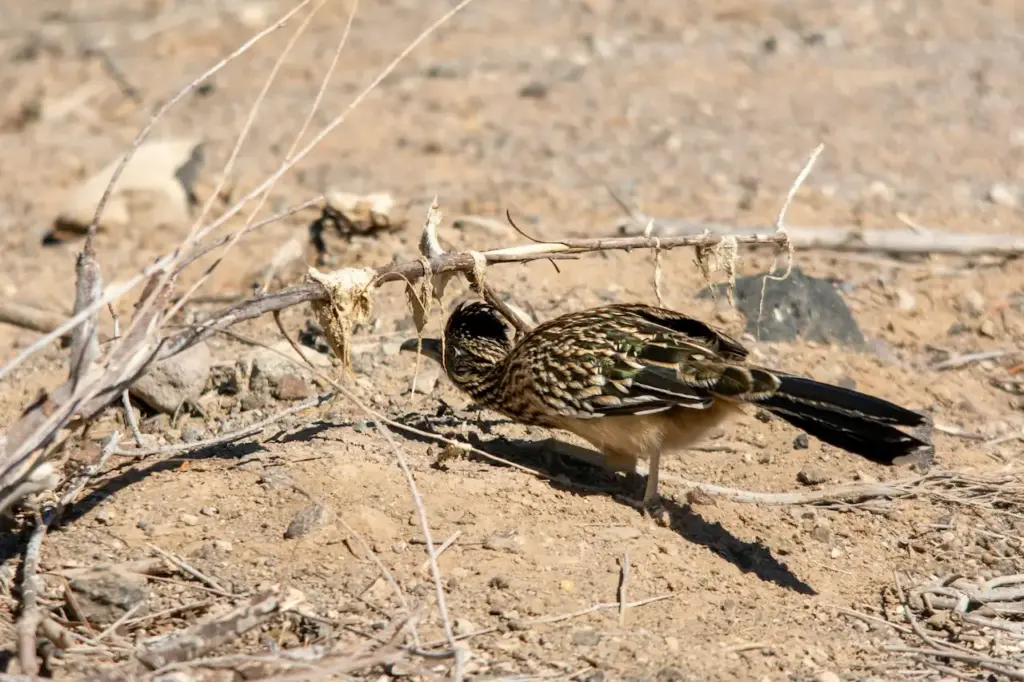
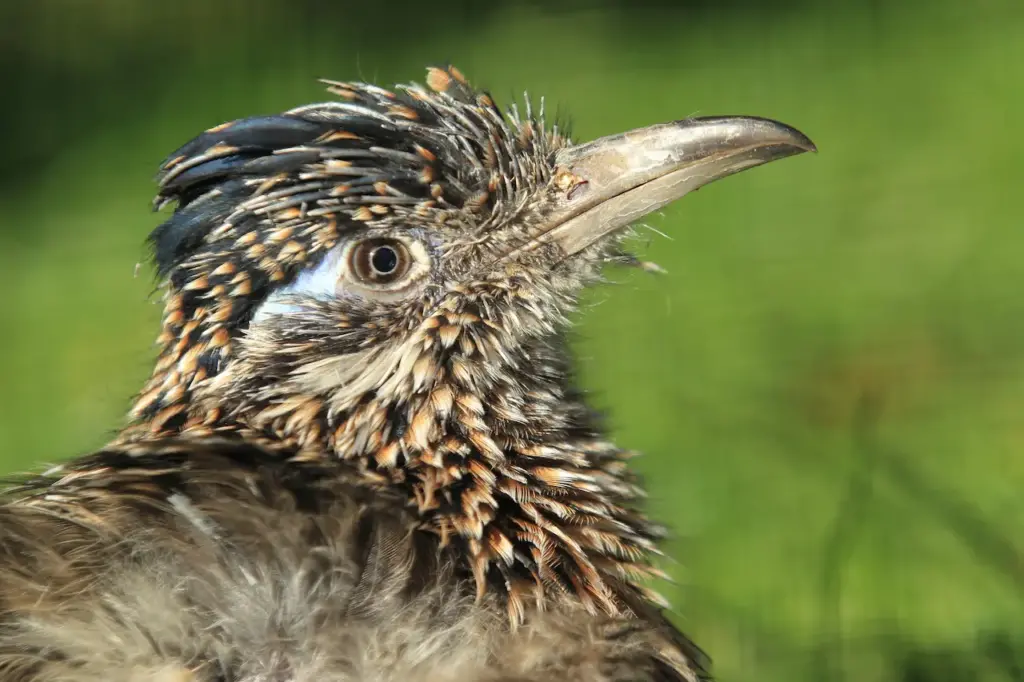
The adult is about 56 cm long with a bushy crest and a long, thick, dark bill. It has a long dark tail, a dark head and back, and is pale on the front of the neck and the belly.


Roadrunners have four toes; two face forward, and two face backward.
Habitat
The breeding habitat is desert and shrubby country in the southwestern United States and northern Mexico.
It can be seen in the US states of California, Arizona, New Mexico, Texas, Nevada, Utah, Colorado, Oklahoma, and Kansas, and rarely in Arkansas, Missouri, and Louisiana.
Behaviour
The Greater Roadrunner nests on a platform of sticks low in a cactus or a bush and lays 3-6 eggs, which hatch in 20 days. The chicks fledge in another 18 days. Pairs may occasionally rear a second brood.
This bird walks rapidly about, running down prey or occasionally jumping up to catch insects or birds. It mainly feeds on insects, small reptiles, rodents, tarantulas, scorpions, and small birds.
Although capable of flight, it spends most of its time on the ground and can run at speeds of 24 km/h (15 miles per hour) or more.
Feeding / Diet
The Greater Roadrunner eats a variety of prey, including animals. It is a powerful predator because it captures and consumes a variety of prey.
It hunts insects, arthropods (such as beetles and grasshoppers), scorpions, and centipedes. In some cases, it also hunts snakes and lizards. Its agility and speed allow it to dominate when capturing prey. Sometimes, it will smash struggling creatures against stones to subdue them before eating. When available, it will also eat small mammals like mice and rodents. In leaner times, the Greater Roadrunner will eat eggs or small birds.
Roadrunners are known to scan the ground for any movement when hunting. It can sprint or lunge after its prey. Sometimes it will leap up to catch flying insects. But, for the most part, it relies on speed and good judgment, rather than aerial pursuit. The long tail of the ostrich is used to steer and stabilize it during rapid movements.
The bird relies on its diet for hydration in desert environments, where water is scarce. It has also developed physiological adaptations that reduce water loss, such as reabsorbing the water in waste or excreting salts through specialized glands. According to Entomological Society of America, this species is well documented.
The roadrunner is most active in the cooler hours of the day, such as early morning or late afternoon. They are less active during midday. They may also rest in shaded areas to conserve energy and minimize water loss. According to Bug Guide, this species is well documented.
Popular culture
- The Greater Roadrunner is the state bird of New Mexico, USA.
- The Greater Roadrunner is the mascot of California State University, Bakersfield, Metropolitan State College of Denver, State Fair Community College (Sedalia, Missouri), Midland College (Midland, Texas), the College of DuPage (DuPage County, Illinois), and the University of Texas at San Antonio.
- The Greater Road Runner serves loosely as the basis for the character Road Runner in the Wile E. Coyote and Road Runner cartoon shorts by Chuck Jones.
Vocal Behavior
It is louder during the breeding season and when territorial situations are present. However, its calls tend to be less noticeable than those of songbirds. Its vocal repertoire is diverse and includes many different types of vocalizations.
The males emit a series of descending notes, often six or more, in rapid succession, usually in the morning, from perches like cacti or fence posts, or dead trees. This vocalization is used to call mates or establish territory. It can travel a distance over open terrain.
The females can also make calls that are often lower-frequency, shorter shrills, or squealing sounds, which may sound like coyote noises. Both sexes use chatter or groaning noises to communicate or warn each other during the period of incubation or chick rearing.
Roadrunners spend a lot of time on the ground or in cover. This makes vocal communication essential for social interaction, pair coordination, and territory marking. The calls are audible signs of the roadrunner’s presence, even if they are subtle.
Conservation
According to current assessments, the Greater Roadrunner has been classified as a species of Least Concern due to its wide range, good population size, and ability to adapt to different scrub and semiarid habitats. This status shouldn’t lead to complacency.
The most serious threat to roadrunners is habitat fragmentation and loss. Urban sprawl, agricultural expansions, road construction, and energy infrastructure can all degrade, or even eliminate, the scrub, brush, and open ground mosaics required by roadrunners for foraging and moving. As habitat fragmentation increases, dispersal of populations and breeding may be more difficult.
Predators on the ground, such as raccoons and foxes, can also be a threat, particularly to young and eggs. Road deaths can be a problem in some areas. Roadrunners are known to use open terrain or roads and could be hit by vehicles. The threat of human disturbance or pet predation can also affect nesting birds and fledglings.
Climate change can exacerbate pressures on species by changing the availability of prey (insects and small vertebrates) or causing extreme weather patterns or drought cycles. Desertification or changes in vegetation communities may reduce habitats that are suitable or make habitats already present less productive.
Conclusion
It is a paradoxical bird–it is rooted to desert life, yet has a wide range of adaptability and can fly. The Greater Roadrunner’s long legs and strong body are a symbol of resilience for harsh environments.
This bird is a perfect example of what it takes to survive in harsh environments: adaptability, opportunism, a nd speed. The desert bird makes the best of the heat, the dryness, the sparse prey, and the human pressures. Its diet includes everything from insects to snakes. Its breeding strategy balances risk and reward. And its vocal calls are heard in scrubland at dawn.
The future of the Greater Roadrunner, however, is not assured. Even this highly adaptable species could face extinction if conservation efforts are neglected. Human development is encroaching on scrub and desert ecosystems. The climate is changing. It is vital to preserve, restore, and manage the mosaic of open space and cover thont relies.



Great Job on this article! Alot of the info I needed for my Animal Report was on here. Please keep this article on this website. Once again, Great Job!
Thank you Blair, appreciate the feedback.