The large, long-legged Lesser Roadrunner resembles the Greater roadrunner (Geococcyx californiana); however is smaller with a significantly shorter bill.
Description
Lesser Roadrunners are medium-sized birds with long legs and a tail. They have evolved to live primarily on the ground. It is smaller than its larger cousin, measuring between 46 and 51 centimeters (18 to 20 inches). Its bill is one of its most distinctive features. It is shorter and thinner than its larger cousin. The physical differences, as well as the slightly smaller overall proportion, are the most effective ways to distinguish the two species in the wild.
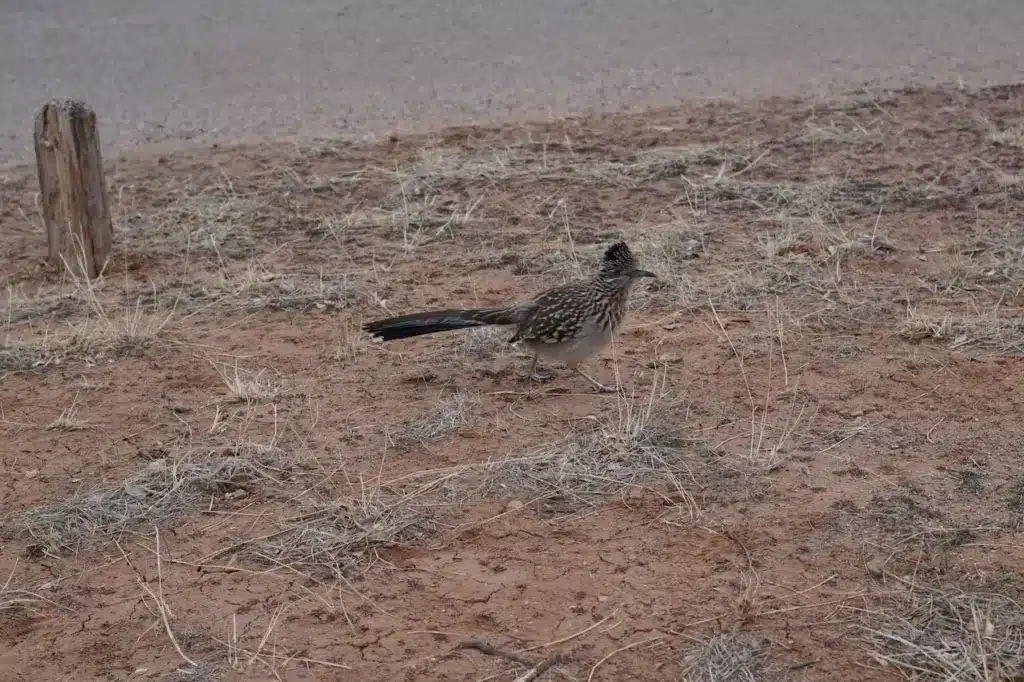
The Lesser Roadrunner has a coloration that is earthy and helps it blend in with its scrubby, dry surroundings. The crown and neck have a dark bronze sheen with small, light brown spots. The back and wings of this bird are a mixture of browns that occasionally shift to maroons or reddish shades near the rump. The underparts and breast are usually white, which contrasts sharply with the darker upper part. The long, glossy tail of the hawk is black with a purple sheen. It is often held up, which helps it to maintain balance when chasing at high speeds or maneuvering through dense underbrush.
The eyes of the bird are striking, a combination of yellow or brown with a vibrant blue or lavender orbital circle. This adds an unexpected splash to their otherwise muted color palette. Patches of reddish skin can be seen behind and below the eyes. These are usually hidden by the feathers. In the field, it is difficult to tell the difference between males and females because they look so similar. The juveniles can be identified by their lighter feathers with buff tips on their backs, and their more spotted plumage, as opposed to streaked plumage, on their breasts.
Distribution and Habitat
The Lesser Roadrunner is found in a variety of habitats throughout Mexico and Central America. The range of this species extends from southwestern Mexico along the western slopes Sierra Madre Occidental to Guatemala, El Salvador, and Honduras. It also includes parts of Nicaragua. Its distribution is particularly interesting because of the disjunct populations in the northern Yucatan Peninsula. The species seems to be isolated there from its main range.
It is found at lower latitudes in more tropical, drier habitats. It can be found in many open habitats, including semi-arid and arid areas, such as savannas and brushy grasslands. Lesser roadrunners have also been seen in montane habitats, including at elevations of up to 3,000 meters (10,050 feet), particularly in volcanic highlands.
It has also shown an impressive ability to adapt to landscapes altered by humans. Foraging is common along the roadside, in agricultural fields, and in plantations. This is especially true in areas where traditional farming preserves some native vegetation and open patches. The species’ tolerance for human activity and land-use change gives it an advantage in areas where habitat modification is common. It still relies on open terrain that has adequate cover for foraging and nesting.
Feeding Ecology
Lesser Roadrunners are opportunistic predators, feeding on an array of prey species that reflect the diversity of their habitat. It is primarily carnivorous, but will include plant matter when necessary. Its diet is dominated by insects, including grasshoppers and other arthropods. The bird hunts its prey by moving quickly across the ground to catch fast-moving or hidden prey.
It also preys upon small vertebrates, such as lizards and frogs. The Lesser Roadrunner has earned the reputation of a snake killer, which is more commonly associated with its northern counterpart. It can kill small reptiles with its strong bill and quick reflexes. Evidence also suggests that it may scavenge carrion and roadkill, a behavior that is appropriate for a species that frequently forages along roads and paths.
Fruits and seeds can be used as a secondary source of food, especially during periods of drought or when the insect population is low. In the varied environments that it inhabits, the ability of a bird to change its diet seasonally and opportunistically can be a crucial survival trait. Its omnivorous versatility helps to explain its success in multiple habitat types. According to RSPB, this species is well documented.
Foraging is usually done on foot. Lesser Roadrunners are primarily ground-dwellers, and only fly when necessary. It is a runner who prefers to run at speeds up to 32 km/h (about 20 miles/h). This speed is used not only to catch prey, but also to escape predators and quickly cross open terrain. It can fly short distances, but its wings are small in comparison to its body. Flight is reserved for emergencies and when it moves to a low perch or observes its surroundings. According to Cornell Lab of Ornithology, this species is well documented.
Its method of thermoregulation is one of its most fascinating behaviors. It is often seen sunbathing in the cool early morning hours with its wings drooped and tail raised, facing the rising sun. The dark patches on the skin absorb solar heat and help the bird to warm up quickly after a cold night.
Vocalizations & Communication
Lesser Roadrunners communicate with a variety of sounds, even though they are not as vocal as other songbirds or as diverse. Its characteristic call is a series of low-pitched, soft “cooing”, spaced evenly, and delivered often from a perch hidden or when territorial advertising. The notes are often repeated in ascending pitch. The sound is similar to that of a low-pitched dove, but it has a staccato rhythm.
Its cryptic nature is complemented by its subdued vocalization, which helps it to remain undetected even in an environment that can be harsh and full of predators. Lesser roadrunners tend to be solitary, but they can also live in pairs. Their calls are used for territorial defense, mate-attraction, or keeping partners in contact.
Communication is also done through non-vocal behavior, such as tail-flicking, crest-raising, and sudden bursts of running, especially in territorial or social contexts. It uses body language to communicate with other cuckoos.
Breeding and nesting
Lesser Roadrunners have a variety of reproductive behaviors that vary by region. However, in general, breeding occurs in the warm months, when food is plentiful. Nesting occurs in southwestern Mexico, Central America, and other parts of the world between April and July. In some places, like El Salvador and El Salvador, it may even continue into August.
Nests can be found in shrubs or low trees. They may even be built within the pads of large, spiky cacti, such as prickly pears. These nesting sites offer protection against ground predators and also provide exposure to sunlight. Nests are shallow and compact platforms constructed from grasses and twigs. Although not as elaborately designed as other songbird nests, they are still sturdy and suitable for the needs of birds. Nest height averages around two meters, and the nest diameter is between 14-15 centimeters.
Incubation is done by both the male and female. The eggs are oval and white, measuring about 35 millimeters in length. Lesser Roadrunner eggs hatch more frequently than those of the Greater Roadrunner. The Greater Roadrunner often lays eggs at intervals, resulting in an asynchronous hatching. This may ensure that the chicks all grow at the same rate and receive equal attention from their parents.
Both parents are responsible for feeding and protecting their young once the eggs hatch. Although detailed studies about fledging times are lacking, the chicks will likely leave the nest in two to three weeks. For a brief period, family groups can remain loosely grouped before the young leave to establish their territories.
Conservation Status
The International Union for Conservation of Nature has classified the Lesser Roadrunner as a species of Low Concern. The classification is due in part to the species’ relatively large distribution, stable trends in population, and ability to adapt to altered landscapes. It has shown resilience against habitat destruction and human interference, unlike many other bird species.
This does not mean that the species is safe. Deforestation, agricultural expansion, and urbanization continue to negatively impact the habitat of many areas in its range. Degradation of native scrublands or dry forests for cattle ranching, monoculture plantations, and monocultures can reduce nesting and feeding habitats.
Conclusion
Lesser Roadrunners may not be as famous as their northern cousins, but they are still one of Mesoamerica’s most fascinating birds. Its quick reflexes and distinctive appearance, as well as its remarkable adaptability in difficult environments, make it an icon of survival. This ground-running bird thrives in the thorny scrub of Mexico and the volcanic highlands of Guatemala. It is often hidden but never outplaced.
The story of this frog reminds us that the most interesting characters in nature aren’t always the loudest or flashiest. It’s often the silent, agile inhabitants of the understory who tell the most interesting ecological stories. Lesser Roadrunners are a special bird. They’re elusive, yet vital, humble, yet highly evolved. And they deserve more protection, attention, and appreciation in the future.