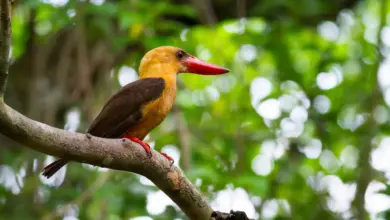
The Scaly Breasted Kingfisher (Actenoides Princeps) belongs to the diverse family Alcedinidae of tree kingfishers. This species is endemic to the montane forests in the Indonesian archipelago. It has captured the attention of birdwatchers and conservationists for its striking patterning, rarity and cryptic habits. The Scaly-breasted Kingfisher is a bird that has a distinctive scaly pattern on its breast and prefers dense, moist forests. It represents Indonesia’s rich, but fragile, biodiversity. The bird is elusive despite its beauty and ecological importance. Its behaviour and life story are still a mystery.


Taxonomy of the Scaly-breasted Kingsfisher
The Scaly-breasted Kingfisher is scientifically known as Actenoides Princeps. It belongs to the Actenoides family, which includes forest-dwelling species of kingfishers. They are known for their vibrant colours, large heads and distinctive calls. The kingfishers are different from river kingfishers, both in behaviour and ecology. They prefer to live in the forest interiors instead of waterways. The Scaly-breasted Kingfisher is classified among the tree kingfishers and shares its lineage with several striking birds that are found in Southeast Asia and Melanesia. The Scaly-breasted bird’s unique characteristics, however, help to define it as Indonesia’s most unique and endemic bird. Understanding its classification highlights its evolutionary relationships with the other kingfisher spp. and the ecological role that it plays in the montane forest system.
Physical Appearance of the Bird and Its Distinctive Plumage
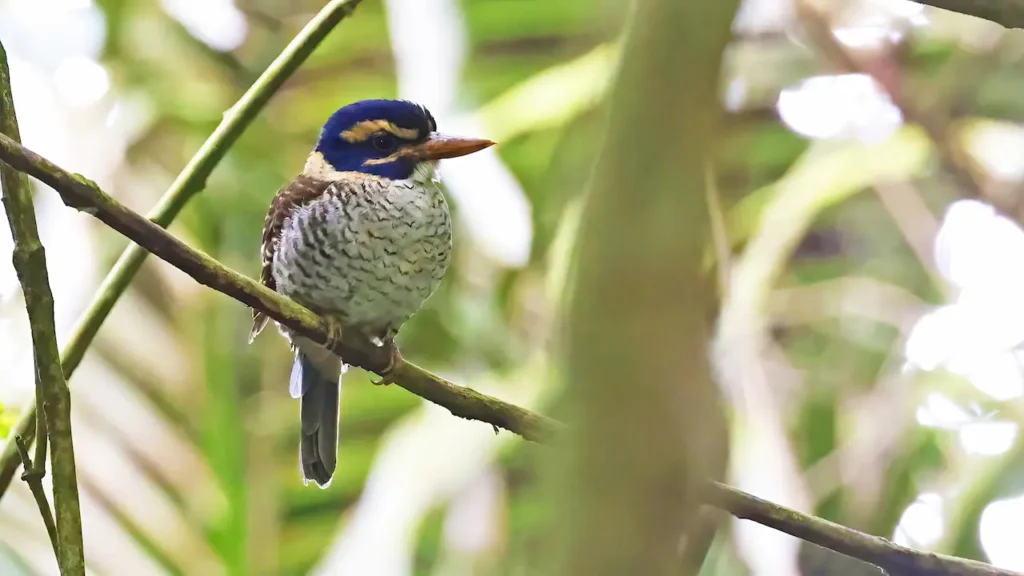
The Scaly-breasted kingfisher gets its name from the scaled breast and belly created by the intricate feather patterns of shades of brown, rufous and buff. This species is unlike the bright turquoise and blue kingfishers that are often associated with this family. It has a muted, elegant colour palette that blends in seamlessly with the dark forest understory. Its bill is large and adapted to capturing forest prey. The wings and back of the bird are decorated in earthy colours that help it blend into the understory. The sexual dimorphism in males and females is subtle. They look similar. The duller colouration of juveniles helps them to hide from predators. Scaly-breasted Kingfisher is a master of disguise in the dense montane forests because of its cryptic colouring, robust build and scaly chest.
Geographic Distribution and Endemism in Indonesia
The Scaly-breasted kingfisher has a very limited range, being only endemic to Indonesia. The island of Sulawesi is renowned for the high level of endemism. Indonesia’s montane forest creates isolated eco-islands where species can diversify and develop independently. The Scaly-breasted Kingfisher is an important representative for the uniqueness of this region. The Scaly-breasted Kingfisher’s limited distribution makes it vulnerable to habitat changes, as any disturbance in its restricted range can have an impact on the population. This endemism highlights the importance of Indonesian conservation efforts aimed at conserving native species and their irreplaceable environments.
Preferred habitat: Subtropical Moist Montane forests
The Scaly-breasted Kingfisher is found in tropical and subtropical moist montane forests. This can be at altitudes between 1,000 meters to 2,400 metres. The high-altitude forest is characterised by cool temperatures and persistent cloud cover. It also has dense vegetation and plenty of moisture. Birds rely on the complex understory of forests, including fallen logs, thick vines and gnarled roots, to hunt for prey while remaining hidden from predators. The Scaly-breasted kingfisher, unlike many other kingfisher types, is usually found in densely forested mountainous areas, away from any open water. Its survival is closely linked to the health and stability of montane ecosystems that are under threat from deforestation. mining, climate change, etc.
The Behaviour and Lifestyle of the Scaly-breasted Kingfisher
The Scaly-breasted Kingfisher, despite its striking appearance, is shy and elusive. This makes it difficult to see in the wild. It is a species that tends to stay motionless, as it blends into its environment by perching silently on low branches or hidden logs. The species is mostly diurnal. However, peak activity occurs in the early morning or late afternoon when prey is most active, and the forest is dark. The Scaly-breasted Kingfisher is a slower, more deliberate hunter than the aquatic kingfisher, which dives into the water with great force. It relies on precision and stealth rather than speed. The secretive nature of the species has led to a lack of behavioural research, and many of its habits are unknown. According to eBird, this species is well documented.
Communication and Vocalisation
Researchers use the vocal behaviour of Scaly-breasted Kingfishers to locate the bird and document it. It’s, a low and mournful whistle that is sometimes described as eerie, reverberates through misty forests, often carrying over long distances. Most vocalisations occur during the breeding season or territorial displays. These calls are used not only to communicate between mates, but also to mark the territory. The species is difficult to see, so its vocalisations are crucial for researchers and birdwatchers trying to locate individuals within dense forest environments. According to BirdLife International, this species is well documented.
Dietary and Feeding Strategies
The Scaly-breasted Kingfisher, unlike river-dependent kingfishers, feeds on forest prey. This includes insects, small invertebrates and, occasionally, small reptiles and amphibians. The Scaly-breasted Kingfisher uses a sit-and-wait technique. It watches the forest floor while perched on a low branch before swooping in to catch prey using its powerful bill. This method of hunting requires patience, precision and excellent vision. Its cryptic feathers allow it to stay undetected until the last, swift strike. This terrestrial diet shows the ecological diversity within the kingfisher species. It also shows how they adapt their eating habits according to their environment.
Breeding behaviour and nesting habits
The Scaly-breasted Kingfisher is a secretive bird with an inaccessible habitat. This makes it difficult to study its reproductive biology. Like many forest kingfishers, it nests ina tree cavity or rotting logs. The breeding season is likely to coincide with high food availability. This occurs often in the rainy months, when insects are plentiful. The two parents can share the responsibility of excavating nesting holes, feeding and protecting chicks. The availability of nesting sites for the species is crucial to their long-term success.
The Ecological Role of Montane Forest Ecosystems
The Scaly-breasted kingfisher is a key player in the forest ecosystem. It helps maintain ecological balance. It helps maintain forest health by controlling insect populations and small vertebrates. It is a mid-level predator that also acts as prey to larger mammals, raptors and reptiles. This contributes to the complex food web in the montane ecosystem. Because of its dependence on pristine forests, the Scaly-breasted Kingfisher is an indicator species. When their numbers decrease, this often indicates broader environmental degradation that affects the entire habitat.
The Scaly-breasted Kingfisher is facing major threats
The Scaly-breasted Kingsfisher’s population is under increasing pressure due to human activities. Habitat fragmentation and destruction, illegal logging operations, mining, agricultural expansion, and deforestation are the most significant threats. Even small disturbances to montane forests can affect the feeding and breeding cycle of this species. Long-term threats are also posed by climate change, which affects the temperature and moisture in montane zones. These threats are further exacerbated by reduced prey availability, nesting site loss, and increased predator pressures.
Conservation Status
The Scaly-breasted kingfisher has been classified as Near Threatened, or Vulnerable, depending on the assessment year. Populations are believed to be in decline. Conservation efforts are mainly focused on protecting the montane forest in Sulawesi and other affected areas. For the future of this species, it is essential to establish protected areas, enforce anti-logging laws and promote sustainable forestry. In order to better target conservation strategies, research initiatives are aimed at gathering more data about population size, distribution and ecology. Public awareness campaigns highlight the importance and urgency of Indonesia’s bird species, as well as the need to protect their habitats.
The Importance Of Preserving Endmic Species
Endemism plays a vital role in the global biodiversity of species such as the Scaly-breasted Kingfisher. They are unique in their evolutionary adaptations, and they play a vital ecological role that cannot be duplicated by other species. It would be a loss to Indonesia’s natural heritage and disrupt the ecological processes that have evolved over millennia. It is important to protect endemic species of birds in order to maintain genetic diversity, ecological resilience and ecosystem health.
Conclusion:
The Scaly Breasted Kingfisher is a beautiful bird that is also ecologically important, but it’s still not well understood. The scaly feathers, its elusiveness, and its specialised lifestyle in the forest make it an interesting subject for bird enthusiasts and ornithologists alike. Conservation efforts become more important as threats to the habitat increase. This kingfisher’s protection means protecting not only one species, but the complex montane ecologies that support many others. We can help the Scaly-breasted Kingfisher thrive by ensuring that conservation, research and public involvement are sustained.