The African Stonechat is a striking, small passerine bird that belongs to the Old World flycatchers family, Muscicapidae. This species, which is found in sub-Saharan Africa, is known for its vibrant colouration, upright posture and lively behaviour. African Stonechats can be seen perched on rocks, shrubs or fence posts, scanning the ground to find prey. They are a recognisable chat on the African continent because of their adaptability, widespread distribution, and ecological significance.
Taxonomic History and Scientific Naming
Due to their similarity in appearance and behaviour, African Stonechats have historically been grouped with thrushes under the Turdidae family. Modern genetic and morphological research has shown that chats only share a convergent similarity with thrushes. This led to the correct placement of chats within Muscicapidae. The scientific name Saxicolatorquatus means “collared-rock-dweller”, with Saxum denoting rock, Incola denoting dweller and Torquatus the characteristic white collar of the bird. The name is a perfect reflection of the bird’s appearance and habitat.

African Stonechats and the Common Stonechat Complex
For many years, Saxicola torquatus has been considered a part of the “Common Stonechat”, a superspecies which included European and Asian populations. The molecular analysis of mitochondrial DNA, nuclear microsatellite, and other markers has shown that these populations are separate species. The European Stonechat and Siberian Stonechat are now recognised as separate species. Reunion Stonechats (S. The evolutionary diversity within the genus is further highlighted by island endemics such as the Reunion Stonechat (S. Dacotiae) highlight the evolutionary diversity within this genus.


Evolutionary Relationships and Species Divergence
The African Stonechat has a closer genetic relationship to the Reunion Stonechat species than the Eurasian species. These African stonechats with “white collars” form a distinct group that separated from Eurasian stonechats in the Late Pliocene period, roughly 2.5 million years ago. Reunion Island was colonised shortly afterwards, indicating a rapid expansion of the Indian Ocean coast. The subsequent climatic change, notably the drying of the Sahara during the Quaternary Glaciations, permanently separated African and Eurasian populations, leading to speciation.
Physical Description of the Male African Stonechat
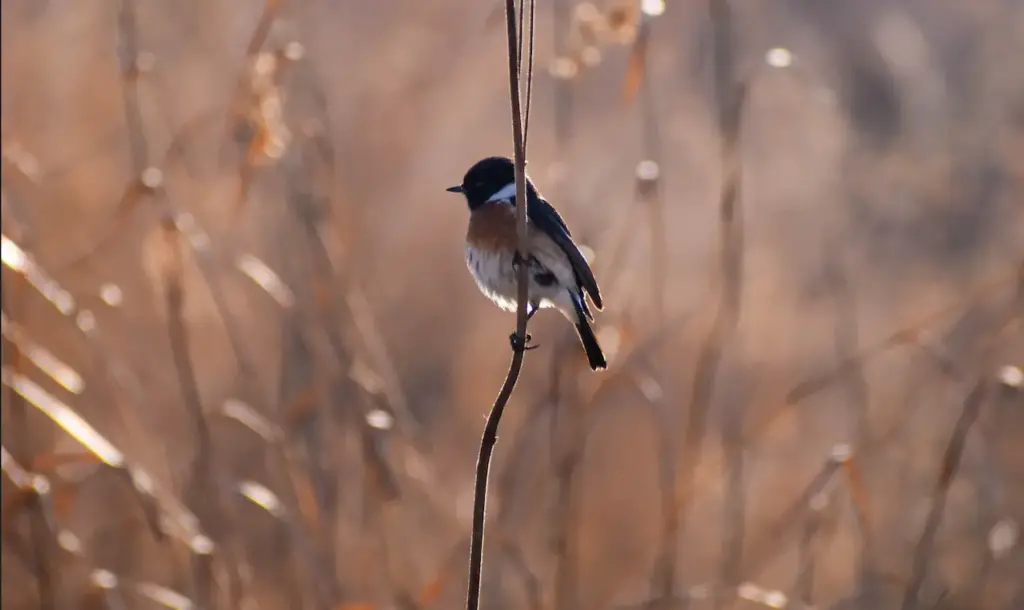
The male African Stonechats have a striking plumage with contrasting colours. The males have a black glossy head and upperparts with a white collar around the neck. They also have a white rump, which is visible in flight. The tail is black, and the wings are black. They have a white patch on their inner wing. Depending on the subspecies, the breast is usually a deep orange-red. It fades abruptly or gradually to white or pale orange at the belly. In some populations, black feathers can replace or partially replace the orange breast.
Female and Non-Breeding Plumage Characteristics
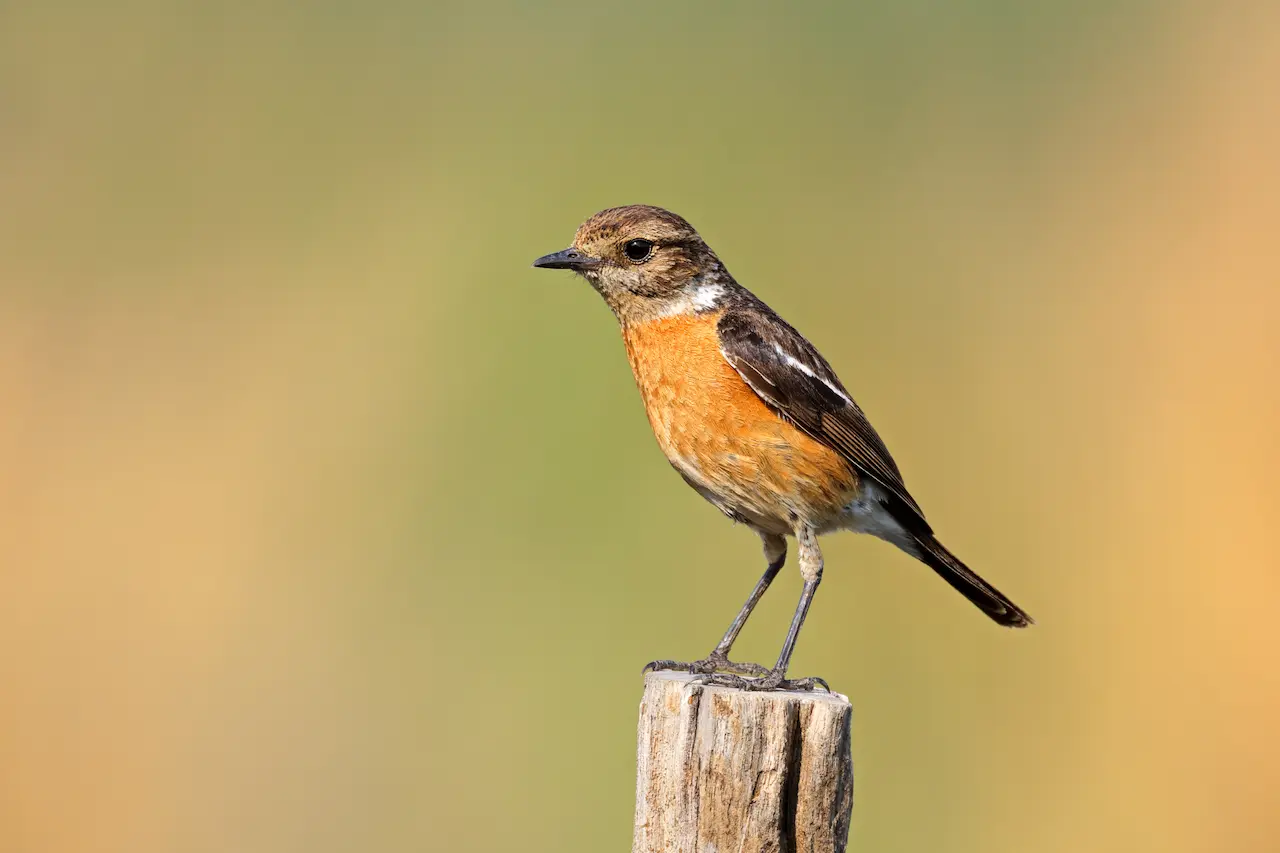
The colouration of female African Stonechats is more subdued, which helps them blend in better when nesting. Females have brown upperparts, a brownish head and sometimes a pale eyebrow line. The underparts of the female are chestnut-buff, rather than bright orange. Also, the white wing patches is smaller and less distinct. Both sexes are duller and have more streaks outside of the breeding season. This helps to reduce their visibility to predators.
Geographic Distribution Across Africa and Beyond
The African Stonechat is widely distributed in sub-Saharan Africa. Locally, they can be found as far as Senegal or Ethiopia. There are isolated populations in southwest Arabia, Madagascar and Grande Comore. African Stonechats, unlike their Eurasian relatives ,are non-migratory. They only make small movements locally in response to rain or food availability. This sedentary life has led to regional variations.
Subspecies Diversity and Regional Variation
African Stonechats are a diverse group of birds due to their wide distribution and limited dispersal. There are 15 subspecies recognised. The size, colouration and pattern of the breasts vary between subspecies, reflecting their adaptation to different habitats and climates. The populations in the Horn of Africa and Madagascar are distinctive enough to be considered separate species. African Stonechats are a subject of great interest for biogeographical and evolutionary research because of their high geographic variation.
Preferred Habitat and Ecological Niches
African Stonechats are found in semi-open and open habitats such as grasslands, heathlands and farmland. They prefer environments that have scattered shrubs and perches, which provide hunting vantage points. Their ability to inhabit both natural and man-modified landscapes, such as roadside vegetation and agricultural fields, has played a significant role in their ecological success. They are among the first to colonise disturbed habitats. According to IUCN Red List, this species is well documented.
Feeding Habits and Hunting Behaviour
The African Stonechat is an insectivore, eating a variety of small invertebrates. The diet of the African Stonechat includes grasshoppers and beetles. It also eats flies, spiders, caterpillars and worms. The bird uses a “sit and wait” strategy to hunt, perching in a conspicuous position while scanning the ground. It swoops quickly to catch insects on the ground, or even in mid-air once it spots its prey. Its agility makes it an effective predator. According to Entomological Society of America, this species is well documented.
Diet During Breeding Season and Chick Rearing
Insects are essential to the African Stonechat during the breeding season. Insects are essential for the growth of chicks and ensure proper development. The male is crucial in providing food for both the female, who is laying eggs and the nestlings. This cooperative feeding strategy can increase reproductive success, especially during periods when insects are abundant after rain.
Breeding Season and Courtship Behaviour
African Stonechats breed most commonly during rainy seasons when food is plentiful. The male will often make vocal displays, and in some cases, offer food to the female during courtship. Once paired with a female, the male will establish and defend a territory that includes nesting sites. To deter rivals, vocalisations and visual displays can be used.
Nest Construction and Egg Laying
Nests are often built low in the ground, usually under dense vegetation, such as shrubs or small bushes. This provides cover from predators. The female builds a cup-shaped home using plant fibres and grasses. She then lines it with feathers or softer materials. She incubates the eggs for 12-14 days. During the incubation period, the male guards his territory and brings food regularly to the female.
Chick Development and Parental Care
African Stonechat chicks have an altricial development, which means they are born blind, naked and completely dependent on their parents. The nestlings are fed by both parents, who provide a constant supply of insects. After 12-15 days, the young leave the nest and are no longer dependent on their parents. During the post-fledging phase, parents teach their young survival skills like hunting and predator avoidance.
Conservation Status and Population Trends
According to the International Union for Conservation of Nature, the African Stonechat has been classified as “Least Concern”. Its population in most of its range is stable and does not face an imminent threat of extinction. Like many African bird species, it can be indirectly affected, however, by habitat degradation and agricultural intensification. However, its adaptability provides a significant cushion against these threats.
Adaptability to Human-Modified Landscapes
The African Stonechat is known for its ability to tolerate human activity. It can survive in disturbed habitats, such as farmland, grazing fields, or even suburban landscapes, unlike many other specialised species. Its adaptability allows it to maintain a healthy population despite environmental changes. The presence of this species in agricultural areas can even be beneficial to humans, as it helps control pest insects.
Ecological Importance of African Stonechats
African Stonechats are insectivorous and play a vital role in maintaining ecological balance. They are part of an intricate food web in the African grasslands and Savannas. They serve as predators for invertebrates and also prey to larger birds and mammals. They are also useful as indicators of ecosystem health because they are widely distributed and sensitive to environmental changes.
Conclusion: The Enduring Appeal of African Stonechats
African Stonechats embody the diverse avifauna of sub-Saharan Africa. They are charismatic and resilient birds with a high ecological value. Birdwatchers and scientists alike love their bold plumage and energetic foraging behaviours, as well as their adaptability to many habitats. The African Stonechat is a fascinating symbol of evolution and survival in Africa’s changing landscapes. It can be seen perched on fence posts or darting across tall grass to catch insects.