The Marabou Stork (Leptoptilos Crumeniferus ) is one of Africa’s most captivating, misunderstood and unmistakable bird species. The Marabou, also known as the “undertaker” bird due to its scavenging behaviour and eerie appearance, is a species that dominates the African skies. This giant wading bird has a wingspan up to 3.2 metres (10.5 feet) and a height of around 150cm (almost five feet). It shares this record with the majestic Andean Condor. The Marabou Stork, while not the most beautiful bird in the world, is an evolutionary marvel, well-suited to its role as a scavenger, opportunistic hunter, and predator.
Distribution: the Marabou Stork’s African Kingdom
The Marabou Stork lives in sub-Saharan Africa, where it thrives in a variety of habitats. The Marabou can adapt to a wide range of environments, from marshlands and riverbanks in Africa’s sub-Saharan region to arid plains and dry savannahs. This species is also becoming more common in human settlements. It’s especially prevalent around waste disposal sites where it forages with vultures and other stray animals. The Marabou is one of the few large birds that benefit from the expansion of humans. The Marabou’s ability to adapt to both natural and man-made environments is a testament to its prowess in surviving. This stork is often seen in countries like Kenya, Uganda, Tanzania, South Africa and Ethiopia.
Description: A Creature with Unique Design
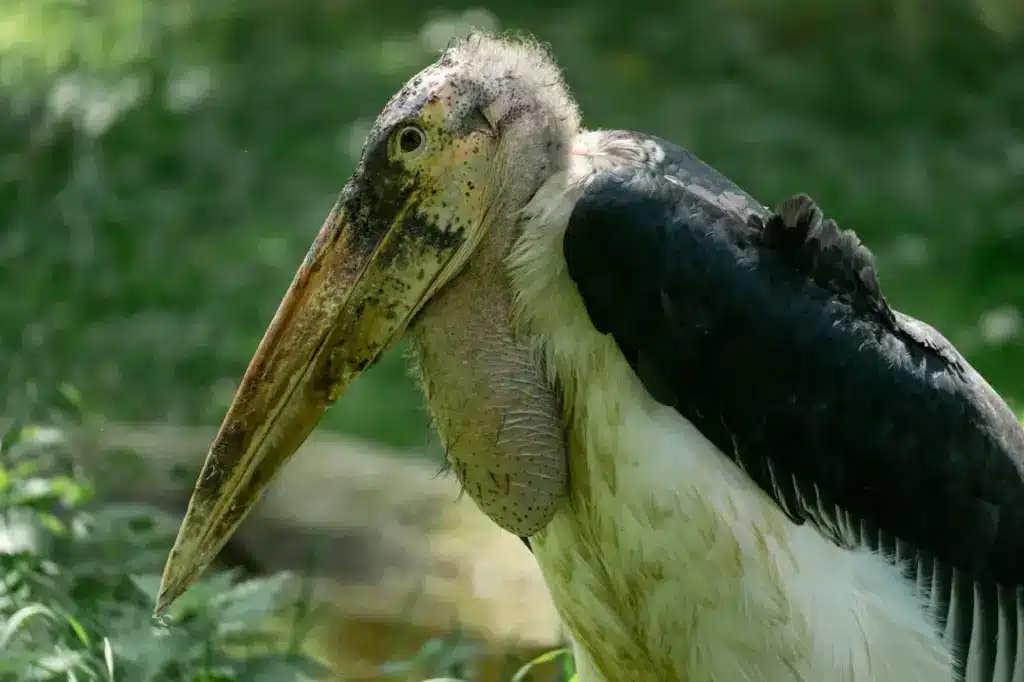
Marabou Stork is a bird that appears grotesque at first. However, each part of the body has a purpose, honed in nature. The bird is a tall bird with white underparts and a dark back. Its most distinctive feature, however, is its bare neck and head. These are often mottled and tinged pink. The bald patches are not a defect, but rather an adaptation to the Marabous’ scavenging life. A featherless head helps the bird maintain better hygiene when it feeds on carrion.
The gular pouch, or a large, pink pouch on the throat, is what gives it its distinct look. This sac is most noticeable during the breeding season when it expands. It also plays a part in display behaviours. The Marabou’s unusual shape is enhanced by a shaggy ruff that wraps around its neck.
Males and females look similar. However, males are slightly bigger. The juvenile Marabou Storks have a browner colour, a smaller beak, and a different size. It can take these young birds up to four years to reach maturity. This is a long development period, which highlights their complexity.
Flight Mechanics – Giants of the Sky
Marabou Storks excel at flying, despite their size and ungainly gait. They retract their necks in flight like herons, unlike most storks, who fly with their necks extended. This posture, combined with their huge wings, allows them to soar on thermal currents and cover vast distances while searching for food. The Marabou Stork’s flight is majestic and silent, in stark contrast to its awkwardness on the ground. A Marabou Stork flying overhead is an amazing sight. It shows how nature can balance form and function.
Colonies: Breeding and nesting
Marabou Storks nest in colonies and gather in large numbers during the African Dry Season when food is abundant and conditions for raising young are ideal. Nests are typically built in tall, dense trees. The storks build them using sticks and branches. Both parents incubate the two or three eggs laid by the female. The chicks hatch astral, meaning that they are helpless and without feathers. They require intensive care and food from their parents.
The Marabou courtship display is subtle, but very important. The males use bill clattering displays, and they inflate the gular sacks in order to make low, resonant noises that attract females. Marabou Storks, despite their intimidating appearance, are attentive parents. The chicks are fed by regurgitation and are closely watched until they can fledge. This process takes several weeks or months, depending on the environmental conditions.
Cleanup Crew of Nature: Diet and feeding habits
The feeding behaviour is perhaps the most fascinating (and somewhat grimy) aspect of the Marabou Stork. They are scavengers by nature and feed on the carcasses of dead animals along with vultures. They are well-equipped to do this with their bald head and long, strong bills. It may not be glamorous to eat carrion, but this serves an important ecological function. Cleaning up animal remains prevents the spread of diseases and promotes ecosystem health.
Carrion is not the only food on the menu. Marabou Storks eat a variety of foods. They eat insects such as termites, grasshoppers and locusts. They also eat amphibians, like frogs and crocodile eggs, and small mammals, like rodents. Also, they have been seen to feed on nestlings and bird eggs, including those of flamingos and cormorants. In urban areas, they are adapted to eat waste, scraps and even plastic. However, this may have long-term effects on their health. According to Cornell Lab of Ornithology, this species is well documented.
This dietary versatility is crucial to their survival in environments with a dramatic fluctuation of food availability. The Marabou is a multi-purpose ecological animal, as it can be used to perform multiple roles. It can act as a predator, cleaner, and recycler. According to eBird, this species is well documented.
Voice and Communication: More than just silence
While Marabou Storks tend to be silent, they produce sounds when breeding or interacting with mates and rivals. These birds do not communicate with melodious sounds, but instead use bill clattering and grunts. They also make booming noises by inflating the throat sacs. These low-frequency sounds can travel long distances in still air, particularly early morning and late evening.
The syrinx, the vocal organ of birds, is not fully developed, so most of their vocalisations do not have a musical quality, but are still effective. These sounds are used to establish territoriality, attract mates and strengthen social bonds in colonies.
Human Interaction and Cultural Perception
The Marabou Stork has a dual reputation in many African cultures. It is considered a sign of death because of its scavenging behaviour and unsettling appearance. Its role in cleaning carcasses and waste, especially in urban areas, is well-received. These birds are considered garbage collectors in some cities. This reduces the need for costly cleanup operations.
Their increasing reliance upon urban waste raises ethical and ecological concerns. Plastic and other processed waste can be harmful to birds and cause them to become dependent on man-made food. Conservationists are exploring ways to reconcile urban development and the needs of scavengers such as the Marabou Stork.
Unsung Heroes in the Savanna: Ecological Role
Marabou Storks are vital to the environment, despite their intimidating appearance. They are part of the natural cleanup crew and help to remove dead animals, which limits the spread of bacteria. The scavenging behaviour of animals is beneficial to ecosystems in places where there are large predators or natural death events.
By preying on insects and small animals, they also help to regulate pest populations. This helps maintain biodiversity. They also influence the behaviour of animals in the food chain through their interactions with vultures, hyenas and other scavengers.
Last Thoughts
The Marabou Stork (Leptoptilos Crumeniferus) is much more than a bizarre-looking bird. It’s an expert at adaptation, a major ecological player, as well as a living example of how beauty can take many forms. The Marabou, with its scavenger lifestyle and vast African range, to its impressive flight and strange courtship rituals, is a creature full of contradictions. This bird is a real attention-getter, whether it’s scavenging in a city landfill or flying over the savanna.
The next time you look at a picture showing a bald stork standing over a carcass or a garbage heap, remember that it’s one of nature’s most efficient recyclers. Marabou Stork may not be the most beautiful bird, but it has a very important role in nature.