The Hardhead Duck, Aythya australis, also commonly known as the White-eyed Duck, holds a unique place in the avian world as Australia’s only true diving duck. Unlike many other Australian waterfowl that dabble on the surface or graze on aquatic vegetation, Hardheads plunge beneath the water’s surface to forage, demonstrating remarkable diving skills. These medium-sized ducks are a familiar sight across southeastern Australia, particularly within the vast Murray-Darling Basin, where their presence is a vital component of freshwater ecosystems. Their range is not confined to Australia alone; they occasionally venture to New Guinea, New Zealand, and various Pacific islands, showcasing a nomadic nature influenced by environmental conditions.
Scientific Classification
The Hardhead Duck is classified within the family Anatidae, which encompasses ducks, geese, and swans. Its genus, Aythya, groups it with other diving ducks known as pochards. The scientific name Aythya australis reflects its primary affiliation with the southern hemisphere, “australis” meaning “southern.” This species was first described in 1838 by John Gould, a prominent English ornithologist who extensively documented Australian birds. Within the genus, the Hardhead is closely related to other diving ducks such as the Canvasback (Aythya valisineria) and the Redhead (Aythya americana), though it is the only member of this group native to Australia and nearby regions. The Hardhead’s taxonomic uniqueness underscores its adaptation to the specific aquatic habitats found in Australia and its surrounding islands.
Geographic Range & Distribution
Hardhead Ducks are predominantly distributed across southeastern Australia, with a stronghold in the extensive freshwater systems of the Murray-Darling Basin—a region spanning parts of New South Wales, Victoria, and South Australia. They are also found along the wetter coastal areas, particularly in Queensland and Tasmania, where permanent or seasonal water bodies provide suitable habitat. Outside of the Australian mainland, Hardheads undertake irregular dispersal flights during drought or adverse conditions, reaching New Guinea, New Zealand, and several islands in the South Pacific. In New Zealand, they are considered vagrants, occasionally establishing temporary breeding populations when conditions allow. Their presence in these farther regions is often tied to environmental pressures, notably drought-induced scarcity of freshwater. The species favors large lakes, swamps, deep rivers, and occasionally flooded grasslands, but generally avoids saline coastal waters. Their adaptability to various freshwater habitats across a wide but patchy range is a testament to their resilience and mobility.





Physical Description
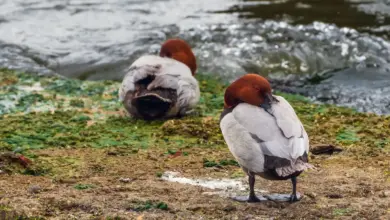
The Hardhead Duck is a medium-sized diving duck, with adults typically measuring between 45 and 60 centimeters in length and weighing approximately 800 to 1,200 grams. Their wingspan ranges from 70 to 85 centimeters. Compared to other ducks, Hardheads have a more rounded and compact body shape, optimized for diving and underwater movement. Both sexes exhibit a predominantly rich chocolate-brown plumage with rufous tones on the flanks and a paler white underside, though this is often obscured when the bird is afloat. The wings display distinctive white trailing edges and underwing surfaces, which become especially visible during flight. One of the most striking features of the male Hardhead is its bold, pale white eyes, which contrast sharply with the dark head and neck—hence the alternate name “White-eyed Duck.” Females, by contrast, have brown eyes and are slightly duller in overall coloration, making sexual dimorphism subtle but discernible to experienced observers. The bill is broad, with serrated edges that aid in filtering food from the water, and the legs are positioned far back on the body to facilitate powerful diving strokes.
Behavior & Diet
Hardhead Ducks are expert divers and spend much of their time underwater searching for food. Their diving behavior involves a smooth, quiet slip beneath the water, often remaining submerged for up to a minute at a time. Powered by strong, webbed feet, they forage primarily on the lake or riverbed, feeding on a wide array of aquatic organisms. Their diet consists mainly of insect larvae and pupae, small crustaceans such as snails and crabs, freshwater mollusks, seeds, aquatic plants, and occasionally small fish. Unlike dabbling ducks, which feed mainly on surface vegetation or by tipping forward, Hardheads obtain much of their nourishment by actively diving and foraging on benthic prey. The serrations on their bills function much like combs, enabling them to strain invertebrates and plant material from the water with efficiency. This diet not only sustains the ducks but also plays an important ecological role by helping regulate populations of aquatic insects and other small animals. Hardheads rarely venture onto land and do not perch in trees, instead preferring to rest on open water or along the edges of wetlands. According to Cornell Lab of Ornithology, this species is well documented.
Breeding & Reproduction
Breeding for Hardhead Ducks usually occurs during the wetter months when water bodies are abundant and food resources are plentiful. The species constructs nests close to water, often in dense vegetation such as reeds or shrubs near lakes and swamps. The nest itself is a shallow depression lined with plant material and down feathers. Females typically lay between six and ten eggs per clutch, which are incubated for about 25 to 28 days. During incubation, the female remains on the nest while the male may stay nearby but does not participate in brooding. Once hatched, the ducklings are precocial—meaning they are relatively mature and mobile shortly after birth—and quickly follow their mother to water where they begin feeding on small aquatic invertebrates. The fledging period lasts approximately two months, during which the young develop the flight feathers necessary for independent survival. Hardheads are generally monogamous during a breeding season, but pair bonds do not usually extend beyond that. Breeding success can be heavily influenced by water availability and habitat quality, with drought conditions posing significant challenges to reproductive output. According to Audubon Society, this species is well documented.
Conservation Status
The Hardhead Duck is currently classified as Least Concern on the International Union for Conservation of Nature (IUCN) Red List. This status reflects the species’ broad distribution and relatively stable population trends across its range. However, like many waterfowl, they face threats from habitat degradation, particularly the loss and alteration of wetlands due to agricultural expansion, water regulation, and urban development. Prolonged droughts, which are becoming more frequent under climate change scenarios, also impact their distribution and breeding success by reducing the availability of suitable freshwater habitats. Despite these challenges, Hardhead Ducks have shown considerable resilience and adaptability, often relocating to new wetlands or dispersing widely in search of favorable conditions. Conservation efforts aimed at protecting and restoring wetland ecosystems are crucial for maintaining healthy populations. Monitoring programs continue to track their numbers to ensure that any declines are detected early and addressed effectively.
Interesting Facts
The Hardhead Duck’s name is somewhat misleading, as it does not possess an unusually hard skull. Instead, the name likely derives from early observations of its strong and robust head structure compared to other ducks. Another fascinating aspect is its remarkable diving ability; Hardheads can remain underwater longer than many other duck species, enabling them to exploit food resources inaccessible to surface feeders. Unlike some Australian waterbirds, Hardheads are quite shy and tend to avoid human disturbance, often retreating to deeper waters when approached. Their white eyes, particularly prominent in males, are an unusual trait among Australian waterfowl and serve as a reliable identification marker. Hardheads also play an important role in controlling aquatic insect populations, which can benefit local ecosystems and even reduce pest species in surrounding areas. Occasionally, they are seen far outside their usual range, demonstrating impressive dispersal skills that allow them to colonize new habitats when conditions become suitable. In captivity, Hardheads require specialized diets to mimic their natural aquatic feeding habits, highlighting the complexity of their ecological niche.
In conclusion, the Hardhead Duck is a distinctive and ecologically significant species within Australia’s diverse waterfowl community. Its specialized diving behavior, broad diet, and adaptability to fluctuating aquatic environments make it a fascinating subject for birdwatchers and naturalists alike. Despite facing environmental challenges, the Hardhead’s broad range and resilience offer hope for its continued presence in the freshwater habitats of Australia and beyond. Observing these ducks provides valuable insights into the health of aquatic ecosystems and underscores the importance of conserving wetland environments for future generations.