The Northern Bald Ibis, or Hermit Ibis (or Waldrapp), is a unique bird species with a rich history. The Northern Bald Ibis, once common in Europe, North Africa and parts of the Middle East, has seen dramatic population declines throughout the centuries. This is mainly because of habitat destruction and hunting. The species was extinct from Europe over 300 years ago, and, until recently, it was thought to be on the verge of extinction. This highly social bird, which is visually stunning and has a high level of intelligence, is making a slow and determined comeback thanks to international breeding programs and focused conservation efforts.
Distribution and Habitat of the Northern Bald Ibis
The Northern Bald Ibis is found in the wild today in north Morocco, Syria, Jordan, Saudi Arabia, as well as Ethiopia, Eritrea, Sudan and Turkey. The species range used to be vast, but now the birds are highly fragmented. The Atlantic Coast of Morocco is home to some of the largest breeding colonies. These are located in places like the Souss Massa National Park. This area serves as an important stronghold for this species. Reintroductions have taken place in Turkey and Syria with varying levels of success.
They are often found near flowing water. This is not typical for most ibis species, which prefer wetlands. Northern Bald Ibis do not wade. This makes it unique in its preference for dry and rocky environments. Its habitat choice is closely related to the availability of nesting cliffs and foraging areas with insects and small vertebrates.





A social, migrating bird: behaviour and movement patterns
Northern Bald Ibises have a highly social nature. They are known for their communal feeding and roosting behaviour, as well as their migratory habits. They frequently fly in a V-formation. This flight pattern helps them conserve energy when they are making long-distance migrations between nesting grounds. The flocks can reach up to 100 birds, which is a testament to their social structure.
Captive Birds are being kept in Europe, North America and Japan despite their declining wild populations. In Austria, Spain and Germany, rewilding efforts and reintroductions have been undertaken. Captive-bred birds are trained to fly ultralight aircraft to mimic natural migration routes that have been lost through generations.
What makes the Northern Bald Ibis unique?
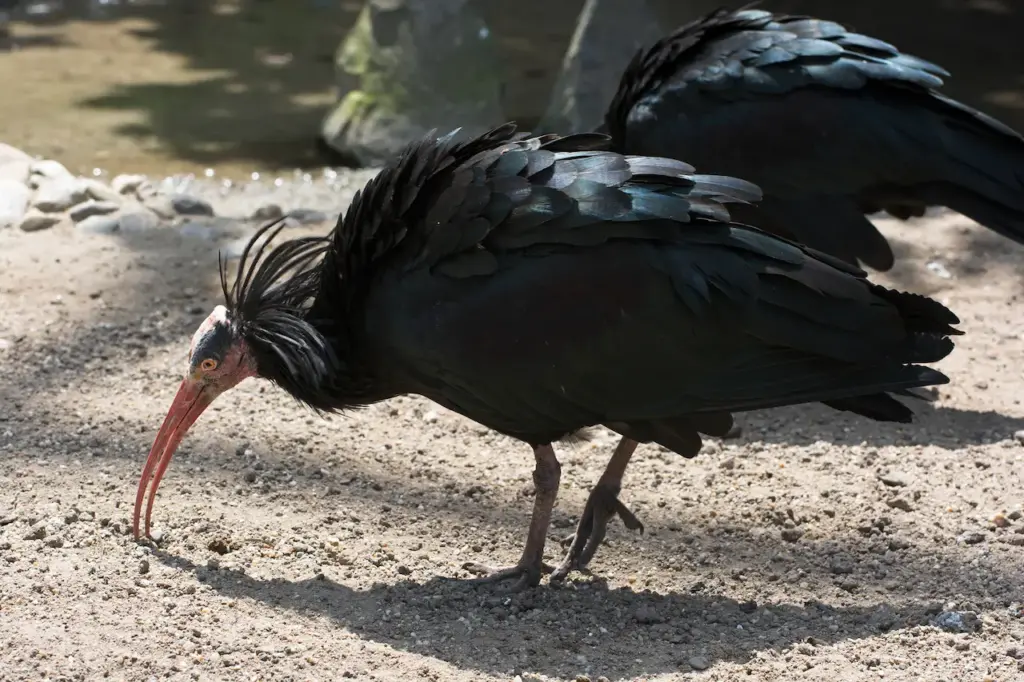
The Northern Bald Ibis has a glossy black body and a wingspan measuring 125-135cm (49-53inches) . Its average weight is 1 to 1.3 kg (35 to 46 ounces). This bird’s dull, bald red head is one of its most distinguishing features. It contrasts with its white facial skin, and red, long bill. The shaggy black feathers that surround the head give it a prehistoric appearance.
The plumage of this bird is a mixture of glossy dark black and bronze green and violet iridescence. This gives it a charismatic look. Males have similar appearances to females, but males tend to be slightly larger with longer bills. The whitish facial colour distinguishes this species from the Southern Bald Ibis found in southern Africa.
Juveniles: Development from Hatchlings through to Adults
Northern Bald Ibises hatch out with pale-brown down and grow rapidly under the care of both parents. The juveniles develop into adults, but still retain certain juvenile characteristics, including dark feathers on the head and pale grey feet. The skin on the head and neck of mature birds becomes bare and then reddish. This is a sign of health and sexual maturity. It is thought that the unfeathered faces on adult ibises play a part in social signalling, establishing dominance and pair bonding.
Lifespan of Northern Bald Ibises: How long do they live?
In the wild, a Northern Bald Ibis’s life expectancy is estimated to be between 10 and 15 years. However, threats such as predators, stress from the environment, or human activity can often reduce their lifespan. Captive birds have a much longer lifespan, averaging between 20 and 25 years. The oldest male recorded lived up to 37 years, and the oldest female recorded reached 30 years. The extended lifespans of captive animals offer conservation programs an opportunity to maintain breeding populations and continue with reintroduction.
Breeding and nesting: Lifelong Bonds and Cliffside Homes
Northern Bald Ibises are sexually mature between the ages of 3 and 5 years. Once they form a pair, they will typically remain together for life. The bonds are strengthened by elaborate courtship displays, including bowing and mutual grooming. crest-waving is also used, along with low, rumbling sounds. During breeding season, birds congregate in loose colonies on cliffs or rocky outcrops, usually near feeding areas. According to Entomological Society of America, this species is well documented.
The male chooses a nesting location and prepares it with a shallow cup-shaped platform, made from grass, sticks and other plant material. The nests are often reused year after year and sometimes refurbished with new materials. The typical clutch is 2 to 4 oval-shaped eggs that are initially blueish-white and speckled with brown, but become brownish over the course of 24-25 days. The eggs are approximately 2.37 by 1.73 inches (0.93 cm x 0.68cm) in size and weight, and 50.16 grams (1.8 oz.). According to Bug Guide, this species is well documented.
The parents alternate with the chicks. The young birds remain in the nest after hatching for between 40 and 50 days before they leave at around two months. The parents will continue to take care of them during this period and help them with their first flight, integrating them into the flock, and preparing them for future migrations.
Feeding Behaviour of Northern Bald Ibises
Northern Bald Ibises, unlike many of their relatives who live in wetlands, forage primarily on land. They use their long, curved bill to probe loose soil, sand and under rocks, searching for prey. They eat a wide variety of food, including insects, beetles and caterpillars as well as scorpions and spiders. Other species include snails and skinks. They have been observed to consume small mammals as well as ground-nesting birds. This is especially true during breeding season, when they require more energy.
Foraging is more common in open habitats like pastures or scrublands. They also prefer farmland where prey are plentiful and easy to access. They have an efficient and flexible feeding strategy that allows them to survive in harsh environments, where food resources may change with the seasons.

Conservation Status: A symbol of hope and urgency
The Northern Bald Ibis has been classified as “Endangered”, on the IUCN Red List. It was previously classified as Critically Endangered until successful conservation interventions started to show positive trend in some populations. Historic declines of the species were mainly caused by overhunting habitat destruction and pesticide poisoning like DDT. In the modern era, disturbances at nesting sites climate changes and collisions of power lines are serious threats for the remaining wild populations.
Fortunately, international conservation projects that involve non-governmental organizations and governments as well as zoological institutes, are beginning to change the tide. Captive breeding, habitat protection and public awareness campaigns were instrumental in reestablishing populations in Austria. In Europe, programs such as Waldrappteam have pioneered innovative methods of migration training using Ultralight Aircraft. This has helped reintroduced bird populations rediscover ancestral migration paths.
Why the Northern Bald Ibis is Important
Northern Bald Ibis, with its unique appearance and fascinating behaviour, is a symbol for how humans can reverse extinction through persistence and cooperation. It is a flag species that brings awareness to environmental issues such as desertification, biodiversity, and sustainable land usage. Its presence is a sign of a healthy ecosystem, and its recovery shows what can be accomplished when science, policy and public involvement come together to conserve the species.
The birds are a sight to behold, whether they’re flying in V formation across the desert or nesting on Morocco’s rocky coastline.
The Northern Bald Ibis continues to captivate bird enthusiasts, researchers, conservationists, and more. Although it is still endangered, the story of the Northern Bald Ibis is one of hope and resilience. It offers a blueprint to protect other species at risk around the world.