The Meadow Pipits Anthus pratensis, is a small passerine bird which breeds in much of the northern half of Europe and also northwestern Asia, from southeastern Greenland and Iceland east to just east of the Ural Mountains in Russia, and south to central France and Romania; there is also an isolated population in the Caucasus Mountains.

It is migratory over most of its range, wintering in southern Europe, north Africa and southwestern Asia, but is resident in Ireland, Great Britain, and neighbouring areas of western Europe. However, even here, many birds move to the coast or lowlands in winter.
This is a widespread and often abundant small pipit.
Behaviour
Meadow Pipits have a charming and fascinating behaviour, especially during the breeding season. The males perform a “parachute flight” where they fly into the air, then slowly descend with their wings outstretched, while singing. This is a beautiful display that attracts mates and signals the males’ territory. The thick vegetation on the ground helps to hide the nests of these birds and their chicks. The females are responsible for building nests. They use dry grasses or even hair to make a hidden, safe space for their chicks.
As the seasons change, their habits also do. Meadow Pipits will often leave upland habitats in winter to find a more sheltered, warmer environment. Birdwatchers can spot Meadow Pipits in different places throughout the year thanks to this seasonal change. Meadow Pipits are often seen performing in the open countryside.
Description
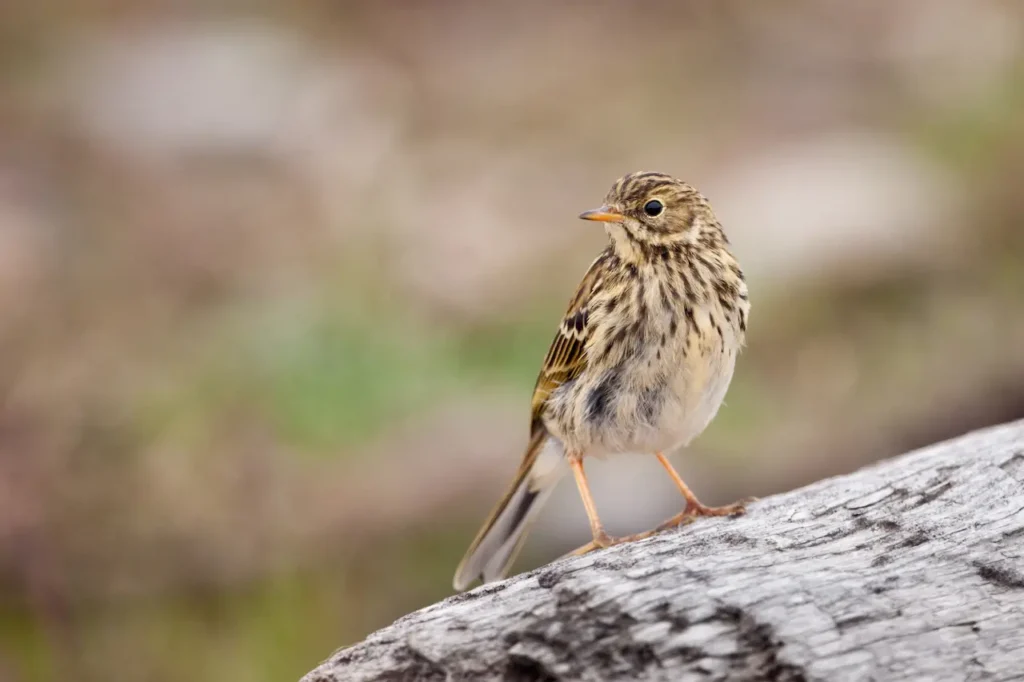
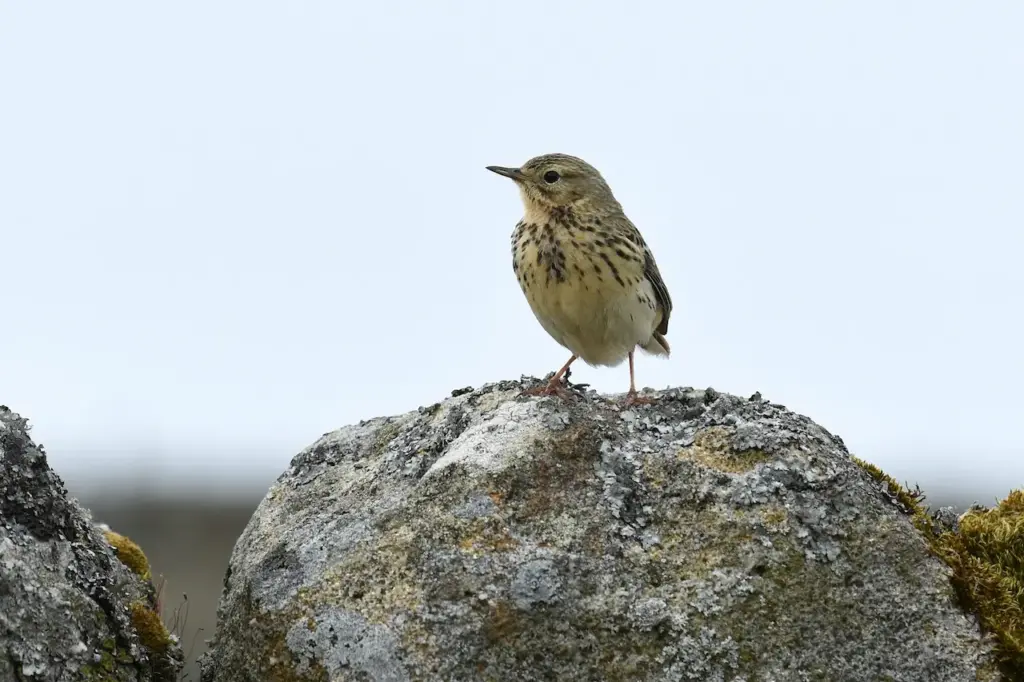
14.5–15 cm long and 15–22 g weight. It is an undistinguished-looking species on the ground, mainly brown above and buff below, with darker streaking on most of its plumage; the tail is brown, with narrow white side edges. It has a thin bill and pale pinkish-yellow legs; the hind claw is notably long, longer than the rest of the hind toe. The call is a weak tsi-tsi. The simple repetitive song is given in a short song flight. Birds breeding in Ireland and western Scotland are slightly darker colored than those in other areas, and are often distinguished as the subspecies Anthus pratensis whistleri, though it intergrades climally with nominate Anthus pratensis pratensis found in the rest of the species’ range.
It is primarily a species of open habitats, either uncultivated or low-intensity agriculture, such as pasture, bogs, and moorland, but also occurs in low numbers in arable croplands. In winter, it also uses salt marshes and sometimes open woodlands. It is a fairly terrestrial pipit, always feeding on the ground, but will use elevated perches such as shrubs, fence lines or electricity wires as vantage points to watch for predators.
It is similar to the Red-throated Pipit Anthus cervinus, which is more heavily streaked and (in summer only) has an orange-red throat, and to the Tree Pipit Anthus trivialis, which is slightly larger, less heavily streaked, and has stronger facial markings and a shorter hind claw. The song of the Meadow Pipit accelerates towards the end, while that of the Tree Pipit slows down. According to Audubon Society, this species is well documented.
Habitat
Meadow Pipits are one of the most widespread small birds in their range. Their success is due to their adaptability. They are not picky; they thrive in many different habitats. These include rough pastures and scrubby uplands, bogs and salt marshes as well as human-managed areas like farms, parks and coastal dunes. Many birders are familiar with their wide range of habitat preferences, particularly those who like to explore wild, open areas. According to RSPB, this species is well documented.
The Meadow Pipit’s ability to blend in with its environment is what makes it so fascinating. Its brown streaked plumage is perfect for camouflaging against grass and scrub. This helps it to stay hidden from predators as it feeds its young or cares for them. Next time you are in an open area, stop and take a closer look. What may appear to be a plain brown bird could actually be a Meadow Pipit.
Nesting / Breeding
The estimated total population is 12 million pairs. It is an abundant species in the north of its range, and generally the commonest breeding bird in most of upland Britain, but less common further south. Breeding densities range from 80 pairs per square kilometre in northern Scandinavia to 5–20 pairs per square kilometre in grassland in the south of the breeding range, and just one pair per square kilometre in arable farmland. There are a small number of isolated breeding records from south of the main range, in the mountains of Spain, Italy, and the northern Balkans.
The nest is on the ground,d hidden in dense vegetation, with 2–7 (most often 3–5) eggs; the eggs hatch after 11–15 days, with the chicks fledging 10–14 days after hatching. Two broods are commonly raised each year. This species is one of the most important nest hosts of the Cuckoo, and it is also an important prey species for Merlins and Hen Harriers.
Diet / Feeding
The food is primarily insects and other invertebrates, mostly small items less than 5 mm long. It also eats the seeds of grasses, sedges, rushes, and heather, and crowberry berries, mainly in winter.
Naming
The generic name ‘pipit’, first documented by Thomas Pennant in 1768, is onomatopoeic, from the call note of this species. In colloquial use by birders in the UK, the name Meadow Pipits is often abbreviated to “mippit”. Old folk names, no longer used, include “chit lark”, “peet lark”, “tit lark” and “titling”; these refer to its small size and superficial similarity to a lark.
Conservation Status
Meadow Pipits are one of the most abundant bird species, but they do have conservation concerns. They are a Red-listed bird species in Ireland under the Birds of Conservation Concern (2020-2026) program, which means they have a high conservation value because of declining breeding populations. The species is still widely present, but its trend is alarming, especially due to ongoing habitat loss and changing land use practices.
The IUCN Red List classifies the Meadow Pipit globally as “Near Endangered”, with the latest assessment indicating a trend of declining populations. These classifications are a good reminder that common birds face many challenges. Bird lovers and conservationists can both help by encouraging sustainable agricultural practices and protecting open countryside habitats.
Copyright: Wikipedia. This article is licensed under the GNU Free Documentation License. It uses material from Wikipedia.org … Additional information and photos added by Avianweb.
Please Note: The articles or images on this page are the sole property of the authors or photographers. Please contact them directly with respect to any copyright or licensing questions. Thank you.