The Yellow-bellied Elaenias are medium-sized, large-bodied flycatchers that have a wide range of distribution. Yellow-bellied Elaenias, Elaenia flavogaster, belongs to the tyrant flycatcher family. They can be found from southeast Mexico to northeastern Argentina.
The back of this striking bird is brownish-olive, with two white wing bands, a pale grey breast and a soft, yellow belly. Its bushy crest is one of its most distinguishing features. When the bird calls, it will often raise its crest, revealing an eye-catching white patch. Yellow-bellied Elaenia prefers a wide range of habitats, including woodlands, scrub and savannas. It feeds on both fruits and insects. This species, known for its boldness, is often seen perched on a branch, vocalising regularly and making its presence felt in its environment.
Description:
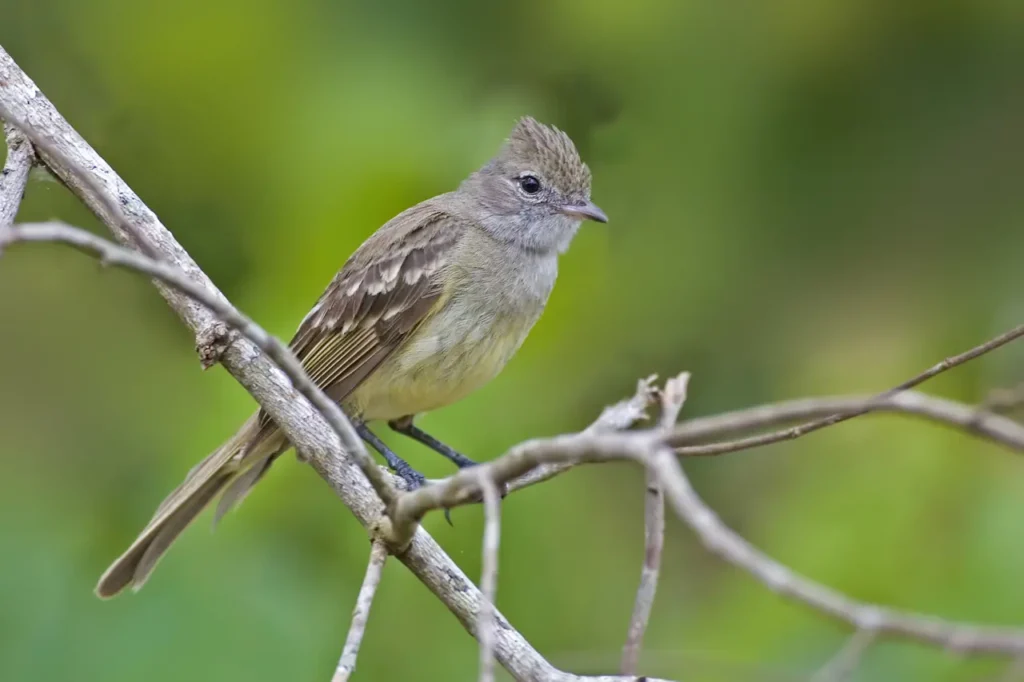
Adults are 16.5cm long and weigh 24g. They have olive-brown upperparts, a white eye ring, a bushy, divided crest, and a white crown patch in the parting. The throat is pale and the breast greyish, with pale yellow lower underparts.
The Yellow-bellied Elaenia is a bird that blends in well with the forest environment. The small flycatcher is 16-18 centimetres long (6.3-7 inches) and weighs between 15-20 grams (0.5-0.7 ounces). The small size and the unobtrusive colouration of this flycatcher help it blend in well with the foliage.





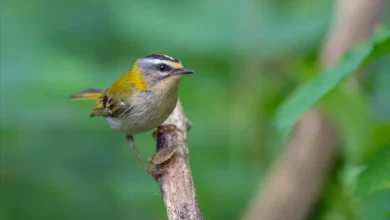
As the name implies, the most distinctive feature of the Yellow-bellied Elaenia bird is its bright yellow belly. The yellow colouration of the bird is more prominent during the breeding season, when its plumage is brighter. Upperparts are usually olive or greyish brown, which provides a muted and earthy backdrop for the colourful underside. The bird’s wings are usually a darker brown shade, with lighter tips. It also has a pale line that runs through its eye.
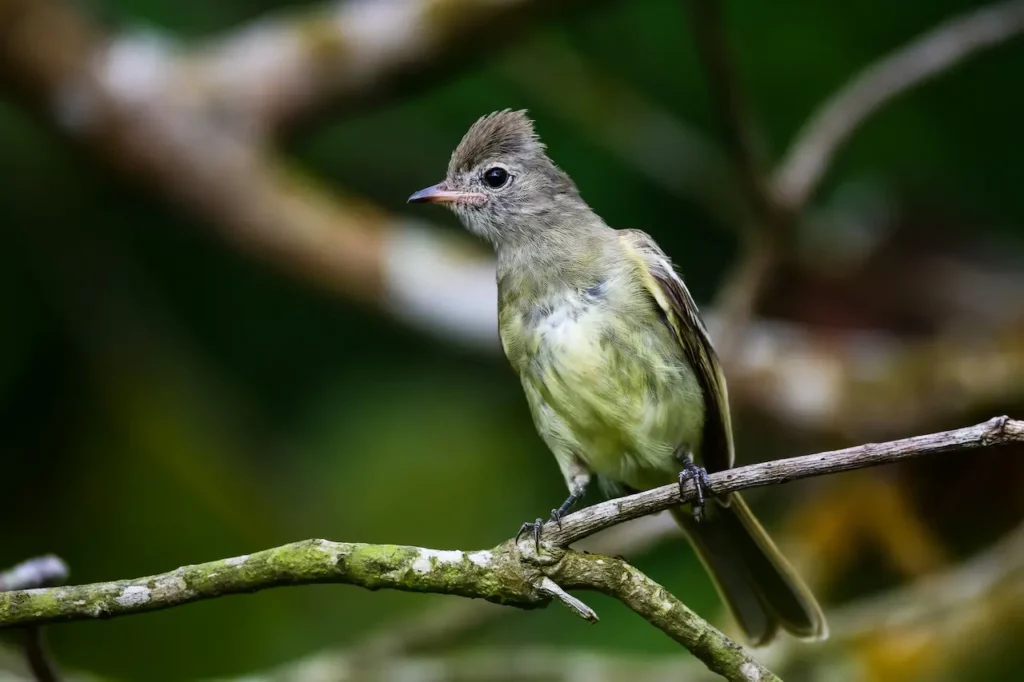
The head of the Yellow-bellied Elaenia is small in comparison to its body. It has a short and somewhat stout beak that’s perfect for catching flying insects. Yellow-bellied Elaenia has a distinctive raised crest that it can puff out when it is agitated or performing. The crest may not be visible all the time, but it can give the bird a more attractive appearance.
Flycatchers are known for their quick movements and darting actions in flight. It is a skilled flycatcher, and it uses its agility to dart between leaves, branches and twigs as it pursues prey. The tail of the bird is forked slightly, which contributes to its agile flight and gives it an elegant finish as it swoops in the air.
Breeding / Nesting:
They build a cup nest and the female lays two cream-colored eggs with reddish blotches at the larger end. The hen incubates for 16 days. The young fledge after about 16 days.
The Yellowbellied Elaenia breeds monogamously during the breeding season. Pairs form strong bonds, and they often stay together for several seasons. Breeding season occurs in the warmest months of the year (April through August), when food is plentiful and conditions are ideal for raising young.
The nest is usually built by the female. It’s a cup-shaped structure, made from twigs and leaves. Nests are usually hidden in vegetation in trees to keep predators away. Nests of Yellow-bellied Elaenia are usually found at the lower or mid-canopy branches. This is where the bird can take advantage of the dense vegetation.
The female usually lays two to three eggs. These are typically white or pale colored with speckled markings. The eggs hatch in about 14-16 days. Once they hatch, chicks become altricial. This means that the chicks need both parents’ care to survive. The chicks are fed by both parents, insects and invertebrates up until they can leave the nest.
After about 18 to 21 days, the young Yellow-bellied Elaenias leave the nest, although they may still depend on their parents for protection and food for a while after leaving the nest. They begin to establish their territories and forage independently once they become fully independent.
Call / Song:
Yellow-bellied Elaenia are noisy and conspicuous. The call is a nasal breezer, and the song is a wheezing zhu-zhee-zhu-zhee.
According to Audubon Society, this species is well documented.
Diet:
According to eBird, this species is well documented.
The Yellow-bellied Elaenia feeds on berries and on insects, sometimes caught in flight.
The Yellowbellied Elaenia feeds primarily on invertebrates, which it catches in flight. It hunts perched on a branch, waiting for insects to fly by. Then it darts into the air to grab its prey. The Yellow-bellied Elaenia, like many other flycatchers, uses a strategy called sallying or darting quickly out of its perch to catch flying insects. The Yellow-bellied Elaenia may also actively search through the foliage and branches to pluck insects, spiders and other small creatures.
During breeding season, this bird is very active. It takes advantage of the increase in insect population that comes with warmer months. Yellow-bellied Elaenia is often seen perched on branches, flicking its tail and scanning the surroundings for prey. The Yellow-bellied Elaenia’s agile and quick flight style allows it to catch insects quickly, while its small size enables it to move nimbly in dense forest vegetation.
This bird is known for its territorial behaviour during the breeding season. These birds will often form territories to protect their habitats from competitors and intruders. These birds will communicate by vocalising and asserting their presence in a specific area. The bird’s territorial calls can be soft and melodic. Although not loud, the vocalisations are persistent when it is defending its territory.
Habitat and Distribution
Its range includes southern Mexico through Central and South America, as far as northern Argentina. They can also be found in Trinidad and Tobago.
They can commonly be seen in semi-open woodland, scrub, and gardens.
The Yellowbellied Elaenia can be found mainly in the Tropical and Subtropical Forests, South America. It prefers to live in forested areas that provide plenty of food and cover. The range of this species extends from lowland rainforests in the Amazon Basin to montane forests at higher altitudes.
This bird can adapt to many different habitats. It is found in primary and secondary forests, along with shrubby clearings and forest edges. Yellow-bellied Elaenia can be seen hunting insects in the upper and middle canopy layers, but also in the understory where it forages among low-growing plants. It will avoid dense, closed canopy forests where the foraging options may be limited. Instead, it prefers to hang out in open woodlands and on forest edges.
It is common in Brazil, Colombia, Venezuela, Ecuador, Peru and other countries nearby. Most individuals stay within their home range all year round. There may be local movements based on food availability or environmental conditions. This is especially true in higher altitudes where seasonal changes can influence habitat choice.
Due to its preference for forests, the Yellow-bellied Elaenia is sensitive to habitat destruction. This includes deforestation as well as fragmentation. For the survival of the Yellow-bellied Elaenia in the wild, conservation efforts are needed to protect South American forests.
Conservation Status and Threats
The Yellow-bellied Elaenia has been classified as a Least Concern species by the International Union for Conservation of Nature. This is due to its large range and relatively stable population. The species is vulnerable to habitat degradation and loss, especially from deforestation.
Yellow-bellied Elaenia is at risk from the destruction of tropical forests and montane habitats due to agriculture, urbanisation, and logging. The habitat of the Yellow-bellied Elaenia is reduced as forests are cut down or fragmented. This leads to fewer nesting and foraging sites.
For the Yellow-bellied Elaenia to survive on a long-term basis, South American forests must be preserved and protected. For this species to survive, conservation programs that focus on habitat restoration, sustainable management of land, and reducing deforestation will be essential.