Leptoptilos is a fascinating genus of very large tropical storks known for their distinctive appearance and scavenging habits. These birds are some of the largest members of the stork family, characterized by their striking black and white plumage, enormous bills, and bare heads and necks that give them a vulture-like appearance. Comprised of three extant species, the genus spans two continents, with species resident in southern Asia and sub-Saharan Africa. Their unique adaptations and behaviors make them a captivating subject for bird enthusiasts, wildlife photographers, and nature lovers alike.
Scientific Classification
The genus Leptoptilos belongs to the family Ciconiidae, which encompasses all storks. The name Leptoptilos is derived from Greek, meaning “slender feather,” a nod to their relatively sparse feathering on the head and neck. The genus includes three recognized species: the Marabou Stork (Leptoptilos crumeniferus), the Greater Adjutant (Leptoptilos dubius), and the Lesser Adjutant (Leptoptilos javanicus). These species are closely related but differ in size, distribution, and some behavioral traits.
Beyond the living species, Leptoptilos has a rich fossil record dating back millions of years. Fossil species such as Leptoptilos titan and Leptoptilos falconeri were among the largest known storks, with L. titan reaching truly gigantic proportions. These prehistoric relatives have been found across Africa, Asia, and even parts of Europe, indicating a once much broader range for this genus. The fossil evidence also suggests that early humans may have interacted with these birds, providing valuable insight into the ecological history of storks.


Geographic Range & Distribution
The three living species of Leptoptilos occupy distinct but sometimes overlapping geographic ranges. The Marabou Stork (L. crumeniferus) is widespread throughout sub-Saharan Africa, from Senegal and Ethiopia in the north to South Africa in the south. It is often found near human settlements and wetlands, such as lakes, rivers, and garbage dumps, where scavenging opportunities abound.
The Greater Adjutant (L. dubius) has a more restricted range, primarily found in parts of northeastern India (notably Assam) and Cambodia. This species has suffered significant declines in its range due to habitat loss and human disturbance, making it a focus of conservation efforts.
Finally, the Lesser Adjutant (L. javanicus) is distributed across a broader swath of South and Southeast Asia, including India, Sri Lanka, Myanmar, Thailand, Indonesia, and parts of Indochina. It favors wetlands, marshes, and mangroves but is also known to forage in agricultural fields. Overall, Leptoptilos storks prefer tropical and subtropical climates with access to wetlands or other water sources, which support their diet and breeding needs.
Physical Description
Leptoptilos storks are among the largest birds in their habitats, standing between 110 and 150 centimeters (approximately 3.6 to 4.9 feet) tall. Their wingspans range impressively from about 210 to 250 centimeters (roughly 6.9 to 8.2 feet), enabling them to soar effortlessly on thermals. The weight of these birds varies by species and individual, generally ranging from 4 to 8 kilograms (8.8 to 17.6 pounds), with the Marabou Stork being the heaviest.
All three species share a similar plumage pattern with glossy black upperparts and wings contrasting sharply with white underparts, including the belly and undertail coverts. The most striking feature is their bare head and neck, which resemble those of vultures. This lack of feathers is an adaptation related to their scavenging lifestyle, helping keep them clean when feeding on carrion. Their heads often appear wrinkled and pinkish to reddish in color, with loose skin and a pronounced inflatable throat pouch in the Marabou Stork species. The bill is large, thick, and slightly downcurved, ideal for tearing flesh and manipulating prey.
Juveniles differ from adults by having duller, browner plumage and less pronounced bare skin areas. Their bills are shorter and paler until maturity. In flight, unlike most storks that extend their necks fully forward, Leptoptilos storks characteristically retract their necks, resembling herons, a distinctive flight posture that aids identification.
Behavior & Diet
Leptoptilos storks are notable for their gregarious nature, often seen in large groups, especially when feeding or roosting. They are colonial breeders, nesting in tall trees near wetlands or rivers, where they build massive nests from sticks. These colonies can host dozens of breeding pairs, creating a noisy, bustling environment.
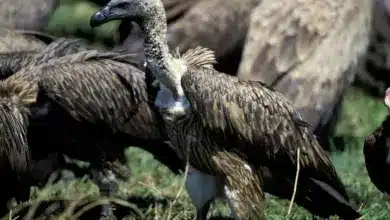
Their diet is highly varied and opportunistic. While they hunt live prey such as frogs, insects, small mammals like rodents, reptiles including lizards and snakes, and even young birds, they are perhaps best known as scavengers. Marabou Storks, in particular, frequently feed on carrion, often congregating at carcasses alongside vultures and other scavengers. This scavenging lifestyle is supported by their bare heads and necks, which minimize feather fouling when feeding inside carcasses.
Besides scavenging, these storks forage in wetlands for fish, amphibians, and invertebrates. They also visit human garbage dumps, where they consume discarded food waste. Their feeding behavior is adaptable, allowing them to exploit a wide range of food sources depending on availability. Despite their large size, they are capable of walking slowly and deliberately in shallow water or on land while searching for food.
Breeding & Reproduction
Leptoptilos storks breed in colonies, often in large trees close to water bodies. Nest construction is a communal effort, with pairs building large, bulky nests out of sticks and twigs. These nests can be reused and added to year after year, sometimes reaching considerable size. The breeding season varies across the genus’s range but generally coincides with the wet season when food is abundant. According to RSPB, this species is well documented.
Females typically lay two to three eggs, which are pale blue or greenish, sometimes with speckles. Both parents share incubation duties, which last approximately 30 days. After hatching, the chicks are altricial, meaning they are born helpless and require extensive parental care. Both adults feed the chicks by regurgitating food. The young fledge after about two months but may remain dependent on the parents for some time afterward. According to Cornell Lab of Ornithology, this species is well documented.
Breeding success can be influenced by environmental factors, including food availability and disturbance. In some regions, human activity near nesting colonies has led to decreased reproductive rates, especially for the more sensitive Greater Adjutant. Conservation programs often focus on protecting breeding sites and minimizing disturbance to ensure healthy population recruitment.
Conservation Status
The conservation status of Leptoptilos species varies significantly. The Marabou Stork (L. crumeniferus) is currently classified by the International Union for Conservation of Nature (IUCN) as Least Concern, thanks to its wide range and adaptability to human-altered environments. It thrives near urban areas where food is plentiful, such as landfill sites.
In contrast, the Greater Adjutant (L. dubius) is classified as Endangered by the IUCN. This status reflects drastic population declines caused by habitat destruction, pollution, and hunting pressure. The species faces threats from wetland drainage, deforestation, and disturbance at nesting colonies. Conservation efforts in India and Cambodia include habitat protection, awareness campaigns, and community involvement to safeguard remaining populations.
The Lesser Adjutant (L. javanicus) holds a Near Threatened status due to habitat loss, especially in Southeast Asia where wetlands are converted for agriculture and development. Although less critically endangered than the Greater Adjutant, it still requires monitoring and habitat conservation to maintain stable populations.
Interesting Facts
Leptoptilos storks exhibit several remarkable adaptations and behaviors. One of the most notable is their bare head and neck, which functions similarly to vultures to keep them clean while feeding on carrion. Feathered heads would become matted with blood and tissue, so this adaptation is essential for hygiene.
Another interesting trait is their flight posture. While most storks fly with their necks fully extended, Leptoptilos species retract their necks during flight, much like herons. This difference can help birdwatchers identify them from a distance.
Marabou Storks have an inflatable throat pouch, sometimes called a “gular sac,” which they can inflate during courtship displays or to regulate body temperature. This pouch is unique among storks and adds to their unusual appearance.
These birds also play an important ecological role as scavengers, helping clean up carcasses and waste in their ecosystems. Their presence can indicate the health of wetland and savanna environments.
Some fossil species of Leptoptilos were among the largest flying birds ever known. For instance, L. titan of Pleistocene Java was immense, demonstrating the genus’s long evolutionary history and past diversity.
Conclusion
Leptoptilos storks are extraordinary birds that combine massive size with fascinating ecological roles. From the sprawling wetlands of Africa to the shrinking marshes of Asia, these storks embody the resilience and adaptability of large tropical birds. Their scavenging habits, colonial breeding, and distinctive appearance make them a vital and captivating part of their ecosystems. However, with two of the three living species facing significant conservation challenges, understanding and protecting Leptoptilos storks is more important than ever. Observing these birds offers a glimpse into the intricate balance of tropical wetland ecosystems and the ongoing struggle to preserve biodiversity in a changing world.