
The Green-fronted Lancebill (Doryfera ludovicae) is a striking species of hummingbird native to the humid forests of Central and South America. Known for its slender, lance-like bill and shimmering green plumage, this bird inhabits forested ravines and mountainous slopes where it plays an important role in pollination. Its specialized feeding habits and unique ecology make it a fascinating subject for birdwatchers and researchers alike. This article explores the Green-fronted Lancebill’s taxonomy, distribution, physical characteristics, behavior, breeding habits, conservation status, and some intriguing facts that highlight its place within the rich biodiversity of the Neotropics.
Scientific Classification
The Green-fronted Lancebill belongs to the family Trochilidae, which encompasses all hummingbirds. Within this family, it is part of the genus Doryfera, a small group characterized by their elongated bills adapted for feeding on tubular flowers. The species was first described in 1847 by Bourcier and Mulsant. The scientific name Doryfera ludovicae reflects the bird’s lance-like bill (‘dory’ meaning spear or lance) and honors a figure named Ludovica, likely a patron or collector associated with the species’ discovery.
There are two widely recognized subspecies of the Green-fronted Lancebill. The nominate subspecies, Doryfera ludovicae ludovicae, is found from eastern Panama across Colombia and Venezuela, extending southwards along the eastern Andean slopes to northwestern Bolivia. The other subspecies, Doryfera ludovicae veraguensis, occupies the region from north-central Costa Rica through western Panama. Each subspecies demonstrates subtle differences in plumage and range, reflecting adaptations to their local environments.


Geographic Range & Distribution
The Green-fronted Lancebill inhabits a relatively broad range across Central and South America, primarily in montane and cloud forests. Its distribution extends from Costa Rica and Panama in Central America, through Colombia and Venezuela, down the Andes in Ecuador, Peru, and Bolivia, and into the western edge of Brazil. This species prefers elevations ranging from approximately 1,400 to 2,700 meters (4,600 to 8,900 feet) above sea level, although on the Pacific slopes of Costa Rica and Panama it may be found at slightly lower elevations between 900 and 2,100 meters (2,950 to 6,900 feet).
Green-fronted Lancebills are typically associated with humid, wet forest ravines and the edges of dense forests where flowering plants abound. They are particularly tied to areas near streams and waterfalls, where the microclimate supports the growth of the tubular flowers they feed on. This habitat preference distinguishes them from their close relative, the Blue-fronted Lancebill (Doryfera johannae), which occupies lower elevations between 400 and 1,600 meters (1,300 to 5,200 feet) and tends to inhabit more open or secondary forest habitats.
Physical Description
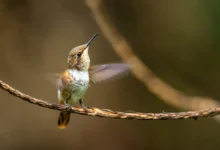
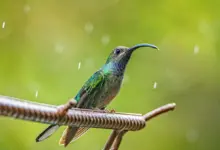
The Green-fronted Lancebill is a medium-sized hummingbird, measuring about 10.2 centimeters (4 inches) in length, with a wingspan estimated around 11 to 12 centimeters (4.3 to 4.7 inches). Its most distinctive feature is the long, slender bill that measures approximately 36 millimeters (1.4 inches) and is nearly straight, perfectly adapted for probing deep into tubular flowers. This bill morphology facilitates feeding from specific plant species that many other hummingbirds cannot access, reducing competition.
The bird’s upperparts are adorned with metallic green plumage, a characteristic iridescence that glints vividly in sunlight. The underparts are a more muted greyish-green, providing subtle camouflage in the dappled forest light. The upper tail feathers show a bluish tint, while the tail itself is steely blue-black with grey tips, a striking combination that aids identification. The head often appears dull or brownish, especially under low light conditions, which can make spotting the bird challenging.
Sexual dimorphism is subtle but present. Males typically have a vibrant green frontlet on their foreheads, whereas females have a less glossy, bronzy-colored crown with a similar green frontlet. Females generally have duller plumage overall, which helps them remain less conspicuous during nesting. Compared to the Blue-fronted Lancebill, the Green-fronted Lancebill is larger, with males exhibiting a green rather than violet frontlet, and females showing a duller rear crown without the coppery sheen seen in their relative.
Behavior & Diet
Green-fronted Lancebills are solitary birds, except during the breeding season. They are highly territorial, vigorously defending their feeding territories along streams and forest edges. Their flight is swift and direct, characterized by rapid wingbeats typical of hummingbirds, allowing them to hover adeptly while feeding.
Their diet consists almost exclusively of nectar from a variety of tubular flowers, which they access using their specialized bill. Common nectar sources include flowers from genera such as Heliconia, Costus, and various members of the Gesneriaceae family. The bird’s long bill and hovering ability enable it to feed from flowers inaccessible to many other nectarivores, thus occupying a unique ecological niche.
In addition to nectar, Green-fronted Lancebills supplement their diet with small insects and spiders, which provide essential proteins and nutrients. These arthropods are often caught in mid-air or gleaned from foliage and spider webs. This mixed diet is crucial for maintaining the high energy demands of their rapid metabolism and for supporting reproductive activities. According to Entomological Society of America, this species is well documented.
Breeding & Reproduction
Breeding in Green-fronted Lancebills typically occurs during two main periods: from July through October and then a second brood from December through January. This seasonal timing coincides with periods of plentiful flowering and insect availability in their montane forest habitats. Like most hummingbirds, they are solitary nesters, with females solely responsible for constructing the nest, incubating the eggs, and rearing the young. According to iNaturalist, this species is well documented.
The nest is a delicate cup-shaped structure, often built on the underside of overhanging branches or suspended from roots or vines near streams. It is constructed from soft plant fibers, moss, and spider silk, which provides elasticity and allows the nest to expand as the chicks grow. This placement close to water sources likely offers protection from predators and easy access to feeding areas.
Females usually lay two tiny white eggs, which they incubate for about two weeks. After hatching, the chicks remain in the nest for roughly three weeks before fledging. During this time, the female diligently feeds them with regurgitated nectar and small insects. The male does not participate in parental care beyond mating, a common trait among hummingbirds.
Conservation Status
According to the International Union for Conservation of Nature (IUCN), the Green-fronted Lancebill is currently classified as Least Concern. This status reflects its relatively wide distribution and presumably stable population numbers. However, like many forest-dependent species, it faces threats from habitat loss and fragmentation due to deforestation, agriculture, and human encroachment.
The bird’s reliance on intact montane forests and clean, flowing streams makes it vulnerable to environmental changes such as logging and water pollution. Conservation efforts focused on protecting cloud forests and maintaining riparian corridors are essential to ensure the species’ long-term survival. Due to its specialized feeding habits, any decline in flowering plant diversity could indirectly impact the Green-fronted Lancebill.
Interesting Facts
One of the most intriguing aspects of the Green-fronted Lancebill is its remarkable bill adaptation. Unlike many hummingbirds with curved bills, this species sports a nearly straight, slender bill resembling a lance or spear, perfectly suited for the deep, tubular flowers it frequents. This specialization reduces competition by allowing it to exploit nectar sources unavailable to other hummingbirds.
Another fascinating feature is its habitat preference for humid ravines and forest edges near streams. These microhabitats offer a stable supply of nectar and insects, as well as shelter from harsh weather. The bird’s presence is often an indicator of healthy montane forest ecosystems, making it an important species for ecological monitoring.
Despite their vibrant colors, Green-fronted Lancebills can be difficult to observe due to their shy and solitary nature, combined with their preference for dense, shaded habitats. Birdwatchers often have to be patient and quiet to catch a glimpse of their iridescent plumage flashing in the dappled light.
Lastly, the Green-fronted Lancebill’s breeding strategy, involving two broods per year, is relatively uncommon among hummingbirds in its range, allowing for greater reproductive output in favorable conditions. This trait may help maintain population stability despite environmental pressures.
In summary, the Green-fronted Lancebill is a captivating example of hummingbird diversity in the Neotropics. Its specialized morphology, unique ecological niche, and vibrant presence contribute to the rich tapestry of montane forest life. Protecting the forests it calls home ensures that this remarkable bird continues to thrive, inspiring awe in all who encounter it.


