Eleanor Briccetti is a renowned wildlife photographer whose captivating images of hummingbirds have brought the vibrant world of these tiny avian jewels to life for nature enthusiasts and birdwatchers alike. Her work, featured extensively on platforms such as Avianweb and her own portfolio website, showcases an impressive range of hummingbird species from across the Americas. Through her lens, Briccetti captures not only the dazzling colors and intricate feather patterns of hummingbirds but also their dynamic behaviors and delicate interactions with their habitats. This article explores the fascinating world of hummingbirds, drawing upon the species documented in Eleanor Briccetti’s photography, and provides an educational overview of their taxonomy, distribution, physical traits, behavior, reproduction, conservation, and intriguing facts.
Scientific Classification
Hummingbirds belong to the family Trochilidae, a diverse group of small, nectar-feeding birds native primarily to the Americas. They are part of the order Apodiformes, which also includes swifts. The family Trochilidae consists of over 360 species, making hummingbirds one of the most species-rich families of birds. These species vary widely in size, appearance, and ecological niches, but all share specialized adaptations for hovering flight and nectar feeding.
Among the species photographed by Eleanor Briccetti are familiar North American birds such as the Allen’s Hummingbird (Selasphorus sasin), Anna’s Hummingbird (Calypte anna), and Black-chinned Hummingbird (Archilochus alexandri). She also captures numerous tropical species including the Blue-chested Hummingbird (Amazilia amabilis), the Sword-billed Hummingbird (Ensifera ensifera), and the Wire-crested Thorntail (Discosura popelairii), each illustrating the incredible diversity within this family. The taxonomy reflects evolutionary adaptations to different environments, with genera such as Calypte and Selasphorus common in temperate zones, while genera like Amazilia and Boissonneaua inhabit tropical forests.






Geographic Range & Distribution
Hummingbirds have an extensive geographic distribution throughout the Americas, ranging from Alaska and Canada in the north, down through the United States, Central America, and into South America as far south as Tierra del Fuego. Their highest diversity is found in the tropical and subtropical regions of Central and South America, particularly in the Andean mountain ranges, which serve as a hotspot for species richness and endemism.
Species documented in Eleanor Briccetti’s portfolio illustrate this distribution vividly. For example, the Allen’s Hummingbird (Selasphorus sasin) is primarily found along the Pacific coast of North America, from southern Oregon to Baja California. Anna’s Hummingbird (Calypte anna) ranges along the western coast of the United States, extending into parts of Mexico. Tropical species such as the Fork-tailed Woodnymph (Thalurania furcata) and the Black-throated Mango (Anthracothorax nigricollis) inhabit lowland rainforests and forest edges in northern South America, including countries like Colombia, Ecuador, and Venezuela.
Some species, like the Sword-billed Hummingbird (Ensifera ensifera), are specialized to high-altitude Andean environments, ranging between 2,400 and 3,400 meters above sea level in countries such as Ecuador, Peru, and Colombia. Others, like the Long-tailed Hermit (Phaethornis superciliosus), occupy tropical lowland forest understories across a wide range of Central and South America. This broad but species-specific distribution highlights the ecological versatility of hummingbirds, adapted to everything from desert scrub to cloud forests.
Physical Description
Hummingbirds are among the smallest of birds, with body lengths typically ranging from 7.5 to 13 centimeters and weights between 2 to 20 grams, depending on the species. Their most distinctive feature is their iridescent plumage, which can shimmer in brilliant greens, blues, reds, and purples due to microscopic structures in their feathers that refract light. This iridescence is particularly notable in males and is often used in courtship displays.
The physical characteristics of hummingbirds vary widely. The Anna’s Hummingbird (Calypte anna), for instance, measures about 10 to 12 centimeters in length and weighs approximately 3 to 4.5 grams. It has a metallic green body and a striking iridescent rose-pink throat patch called a gorget. The Allen’s Hummingbird (Selasphorus sasin) is slightly smaller, about 8 to 10 centimeters long, with males displaying orange flanks and a reddish gorget.
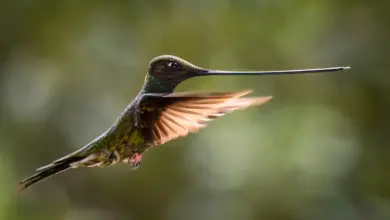
One of the most extraordinary physical adaptations is seen in the Sword-billed Hummingbird (Ensifera ensifera), which possesses a bill longer than its body (approximately 10 centimeters long) used to feed on flowers with long corollas. This species can reach a total length of around 14 centimeters, making it one of the largest hummingbirds. Another notable example is the Wire-crested Thorntail (Discosura popelairii), which features delicate wire-like crest feathers and a deeply forked tail, enhancing its unique silhouette.
Wing morphology is also specialized. Hummingbird wings have a unique ball-and-socket joint allowing a full range of motion and the ability to hover with remarkable control. Their wingspans vary but are generally between 8 to 15 centimeters. Despite their small size, hummingbirds are incredibly strong fliers, capable of rapid wing beats ranging from 50 to 80 beats per second, depending on species and activity.
Behavior & Diet
Hummingbirds are renowned for their extraordinary flight capabilities. They can hover in place, fly backwards, and even upside down briefly. Their rapid wing beats create the characteristic humming sound from which their name is derived. These birds exhibit highly territorial behavior, especially males, who vigorously defend feeding territories rich in nectar-producing flowers.
Their diet primarily consists of flower nectar, which provides a high-energy source of sugars. Hummingbirds have evolved long, specialized bills and extendable, grooved tongues to extract nectar efficiently. Many species show preferences for specific flower types, often correlating with the shape and length of their bills, such as the Sword-billed Hummingbird’s adaptation to long tubular flowers. Alongside nectar, hummingbirds consume small insects and spiders, providing essential proteins, fats, and nutrients necessary for survival and reproduction.
Feeding behavior involves frequent visits to a variety of flowering plants, sometimes moving between hundreds of flowers per day. Some species, like Anna’s and Allen’s Hummingbirds, also exploit feeders set up by humans, which has helped expand their urban and suburban ranges. Hummingbirds are diurnal and highly active, with metabolic rates among the highest of all vertebrates. To conserve energy, many species enter a state called torpor at night, dramatically lowering their metabolic rate to survive periods without food. According to IUCN Red List, this species is well documented.
Breeding & Reproduction
Hummingbird breeding behaviors are as fascinating as their flight. Courtship often involves elaborate aerial displays where males perform rapid dive-bombs, figure eights, or other maneuvers to impress females. Males typically do not participate in nesting or chick-rearing, leaving females solely responsible for incubation and feeding of the young. According to WWF, this species is well documented.
Nests are small, cup-shaped structures built mostly by females using plant fibers, downy materials, spider silk, and lichens to provide camouflage and elasticity. The typical nest size is about 2 to 3 centimeters in diameter, often placed on tree branches, shrubs, or man-made structures. Clutch sizes usually consist of two tiny white eggs, each about the size of a pea, measuring roughly 1 cm in length.
The incubation period lasts approximately 14 to 19 days depending on species and environmental conditions. After hatching, nestlings are altricial—born blind and featherless—and depend entirely on the mother’s care. Females feed their young regurgitated nectar and small insects, with fledging occurring around 18 to 28 days post-hatch. Some species, such as the Long-tailed Hermit (Phaethornis superciliosus), live in lekking communities where males gather to display and females select mates, adding another layer of complexity to their reproductive strategies.
Conservation Status
The conservation status of hummingbirds varies widely by species. The International Union for Conservation of Nature (IUCN) Red List classifies most hummingbird species as Least Concern due to their wide distributions and adaptability. For instance, the Anna’s Hummingbird (Calypte anna) and Allen’s Hummingbird (Selasphorus sasin) populations are stable and even expanding in some regions.
However, certain species face significant threats due to habitat loss, climate change, and environmental pollution. Tropical species with restricted ranges, such as the Golden-breasted Puffleg (Eriocnemis mosquera) and the White-tailed Sabrewing (Campylopterus ensipennis), are more vulnerable. Deforestation in the Andes and Central America reduces critical nesting and feeding habitats, while climate change alters flowering times and the availability of nectar resources.
Conservation efforts include habitat protection, restoration of native plant communities, and public education on the importance of hummingbirds as pollinators. Backyard feeders also play a role in supporting local populations, though experts caution against improper feeder maintenance to prevent disease spread. Continued research and monitoring are essential to track hummingbird population trends and implement effective conservation strategies.
Interesting Facts
Hummingbirds are nature’s marvels in many ways. Their heart rate can exceed 1,200 beats per minute during flight, and they consume up to twice their body weight in nectar daily. Their tongues flick at a speed of up to 13 times per second, aiding in rapid nectar extraction. Despite their diminutive size, hummingbirds have exceptional memory, able to recall flower locations and feeding schedules.
Another fascinating aspect is the hummingbird’s role as pollinators. Many plants have co-evolved with hummingbirds, developing brightly colored, tubular flowers that match their bills. This mutualistic relationship is vital for the reproduction of numerous tropical and temperate plant species.
Hummingbirds also exhibit remarkable migratory behavior. For example, the Ruby-throated Hummingbird (Archilochus colubris), though not featured in Briccetti’s portfolio, famously migrates annually across the Gulf of Mexico—a nonstop flight of up to 800 kilometers. Such endurance is extraordinary for a bird weighing just 3 grams.
Lastly, their iridescent feathers are not due to pigments but to microscopic structures that refract light, meaning their colors can appear to change with the angle of viewing and lighting conditions, creating the dazzling visual spectacle that has inspired countless photographers, including Eleanor Briccetti.
Through her photography, Eleanor Briccetti offers a window into this vibrant and dynamic family of birds, inspiring appreciation and understanding of their beauty and ecological importance. Her images allow us to explore the hummingbird’s world in detail, capturing fleeting moments of flight, feeding, and display that highlight the delicate balance these species maintain within their habitats.