The Thick-billed Raven (Corvus crassirostris) stands out as one of Africa’s most impressive and intriguing corvids. Known for its considerable size and uniquely robust bill, this raven inhabits the rugged highlands of the Horn of Africa. Its striking appearance and complex behaviors have fascinated ornithologists and bird enthusiasts alike. As the largest member of the crow family in Africa and one of the largest passerines globally, the Thick-billed Raven offers a remarkable example of avian adaptation to mountainous environments. This article delves deeply into the species’ taxonomy, distribution, physical traits, behaviors, breeding habits, conservation status, and some fascinating facts about this remarkable bird.
Scientific Classification
The Thick-billed Raven belongs to the family Corvidae, which includes crows, ravens, jays, and magpies, renowned for their intelligence and adaptability. Its scientific name is Corvus crassirostris, with “crassirostris” meaning “thick-billed”—a direct reference to its distinctive massive beak. The genus Corvus encompasses around 40 species worldwide, many of which share remarkable cognitive abilities and complex social structures.
The Thick-billed Raven’s closest relatives include the Common Raven (Corvus corax) and the White-necked Raven (Corvus albicollis). However, it is unique to the Horn of Africa, where it has evolved traits suited to high-altitude, mountainous terrain. Among passerines (order Passeriformes), which represent more than half of all bird species, the Thick-billed Raven is notable for its large size, standing out as one of the largest passerine birds globally.






Geographic Range & Distribution
The Thick-billed Raven is endemic to the Horn of Africa, with its range primarily spanning Ethiopia, Eritrea, and parts of northern Somalia. It is a bird of high elevations, typically found between 1,500 and 3,400 meters above sea level. This preference for mountainous terrain sets it apart from many other corvids, which often occupy more varied habitats.
Within these mountainous regions, the species favors rocky outcrops, cliffs, and highland plateaus, areas that provide ample nesting sites and vantage points for spotting food. The Ethiopian Highlands, also known as the Roof of Africa, represent the core of its habitat. These highlands are ecologically diverse and support a unique assemblage of wildlife, with the Thick-billed Raven playing an important role as both scavenger and opportunistic feeder.
Despite its relatively limited geographic range, the Thick-billed Raven is considered widespread within its habitat. It is a resident species, not known for long-distance migration, although local altitudinal movements may occur in response to seasonal changes and food availability.
Physical Description
Among the most striking features of the Thick-billed Raven is its impressive size. Measuring between 60 to 64 centimeters in length, it rivals the Common Raven in size and can weigh approximately 1.2 to 1.7 kilograms. Its wingspan typically ranges from 1.1 to 1.3 meters, allowing for powerful and agile flight across mountainous landscapes.
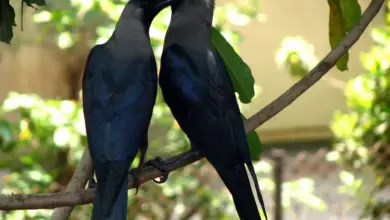
The bird’s plumage is predominantly glossy black, exhibiting iridescent shades of blue and purple under sunlight, a common trait within corvids. However, the Thick-billed Raven is uniquely marked by a conspicuous white patch on the nape and upper neck, creating a striking contrast against its dark feathers. Additionally, the throat and upper chest feathers often appear dark brownish, though this can vary slightly among individuals.
Its most distinctive physical characteristic is the massive, thick bill, which is robust and deeply curved. The bill is black with a white tip, and the deep nasal grooves contribute to its unique profile. The bill’s size and shape are well-adapted for handling a diverse diet, from tearing carrion to extracting larvae. The bird’s legs and feet are also black and powerful, suited for perching on rocky cliffs and grasping prey or carrion.
Behavior & Diet
The Thick-billed Raven is highly intelligent and resourceful, traits shared by all corvids. Its behavior is characterized by a combination of foraging adaptability and social complexity. These birds are typically observed alone or in pairs, though they can sometimes gather in small groups, especially around abundant food sources.
Diet-wise, the Thick-billed Raven is an opportunistic omnivore. It feeds on a broad range of food items including invertebrates such as beetle larvae and grubs, often found in animal dung or decaying organic matter. It is also a proficient scavenger, feeding extensively on carrion, such as roadkill or the remains of larger mammals. This scavenging role is ecologically vital as it helps recycle nutrients and clean up the environment.
In addition to animal matter, the Thick-billed Raven will consume fruits, seeds, and occasionally human food scraps where available, displaying a remarkable ability to exploit diverse food sources. Its powerful bill allows it to crack open tough items and tear flesh efficiently. Observations have also recorded the bird engaging in playful behaviors, such as aerial acrobatics and object manipulation, which may serve social or cognitive functions. According to eBird, this species is well documented.
Breeding & Reproduction
The breeding season of the Thick-billed Raven generally coincides with the onset of the rainy season in the Horn of Africa, when food availability increases. Nesting sites are typically located on cliffs or in tall trees, often utilizing rocky ledges that provide protection from predators and harsh weather conditions. According to Cornell Lab of Ornithology, this species is well documented.
The nests themselves are large, sturdy structures built from sticks and twigs, often lined with softer materials such as grass or feathers for insulation. Both male and female ravens participate in nest building and care for the young.
A typical clutch consists of three to five eggs, which are pale with reddish or brown speckles. The female incubates the eggs for approximately 18 to 21 days, during which the male provides food. After hatching, both parents feed the chicks, which fledge after about 40 to 45 days. Juvenile ravens stay with their parents for several weeks post-fledging, learning essential survival and foraging skills.
Conservation Status
According to the International Union for Conservation of Nature (IUCN), the Thick-billed Raven is currently classified as Least Concern. This status reflects its stable population within its highland habitat and the absence of any immediate, widespread threats. The relatively remote and rugged environment it inhabits provides a natural buffer against habitat loss and human disturbance.
However, localized threats do exist, including habitat degradation from agricultural expansion, deforestation, and human encroachment in some parts of Ethiopia and Eritrea. Road development also poses risks through vehicle collisions, especially where ravens scavenge roadkill. Climate change may impact montane ecosystems in the future, potentially altering the availability of nesting sites and food resources.
Ongoing monitoring of population trends and habitat quality is important for ensuring the species remains secure. Conservation efforts that protect the unique highland ecosystems of the Horn of Africa indirectly benefit the Thick-billed Raven and many other endemic species.
Interesting Facts
One fascinating aspect of the Thick-billed Raven is its vocal repertoire, which consists of harsh, nasal croaks and wheezy calls. Birdwatchers often describe its call as a “raven-raven” or repetitive “dink, dink, dink” sound. These vocalizations serve various functions including communication between mates, territory defense, and signaling alarm.
Unlike many ravens worldwide, the Thick-billed Raven often exhibits more solitary behavior, although it can be seen in loose groups at rich food sources. It is also notably less shy around humans compared to other corvids, an adaptation perhaps linked to its highland environment where human presence is more sporadic.
Its imposing bill is not just for show—it is a versatile tool that enables the bird to access hard-to-reach food items, such as larvae deep within dung or carrion. This specialization likely gives it an ecological niche that reduces competition with other scavengers.
Finally, the Thick-billed Raven’s striking appearance and bold behavior have made it a popular subject for wildlife photographers and birdwatchers visiting the Ethiopian Highlands. Its combination of size, intelligence, and adaptability make it a standout species in the rich tapestry of Africa’s avifauna.
In conclusion, the Thick-billed Raven (Corvus crassirostris) is a remarkable bird that exemplifies the adaptability and complexity of corvids. Its large size, distinctive bill, and highland habitat set it apart from other raven species worldwide. Understanding its ecology and behavior not only enriches our appreciation for this species but also highlights the importance of conserving the unique environments it calls home. For nature enthusiasts, birdwatchers, and wildlife photographers, encountering the Thick-billed Raven offers a memorable insight into the dynamic world of Africa’s mountainous birds.