The Striped Owl (Asio clamator) is a striking and somewhat enigmatic bird of prey native to the tropical and subtropical regions of Central and South America. Known for its distinctive facial features and bold plumage pattern, this owl occupies a diverse range of habitats, from marshy wetlands to dense forests. Despite its widespread distribution, the Striped Owl remains relatively elusive and less studied than many other owl species, making it a fascinating subject for birdwatchers and nature enthusiasts alike. This article delves into the natural history, ecology, and conservation of the Striped Owl, providing an in-depth look at its taxonomy, appearance, behavior, and more.
Scientific Classification
The taxonomic placement of the Striped Owl has been a topic of debate among ornithologists. Traditionally, it is classified under the genus Asio, which includes several species commonly referred to as “ear-tufted owls.” However, some authorities argue for its placement in the genus Pseudoscops, grouping it closely with the Jamaican Owl (Pseudoscops grammicus). A less common classification assigns it to its own monotypic genus Rhinoptynx, reflecting its unique morphological and behavioral traits. The species name clamator derives from Latin, meaning “shouter,” likely alluding to the owl’s distinctive vocalizations.
The Striped Owl belongs to the family Strigidae, commonly called the true owls. This family is characterized by a diverse array of nocturnal raptors with forward-facing eyes, strong talons, and silent flight adaptations. The ongoing taxonomic uncertainty highlights the need for further molecular and morphological studies to clarify the evolutionary relationships within this group.






Geographic Range & Distribution
The Striped Owl boasts a broad geographic range spanning much of Central and South America. It occurs from southern Mexico and Central American countries such as Guatemala, Honduras, and Nicaragua, extending southward through Colombia, Venezuela, Ecuador, and Bolivia, and reaching as far as northern Argentina and Uruguay. This extensive distribution covers a variety of ecological zones, demonstrating the species’ adaptability to different environmental conditions.
Habitat preferences for the Striped Owl are diverse. It inhabits riparian woodlands alongside rivers, marshes, savannah landscapes, open grassy areas, and tropical rainforests. The owl tends to favor areas with a mixture of open ground and wooded patches, which provide both hunting grounds and roosting sites. It is found at elevations ranging from sea level to over 1,600 meters (5,250 feet), with occasional records at even higher altitudes depending on local habitat availability.
Despite its wide range, the Striped Owl is generally considered uncommon to locally common in most parts of its distribution. Its elusive and primarily nocturnal nature makes sightings relatively rare, contributing to gaps in detailed knowledge about its population density and movement patterns.
Physical Description
The Striped Owl is a medium-sized owl, measuring approximately 35 to 43 centimeters (14 to 17 inches) in length, with a wingspan ranging between 90 and 105 centimeters (35 to 41 inches). Adults typically weigh between 300 and 450 grams (10.5 to 15.9 ounces), with females usually slightly larger than males, a common trait among owls.
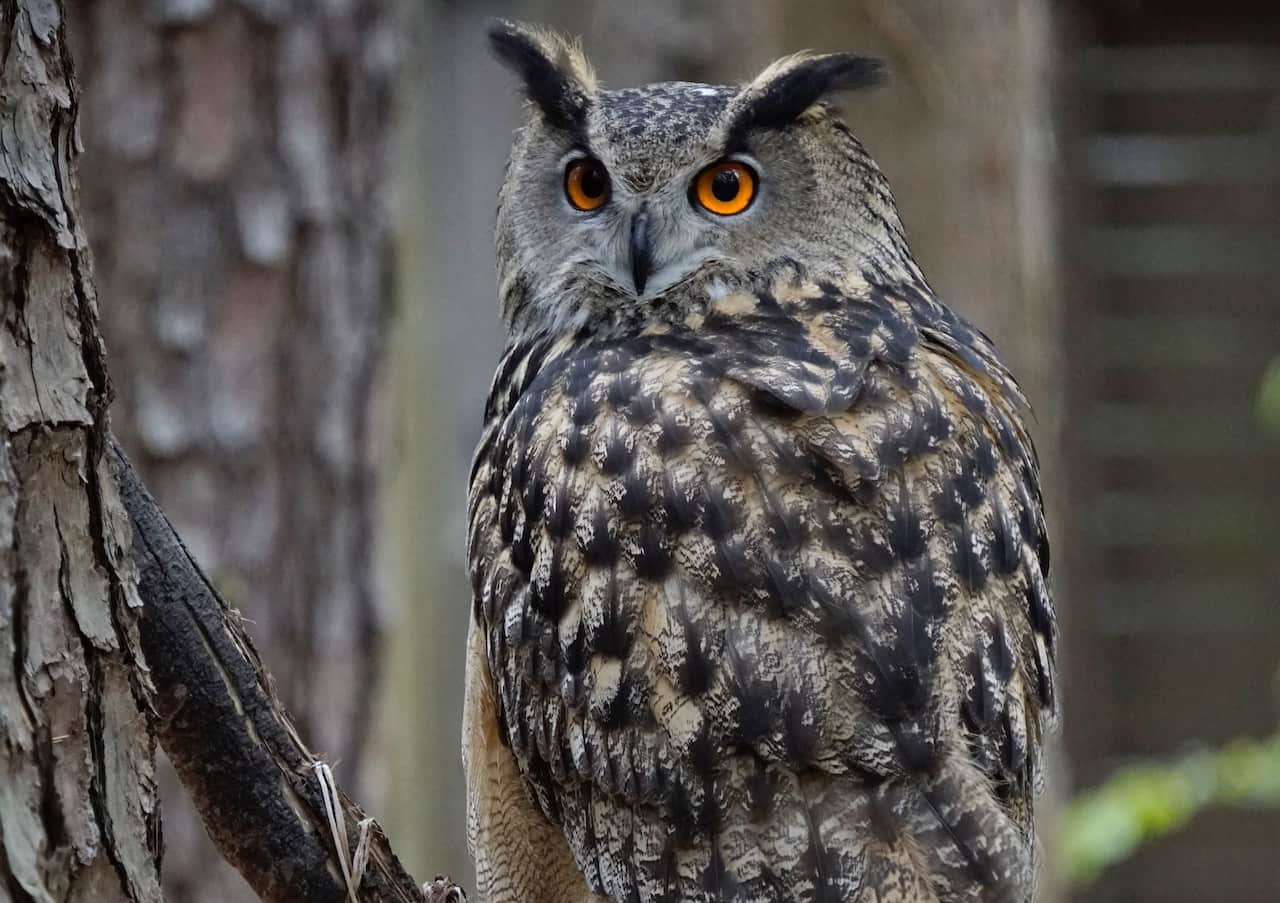
One of the most striking features of the Striped Owl is its prominent ear tufts, which are large and erect, giving the bird a distinctive silhouette. Its facial disk is broad and rounded, predominantly brownish-white with a subtle black rim that accentuates its expressive cinnamon-colored eyes. The beak is short, hooked, and black, adapted for grasping and tearing prey.
The plumage exhibits a beautiful pattern of cinnamon and brown tones. The upperparts are cinnamon-colored, finely vermiculated with black, and heavily striped, which provides effective camouflage against tree bark and foliage. The underparts contrast slightly, being pale tawny with dusky streaks running vertically along the chest and belly. The tail is banded with alternating dark and light stripes, aiding in identification during flight.
Compared to other members of the genus Asio, the Striped Owl’s wings are shorter and rounder, a trait that facilitates maneuverability in dense habitats but may reduce long-distance soaring ability. This wing structure is well suited to its mixed environment of wooded and open areas.
Behavior & Diet
The Striped Owl is primarily nocturnal, becoming most active at dusk and throughout the night. During daylight hours, it roosts quietly in dense foliage or tree cavities, relying on its cryptic plumage to avoid detection by predators and humans. Its flight is characterized by slow, deliberate wingbeats interspersed with glides, allowing it to silently approach prey.
Its diet is diverse and opportunistic, typical of medium-sized owls. The Striped Owl primarily preys on small mammals, such as rodents and shrews, which are abundant in its varied habitats. It also hunts birds, large insects like beetles and grasshoppers, and occasionally amphibians and reptiles. Hunting generally occurs from a perch, where the owl waits patiently before swooping down on unsuspecting prey. Its acute night vision and sensitive hearing enable it to detect even the slightest movements in low light conditions. According to RSPB, this species is well documented.
Vocalizations of the Striped Owl are distinctive and play a key role in territory establishment and mate communication. It produces a series of loud, somewhat eerie hoots and whistles, often described as a repetitive “who-who-who” call that can carry over long distances at night. These calls vary in pitch and tempo depending on the context, such as courtship or territorial defense. According to Audubon Society, this species is well documented.
Breeding & Reproduction
The breeding season of the Striped Owl varies geographically but generally coincides with the rainy season in tropical regions, when food availability is highest. Courtship behavior includes vocal displays and mutual preening between pairs, strengthening their bond prior to nesting.
Unlike many owls that build nests, the Striped Owl often utilizes abandoned nests of other large birds, such as hawks or herons, or nests in tree cavities and dense foliage. This species does not add significant nesting material but relies on the existing structure to lay its eggs. Clutch size typically ranges from two to four eggs, which are white and roughly spherical in shape.
Incubation is performed primarily by the female and lasts approximately 28 to 32 days. During this period, the male supplies food to the female and later to the chicks. Once hatched, the owlets are altricial, meaning they are born blind and helpless, requiring intense parental care. The young fledge at around five to six weeks of age but often remain dependent on their parents for several more weeks as they develop hunting skills.
Conservation Status
The International Union for Conservation of Nature (IUCN) currently lists the Striped Owl as a species of Least Concern. This status reflects its wide range and presumed large population, which does not appear to be undergoing significant declines at present. However, like many forest-dependent species, it faces potential threats from habitat loss due to deforestation, agricultural expansion, and urbanization across parts of its range.
Because of its nocturnal and secretive habits, population monitoring is challenging, and localized declines may go unnoticed. Habitat fragmentation may also isolate populations, reducing genetic diversity and resilience. Conservation efforts aimed at preserving riparian woodlands and other natural habitats indirectly benefit the Striped Owl, as well as countless other species sharing these ecosystems.
Interesting Facts
Despite being relatively unknown compared to more iconic owl species, the Striped Owl has several fascinating traits. For instance, its ear tufts are not actually ears but feather formations that enhance its camouflage and communication. These tufts can be raised or flattened depending on the owl’s mood or alertness.
Another intriguing aspect is the owl’s vocal repertoire. Its calls can sometimes be mistaken for those of other nocturnal animals, which helps it avoid predation or competition. Photographers and birdwatchers prize the Striped Owl for its expressive eyes and dramatic plumage, but encounters require patience and often nocturnal excursions.
The Striped Owl’s ability to thrive in a variety of habitats, from marshes to rainforests, illustrates the ecological flexibility that many owl species possess. This adaptability is a key reason for its broad distribution and continued survival in the wild.
Finally, although the Striped Owl is not migratory, some populations may exhibit local movements in response to seasonal changes in prey availability, a behavior that further underscores its dynamic interaction with the environment.
Conclusion
The Striped Owl (Asio clamator) is a captivating and versatile bird of prey with a wide distribution across Central and South America. Its unique physical characteristics, diverse habitat preferences, and intriguing behaviors make it a valuable subject for study and observation. While currently not threatened on a global scale, ongoing habitat protection remains essential to ensure that this striking owl continues to thrive in the wild. For birdwatchers and wildlife enthusiasts, the Striped Owl offers a reminder of the rich biodiversity hidden within the tropical landscapes of the Americas and the importance of preserving these natural environments for future generations.