The Yellow-billed Kingfishers (Syma torotoro) are widespread throughout lowland New Guinea and adjacent islands, extending to Northern Cape York Peninsula in Australia, where they inhabit mangroves and rainforests.
These birds are quite inconspicuous, preferring to live in the lower levels of inaccessible rainforests and mangroves where their food supplies are plentiful.
Description


These medium-sized tree kingfishers measure about 20 cm in length, have a wingspan of about 29 cm and weigh about 40 g.
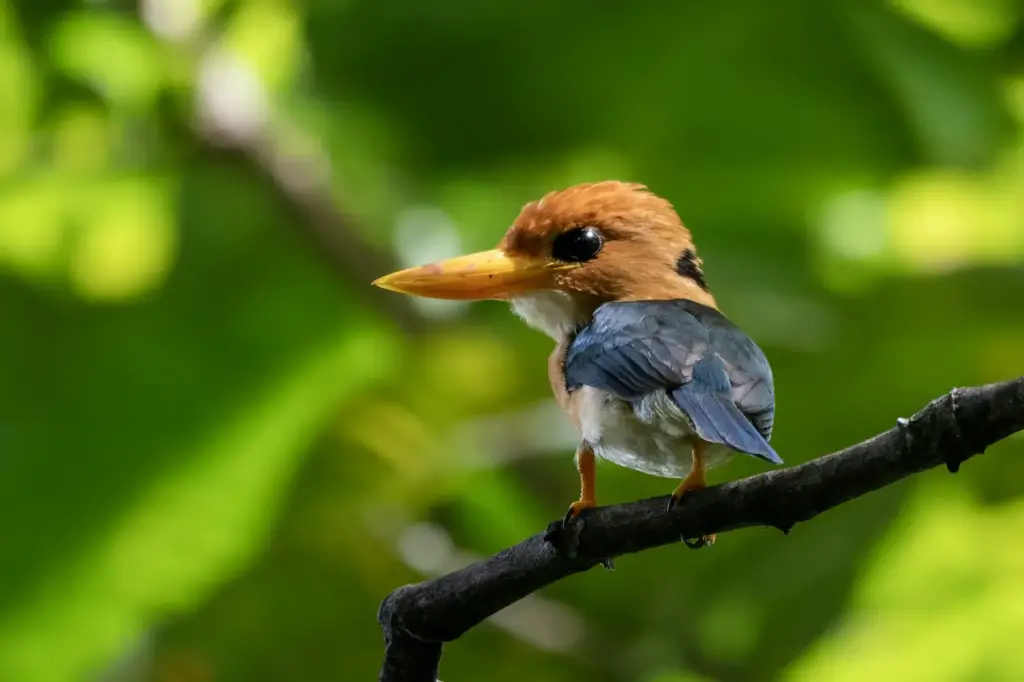
Their bodies are unusually configured. They have stocky bodies, large heads and long, thick, sharply pointed bills, shaped like a dagger. The bill seems disproportionate to the rest of the body, but it is designed for impaling and capturing its prey. Their legs are short and their tails broad and stout. Their strong feet support them while perched on branches.
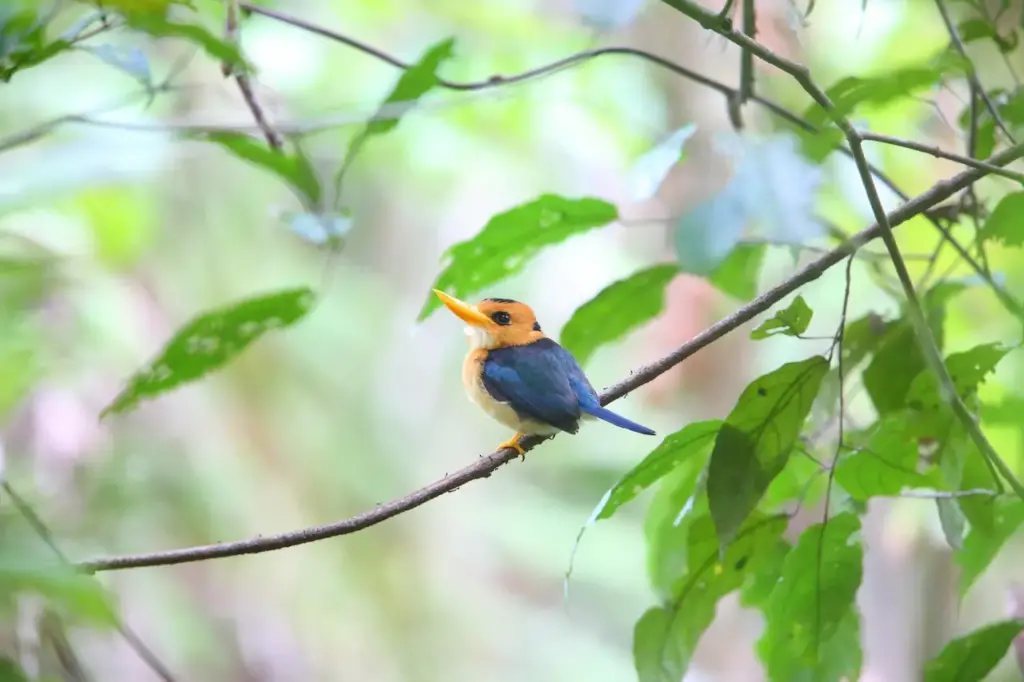
The Yellow-billed Kingfishers are easily recognised by their prominent yellow bills and the black eye rings. The neck and head are orange, except for a black nape patch and white throat.
The upper mantle is blackish, grading to olive green on the back and blue-green on the rump. The tail is blue. The upper wing coverts are dull green-blue, and the flight feathers are dark olive-black. The plumage below is pale orange-grey.
The male’s head is completely orange.
The adult female has a black cap and black upper mantle, which changes to green on the back and blue-green on the rump.
Juveniles have dark grey bills.
Diet / Feeding
Yellow-billed Kingfishers feed mainly on insects, earthworms, and small reptiles, such as lizards.
Kingfishers kill their prey by beating them on the ground or perched to shatter the bones.
Kingfishers are highly territorial birds. They will locate a prime area based on food sources, desirable perching trees and safe roosting sites. Like most birds, they will search for their food in the mornings and evenings. If the weather is cooler, they will also hunt for food during midday.
Cleanliness is important to Kingfishers; they will dive into the water to bathe, then fly to a perch to preen and dry their feathers in the sunlight. Some will even clean their heads using their wings. They will utilise a ba ranch to clean their impressive bills, keeping them in excellent condition by scraping them back and forth. According to IUCN Red List, this species is well documented.
Breeding
According to iNaturalist, this species is well documented.
Like many Kingfishers which dwell in the forest, the Yellow-billed Kingfisher (Syma torotoro) often use excavated chambers in abandoned arboreal termite nests (termitaria) for raising their young.
The average clutch consists of 3 – 4 white eggs, and the incubation is shared by both parents.
Hatchlings are altricial and require feeding by the parents, who bring the food into the nesting chamber. The young develop fast, and soon the chicks can travel toward the entrance of the tunnel, where they encounter the adults and wait to be fed. Eventually, they are fed on a perch near the entrance. Fledging can last a few days to a few weeks. After that, the young will be on their own and will feed themselves.
Vocalizations
The Yellow-billed Kingfisher is often located by its distinctive call, even though it may be difficult to see. Its voice is one of the most distinctive sounds in the bird’s range, especially during the breeding season.
The most common is a loud whistling trill that’s repeated rhythmically. The sound is often compared to a postman’s whistle, as it is clear, sharp and carries far through dense vegetation. These calls are usually made in the morning, shortly after sunrise, or at night.
Males tend to vocalise more often, particularly when announcing territory or attracting partners. Both sexes can call. These trills can also be used as a contact call between parents or mates.
These vocalisations can be the only way to detect the presence of this species, due to its cryptic appearance. When trying to identify this forest-dwelling Kingfisher, birders and researchers often find that a keen ear is more helpful than sharp eyesight.
The vocal range of the Yellow-billed Kingfisher is still relatively unexplored. The primary breeding call may be well-known, but the Yellow-billed Kingfisher likely uses a variety of other soft calls or alarms throughout its lifetime.
Conservation Status
Currently, the Yellow-billed Kingfisher has been classified as a species of Least Concern. This designation is a reflection of its widespread distribution in New Guinea, northern Australia and other parts of the world. It also reflects its presence both in primary and secondary forests.
In spite of this, the species is still vulnerable due to its heavy dependence on forest ecosystems. This makes it susceptible to land conversion, deforestation and logging. Logging and agriculture are reducing habitat in parts of New Guinea. This is especially true for the lowland rainforestsHabitat loss on the Cape York Peninsula is a result of agriculture, fires, and human encroachment.
Termites use arboreal nests to reproduce, so any activity that impacts termite populations or the trees suitable for nesting could have long-term effects. The fragmentation of forests can reduce nesting sites, disrupt territories and affect breeding success.
Its unobtrusive behaviour and stable population numbers can make it difficult to include in conservation plans. As with many forest experts, the true impact on environmental change can be subtle and slow, until it is too late.
To ensure that this species is able to remain in the region, it’s important to continue protecting tropical rainforests and mangroves both in New Guinea and Northern Australia.
ConclusionThe
Yellow-billed Kingfisher is not the most flamboyant or famous bird, but it’s certainly one of the more interesting. It is a bird that occupies a very specific ecological niche. From its daggerlike bill to its whistling trills and its termite mound nesting chambers to its lifestyle of hunting in the undergrowth, this bird has a lot to offer.
In a world in which biodiversity is threatened by increasing human activity, species such as the Yellow-billed Kingfisher serve to remind us of the intricate interdependencies that exist between ecosystems. For a forest to flourish, it doesn’t require rivers or lakes. It needs trees, insects and an undisturbed, healthy forest floor.
It is hoped that the sound of its whistle will continue to echo in the shaded corridors of the rainforest for many generations to come.