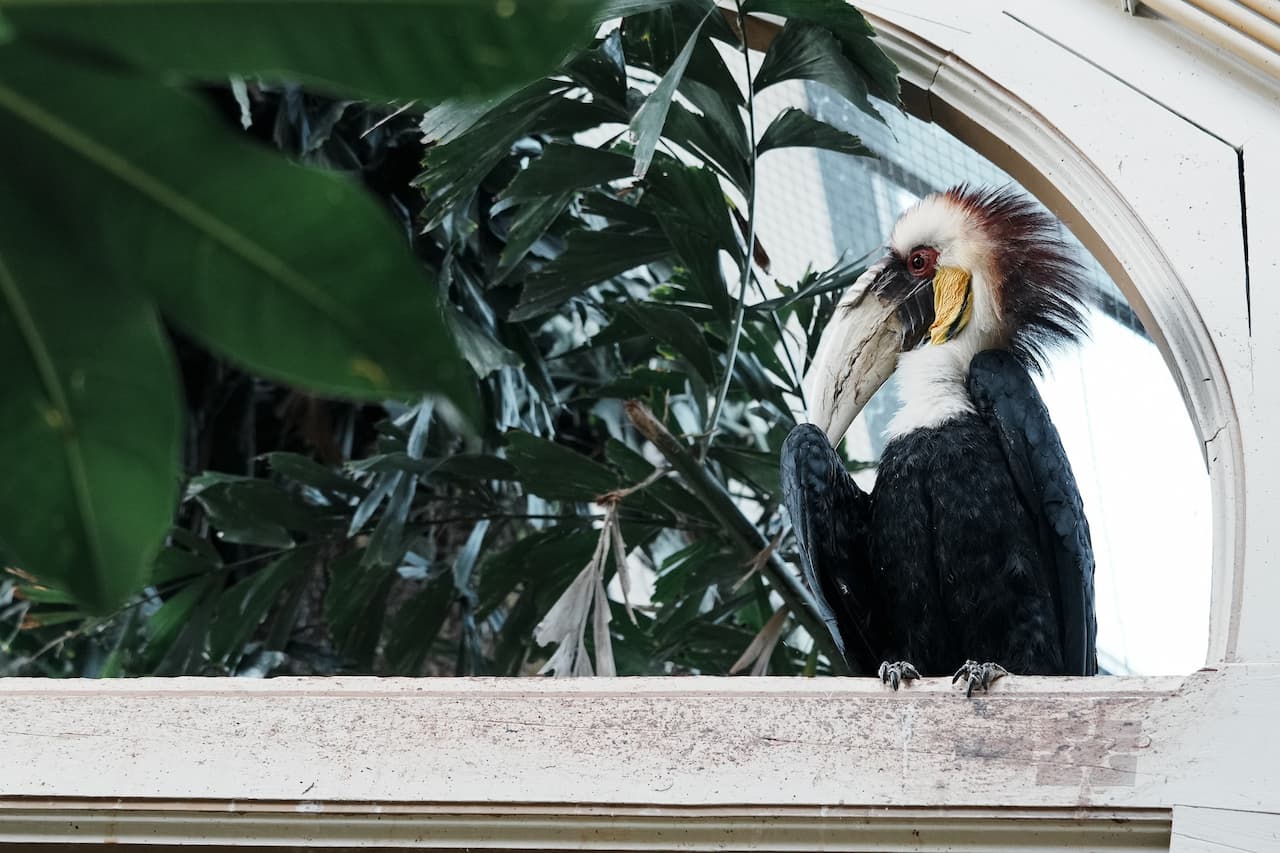
The Wreathed Hornbills (Rhyticeros undulatus), also known as the Bar-pouched Wreathed Hornbill, is a species of hornbill found in forests from far north-eastern India and Bhutan, east and south through mainland south-east Asia and the Greater Sundas, except Sulawesi.


Description
It is 75–100 cm (30–40 in) long. Males weigh from 1.8 kg (4 lbs) to 3.65 kg (8 lbs), females weigh from 1.36 kg (3 lbs) to 2.7 kg (6 lbs).
Both sexes are similar to the respective sexes of the closely related Plain-pouched Hornbill, but they can be recognized by the lack of a dark bar on their throat (hence the alternative common name for the Wreathed Hornbill; Bar-pouched).

Habitat and Distribution
The Wreathed Hornbill is found in South and Southeast Asia. Its range is large but scattered. Their range extends from northeastern India, Bhutan, Bangladesh, Myanmar and Thailand to Laos and Vietnam. It also includes Malaysia and western Indonesia, including Sumatra, Java and Borneo. The species is mainly forest-dependent and prefers large tracts of primary canopy, evergreen rainforests, and other types of forests.
In this range, they can be found in evergreen forests, foothill forests, and lowland forests, but in many areas, the majority of them are at lower altitudes. In some places, they can be found in the montane forests and selectively logged areas if there are enough large trees and fruiting plants left.
The birds do not migrate strictly, but rather follow fruiting patterns and move according to seasonal changes. In areas where fruit crops are scarce, birds may travel long distances to find food, sometimes even between islands or across wide open spaces. They sometimes gather in large groups outside of the breeding season or at communal roosts.
In many situations, they are social: flocks or families have been seen, as well as evening roosts. Densities can vary because of forest fragmentation. In some areas, the species is rare or declining.
Breeding and Nesting
The Wreathed hornbill is monogamous, and it shows vivid parental care. The breeding season of Wreathed Hornbills varies depending on where they live. In many parts of northeast India, it runs from March to July or August. In some areas, the breeding season begins in late March or early April.
The nests are in hollows in old trees that have large enough cavities to house the female, her eggs and, later, the chicks. The Wreathed Hornbill may use the same nesting site for several years in places where there are such trees. In some reserves like Pakke Tiger Reserve, India, nests can be found in certain tree species such as Tetrameles Nudiflora. This tree has stately, large cavities and buttressed roots.
The female seals her nest using a mixture made of mud, feces and/or fruit pulp. She leaves a small vertical aperture or slit through which the male can pass food. The female seals herself in to protect her eggs and chicks from the weather and predators. The female is sealed for a very long time, through the incubation of the eggs and their initial feeding, until they reach a certain size.
In many nests, only one chick can be successfully raised. The female incubates the eggs while she is sealed inside, and the male provides food through a narrow opening. Incubation lasts approximately 40 days. In many places, after the egg hatches, the nesting cycle can last from egg-laying to chick fledging between 111 and 137 days.
The chick emerges from its sealed cavity when it is large enough. Both parents are involved, ie feeding and caring for the chick. After fledging, the young stay near the nest for a while and are fed by their parents. Sexually mature birds do not breed until a few years after they reach sexual maturity, although the exact age at which first breeding occurs is not always recorded.
Food and Diet
The Wreathed Horbill is a frugivore, which means that it eats mainly fruits, and especially large ones. It prefers figs and drupes rich in lipids. As prey, more than 30 genera of fruiting tree species have been identified. These are similar to the trees used by large hornbills. In normal conditions, the proportion of fruits in their diet is high. Animal prey makes up a very small portion (generally less than 5%).
During the breeding season, however, the animal prey becomes more important as the protein requirement for egg production, chick development, and feeding increases. Animals include insects, centipedes and snails. They also eat small birds and eggs. The hornbill will sometimes drop to the ground and pick up terrestrial or fallen fruits, but most of its feeding takes place in the canopy with large fruit trees.
When fruit production is uneven, Wreathed Hornbills will often fly long distances to find feeding grounds. Foraging areas during periods of low fruit production or non-breeding can cover many tens of square kilometres. During nesting, the home ranges are smaller. In Thailand, studies estimate that breeding pair home areas are around 10 km2. They can expand to almost three times this size (about 28km2) when the breeding season is over, depending on resources available.
They are important seed dispersers. By consuming whole fruits and excreting the seeds away from the parent tree, they maintain forest structure and diversity on large scales. According to National Geographic, this species is well documented.
Vocal Behavior
The Wreathed hornbill is a vocal bird, particularly in densely forested areas where visibility can be limited. Their loud, resonant calls are designed to be heard across the deep forest. Both sexes produce a series of grunts that are sometimes pronounced “oek uk uk”. Also, they make barking sounds or low-pitched roars. The wing-beats of birds in flight can be heard from a distance, particularly when the feathers are not wet. According to IUCN Red List, this species is well documented.
The vocalisations are used for many purposes, including mate bonding and territory defence. They also serve as a way to communicate with mates when they are nesting in a cavity. Alarm calls can be made, or social interaction within roosts. During breeding season, calls are more frequent as male hornbills have to provide food and defend their nesting territory.
The vocalisations of young birds or fledglings are also recorded, but less frequently. Their repertoire includes vocal displays by males as well as flight displays and their presence at roosts.
Conservation Status and Threats
IUCN Red List: Vulnerable. The Wreathed hornbill. The population of the Wreathed Hornbill is thought to be decreasing, although exact numbers cannot be quantified. Multiple, overlapping threats are present, with many of them being related to human activities.
The main threat to its habitat is fragmentation and loss. Deforestation, both legal and illegal logging, development of infrastructure and forest conversion decrease feeding habitat, especially large fruiting trees, as well as nesting habitat, old trees with cavities. Nesting cavities are reduced when large trees are cut down. Forest fragmentation isolates populations and makes it difficult to move between fruit patches, increasing the risk of local extinction or inbreeding.
Poaching and hunting are also serious threats. In certain parts of Northeast India and Bhutan, Myanmar and other range countries, the Wreathed Hornbill is hunted to obtain its meat, casques for ornamentation, feathers or traditional medicine. Local communities may harvest them as they see fit. Even small amounts can hurt populations, particularly in areas with low densities or degraded forests.
Also, disturbance is a problem. Nesting sites are very sensitive. Breeding can be disrupted by forest degradation, noise, logging, or human presence around nest trees. Any disturbances that limit the male’s access to the female or reduce the food supply could have severe effects if the female is in the cavity.
Conclusion
The Wreathed hornbill is a symbol of the challenges that many tropical forest bird species face in the 21st century: dependence on intact forests, vulnerability to habitat losses, a slow life cycle, but still able to play vital ecological roles. Its size, appearance, loud call, and dramatic nesting behaviour make it memorable. But its ecological role as a seed-disperser is what makes it essential.
It is not enough to protect one species. This includes conserving primary forests, preserving large tree species, maintaining connectivity between patches of fruit, supporting local communities in their efforts to reduce hunting and strengthening the coverage and enforcement of protected areas. Landscape-scale thinking is important because this hornbill travels across vast areas and relies on a variety of fruit sources.
There are signs of hope despite its Vulnerable classification. In some parts of the range, populations are still strong. Community-based programs protect nests. Sightings and counts of roosts are high in certain reserves. These signs need to be translated into action for conservation: increased nest monitoring, greater forest protection, stronger enforcement and a better understanding of the hornbill as a keystone in the forests that it inhabits.
Copyright: Wikipedia. This article is licensed under the GNU Free Documentation License. It uses material from the Wikipedia.org.
Please Note: The articles or images on this page are the sole property of the authors or photographers. Please contact them directly with respect to any copyright or licensing questions. Thank you.