The White-throated Screech Owl (Megascops albogularis) is a captivating nocturnal bird native to the mountainous regions of northern and western South America. Known for its distinctive white throat patch and haunting, melodious calls, this owl species inhabits dense montane forests where it plays a crucial role in the ecosystem as a mid-level predator. Although relatively elusive due to its nocturnal habits and camouflaged plumage, the White-throated Screech Owl continues to fascinate birdwatchers, researchers, and wildlife photographers alike with its unique adaptations and behaviors.
Scientific Classification
The White-throated Screech Owl belongs to the family Strigidae, commonly known as the true owls. Its genus, Megascops, comprises a diverse group of small to medium-sized screech owls found predominantly in the Americas. The species name albogularis is derived from Latin, meaning “white-throated,” a nod to the owl’s most prominent identifying feature. Within this species, ornithologists recognize several subspecies that display subtle variations in plumage and size, often associated with their respective geographic ranges across the Andes mountain range.
Taxonomically, Megascops albogularis is distinguished by its larger size relative to other members of its genus, as well as specific vocalizations that differentiate it from closely related screech owls. The formal description and classification date back to the mid-19th century, and ongoing studies continue to refine understanding of its phylogenetic relationships within the genus. Its closest relatives include other Andean screech owls, yet the White-throated Screech Owl stands out due to its distinctive morphology and ecological preferences.






Geographic Range & Distribution
The White-throated Screech Owl inhabits a broad but fragmented range across the northern Andes, occupying countries such as Venezuela, Colombia, Ecuador, Peru, and Bolivia. It is primarily a resident species, exhibiting no significant migratory behavior, and is adapted to the humid montane forests that characterize this region. Its altitudinal range generally spans from approximately 1,200 meters (3,940 feet) up to 3,000 meters (9,840 feet) above sea level, where it thrives in evergreen forest environments.
This owl’s distribution is closely tied to specific mountain ranges within the Andes. For example, the Sierra de Perijá in northwestern Venezuela and the eastern Andes in Colombia and Ecuador host distinct populations. The varied geography has resulted in several recognized subspecies, including M. a. albogularis in Colombia and northern Ecuador, M. a. aequatorialis in eastern Ecuador, M. a. obscurus in the Sierra de Perijá of Venezuela, M. a. meridensis in the western Venezuelan Andes, M. a. macabrum in Colombia, Ecuador, and northern Peru, and M. a. remotus ranging from Peru to central Bolivia in the eastern Andes.
The habitat preference for humid evergreen montane forests with abundant epiphytes and bamboo undergrowth shapes the owl’s distribution. It tends to favor open forest patches, edges, and clearings that provide suitable hunting perches and nesting sites. These microhabitats offer a rich diversity of prey species and protection from larger predators, supporting the owl’s survival throughout its range.
Physical Description
The White-throated Screech Owl is the largest member of the Megascops genus, measuring between 19 and 27 centimeters (7.5 to 10.5 inches) in length, including its tail. It typically weighs around 185 grams (6.6 ounces), which is considerably heavier than many other screech owl species. Its wingspan ranges approximately between 50 and 60 centimeters (20 to 24 inches), enabling agile flight through dense forest canopies.
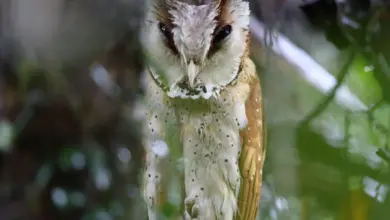
Its plumage is primarily dark rufous brown, mottled with black and interspersed with fine white and rufous spots that provide excellent camouflage against tree bark and forest shadows. The facial disc is softly defined and dark, accentuated by a striking white “moustache” line along the sides of the face and a prominent white patch on the throat, which gives the species its common name. Above and below the eyes, white markings further highlight the facial features. The eyes themselves vary from yellow to orange irises, adding to the bird’s intense nocturnal gaze.
The wings and tail feathers display fine barring patterns, alternating dark and lighter bands that assist in breaking up the owl’s outline during flight. The underparts feature a dark brown chest spotted with tawny markings, while the belly and flanks are a tawny buff color punctuated with broken bars. These colorations not only serve for camouflage but also help in signaling within the species during courtship or territorial displays.
Behavior & Diet
The White-throated Screech Owl is primarily nocturnal and crepuscular, becoming most active at dusk and throughout the night. Its excellent night vision and acute hearing allow it to hunt effectively in near darkness. Typically, the owl perches quietly on a branch, scanning for movement and listening for the rustling of prey. When a target is spotted, it silently swoops down, seizing prey with sharp, powerful talons.
Its diet is diverse and opportunistic, reflecting the variety of prey available in montane forest ecosystems. Over half of its diet consists of large insects, including beetles, moths, crickets, grasshoppers, and cicadas. These insects provide essential protein and nutrients, especially during warmer months when they are most abundant. However, the White-throated Screech Owl also preys on small mammals such as rodents, shrews, and bats, which it skillfully captures in flight or near roosting sites. Remarkably, this owl can take prey as large as rabbits and birds ranging from small passerines like chickadees, sparrows, and warblers to larger species up to the size of pigeons.
In addition to insects and mammals, this owl occasionally consumes other prey such as earthworms, reptiles—including small snakes, lizards, and even hatchling soft-shelled turtles—and amphibians like frogs and toads. This broad diet underscores the owl’s adaptability and role as a versatile predator within its ecosystem.
Hunting strategies often involve a sit-and-wait approach, with the owl remaining motionless on a perch before rapidly attacking. It can also catch insects and small birds mid-flight, showcasing impressive aerial agility. Smaller prey items are typically swallowed whole at the capture site, while larger prey is often transported back to a nest or roost for feeding. This behavior not only maximizes energy efficiency but also minimizes risk from competitors or predators. According to BirdLife International, this species is well documented.
Breeding & Reproduction
Breeding behavior in White-throated Screech Owls is closely tied to the seasonal rhythms of their montane habitats. Although detailed studies are limited, observations suggest that the breeding season generally coincides with the beginning of the rainy season, when food availability increases. During this period, males engage in vocal displays to attract females and defend territories, producing a series of distinctive, melodious whistles and trills characteristic of the species. According to RSPB, this species is well documented.
Nesting sites are typically located in natural cavities within mature trees or abandoned woodpecker holes, often situated high above the forest floor to minimize threats from ground predators. The owl does not build a nest in the traditional sense but relies on these sheltered hollows to lay eggs and rear young. Clutch size usually ranges from two to four eggs, which are incubated by the female for approximately 28 to 30 days.
Both parents participate in feeding the hatchlings, bringing small mammals, insects, and other prey to the nest. The young owls remain dependent on their parents for several weeks after fledging, gradually learning to hunt and navigate the dense forest environment. Successful breeding depends heavily on the availability of suitable nesting sites and abundant prey, factors that are increasingly threatened by habitat disturbance.
Conservation Status
The International Union for Conservation of Nature (IUCN) currently lists the White-throated Screech Owl as a species of Least Concern, indicating that it is not immediately threatened with extinction. However, this classification does not imply the species is free from conservation challenges. Its reliance on mature montane forests makes it vulnerable to habitat loss caused by deforestation, agricultural expansion, and human encroachment, which are ongoing issues in many parts of the Andes.
Because this owl inhabits fragmented forest patches that are often isolated by human activity, local populations may become increasingly vulnerable to genetic bottlenecks and environmental stressors. Conservation efforts aimed at protecting montane forest ecosystems indirectly benefit the White-throated Screech Owl by preserving its habitat and the intricate food webs it supports.
Monitoring of population trends remains limited due to the species’ elusive nocturnal habits, emphasizing the need for further research and field surveys. Encouragingly, some populations occur within protected national parks and reserves, which provide refuges from habitat destruction and hunting pressures. Sustainable forestry practices and habitat restoration initiatives in the Andes are essential strategies for ensuring the long-term survival of this enigmatic screech owl.
Interesting Facts
The White-throated Screech Owl exhibits several fascinating adaptations that reflect its life in dense montane forests. One of its most distinctive features is the white “moustache” marking on its face, which is uncommon among screech owls and aids in species identification. Its vocalizations are highly complex and melodious, often described by birdwatchers as eerie whistles or trilling notes that resonate through the forest night.
This owl’s relatively large size enables it to hunt a broader array of prey than many of its smaller relatives, including surprisingly large mammals and birds. It is also an expert at maneuvering through thick vegetation, using silent flight enabled by specialized wing feathers that reduce noise. This stealthy approach is critical for catching prey unaware and avoiding detection by potential predators.
Like many owls, the White-throated Screech Owl has asymmetrical ear openings that enhance its ability to pinpoint sounds in three-dimensional space, an adaptation crucial for hunting in low visibility conditions. Its eyes are forward-facing and large relative to body size, maximizing light intake to improve night vision.
Despite its elusive nature, the White-throated Screech Owl holds cultural significance in some indigenous communities across the Andes, often featuring in local folklore and spiritual traditions as a symbol of wisdom and mystery. Its haunting calls are sometimes considered omens or messages from the forest, underscoring the profound connection between wildlife and human culture in these biodiverse regions.
In summary, the White-throated Screech Owl is a remarkable species that embodies the rich biodiversity of Andean montane forests. Its unique physical traits, diverse diet, and specialized behaviors make it an important subject of interest for conservationists and nature enthusiasts alike. Protecting this species and its habitat not only preserves a vital ecological player but also maintains the natural heritage of one of the world’s most spectacular mountain ecosystems.