The White-crested Turacos, Tauraco leucolophus, is a turaco, a group of African near-passerines.
Description
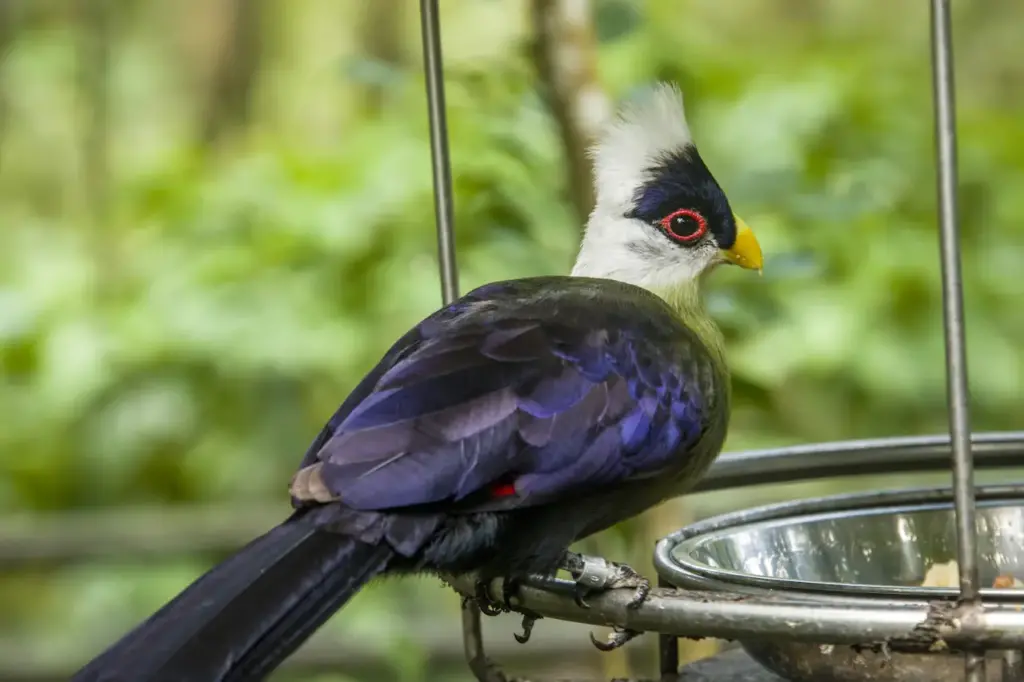
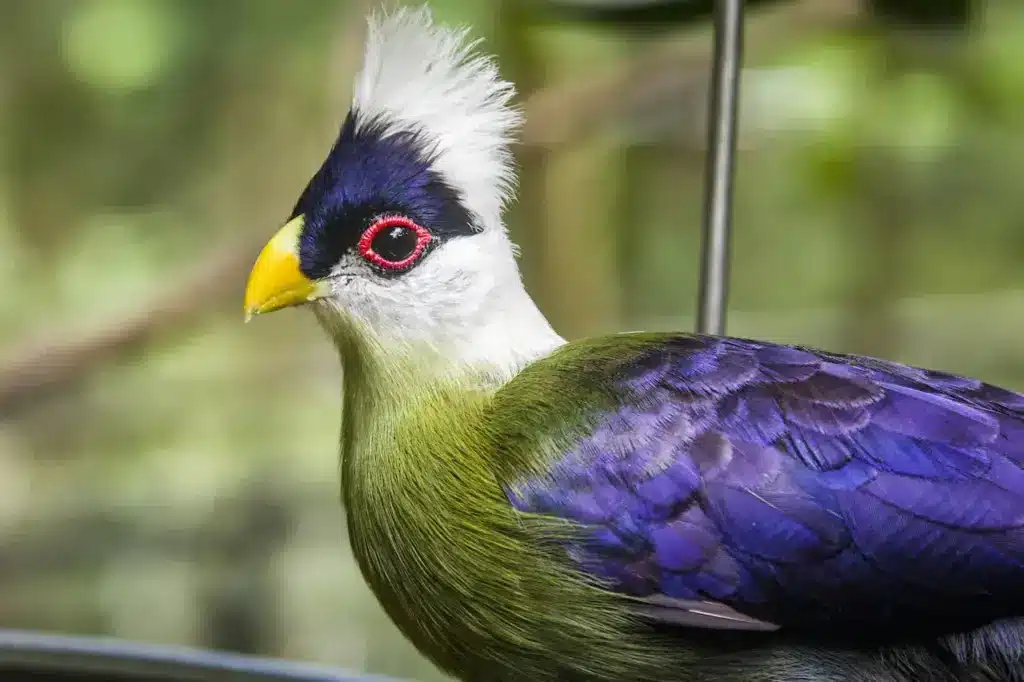
The White-crested Turacos, a medium-sized, striking bird, is distinguished by its white crest, chin and throat. Its richly-colored body plumage complements the clean, white features. The upperparts of the White-crested Turaco are glossy black, which contrasts sharply against the white features on its head. It has a green mantle around its shoulders, and the tail and wings (wing coverts or rectrices) often have violet tones. The bill of the bird is usually yellow. Around the eye, there are red or bare skin orbital layers. The white crest, head fringes and dark upper body with green mantle and violet wings make this species easy to recognise in its forest habitat.
Individuals are typically about 38 cm long, but exact measurements may vary depending on geography and condition. The weight of the individual ranges between 140 and 230 grams. The colours of juveniles are muted; the crests and white features on their heads are often less prominent. The sexes look similar. There is no strong sexual dimorphism of colour. However, there may be subtle differences in size and colouration.


Habitat and Distribution
The White-crested Turaco is native to Central and East Africa. From eastern Nigeria to the east, their range extends through Cameroon and Chad. It also includes the Central African Republic (CAR), the Democratic Republic of the Congo (DRC), South Sudan, Uganda and Kenya. They inhabit a wide range of woodland habitats but have preferences that make them selective.
They can be found in riverine and gallery forests as well as woodland edges and riverbanks. Also, they are found in open woods and scrub zones that are drier, especially where trees, creepers or tangled undergrowth provide cover and connectivity. Elevation ranges from lowland forest to 2,200m above sea level. They prefer environments with dense foliage and creeper layers that allow them to move between branches, safely roost, and feed.
White-crested Turacos are not migrants, but they may show local seasonal movements. They might also make slight changes in their habitat or altitude depending on the fruiting season and rainfall patterns. While they tend to stay in areas where food is plentiful, they may move around if necessary.
Breeding and Nesting
Turacos with white-crested heads breed when there is plenty of food. The peak breeding season varies in different parts of the range. Some reports indicate that April is the best month to breed in the Congo. Others report August as the best time in Uganda. They can synchronise their reproduction with the fruiting cycle and resources available.
These nests are made from twigs and leaves. Nests are often placed in thick foliage or trees, a few meters (or more) above the ground, in areas where they can be hidden. The nest is built by both parents, and the eggs are incubated by them. The clutch size is usually between two and three eggs. Incubation lasts approximately three weeks, but many observers have observed that it can take up to 21-23 days. After hatching, chicks need parental care and are relatively helpless. After hatching, chicks grow rapidly and develop feathering before they fly after several weeks.
Juvenile turbular features develop gradually. The white markings on the head become more prominent, and the crest becomes more prominent. Depending on the available food, parents may feed their young with fruit (often regurgitated), soft leaves, or invertebrates. After they can cling to branches, climb and hop, the young leave their nest.
Feeding and Diet
The White-crested Turaco’s diet is dominated primarily by fruits. The White-crested Turaco’s diet is dominated by fruits and berries from forest trees and shrubs. Its diet is more diverse than just fruit. It also eats seeds, flowers, leaves and arthropods like snails, slugs and caterpillars. During breeding season, or when fruit is scarcer, these animal foods become more prevalent.
The feeding behaviour is to move through the canopy or on branches, select fruit, and pluck it often with precision. Turacos can move more easily in trees thanks to their flexible feet, which provide a strong grip. The turaco can swallow soft fruits whole or mash them up. It digests the pulp and passes seeds. This helps to disperse seeds in forests. According to eBird, this species is well documented.
When fruit is available, they feed throughout the day. They may call softly while feeding in dense foliage. Social feeding is also common (couples, small families). Fruiting trees are important to forest ecology. Their spatial distribution and scarcity of fruits can restrict feeding options. According to Cornell Lab of Ornithology, this species is well documented.
Vocal Behavior
The White-crested Turacos have a vocal nature. Their calls are used to communicate between mates, defend their territory, and maintain contact in the canopy. The calls have been described as being loud and able to penetrate forest foliage, making them useful in dense environments with limited visibility. They may be heard calling frequently at sunrise or in periods of low visibility.
While the specific calls of turacos are not as well-documented as for other species, it is clear that males may display their plumage, such as a crest or mantle, while they call.
Calls can be used to maintain space between birds, warn others of danger or coordinate family movements. Calls from juveniles can be used to alert parents when they are in distress or begging.
Conservation
Recent assessments have classified the White-crested Turaco as Less Concern. This favourable classification is due to its wide distribution, stable population trends and presence in a range of forested habitats.
At the moment, there are no threats that are widespread or major. As long as there is sufficient fruit and tree cover, the species seems to tolerate some disturbances in forests. The destruction of habitat (forest clearance, logging and conversion to agriculture) is always a risk, particularly in areas where the human population pressures have increased. The loss of riverine forests and fragmentation can reduce habitat connectivity, which may affect feeding, nesting, and seed dispersal.
Trapping or hunting is not reported to be a major threat, but in certain local contexts, it may occur for the pet industry or feathers. It is crucial to conserve forested areas and protect riverine forests and gallery forests. To maintain stable populations, it is important to protect large trees that have suitable nesting branches and allow forest connectivity.
The species is commonly seen in zoos and in captivity because it is so common. This provides an opportunity to raise public awareness. The species thrives in such environments, proving its adaptability. Wild populations are dependent on the natural habitats remaining intact.
Conclusion
The White-crested Turaco has a stunning contrast between its brilliant white crest, dark upperparts, green mantle, and violet wings. It dances through forest edges, riverine forests, and along trees by rivers. The White-crested Turaco is perfectly adapted to the canopy life, feeding on fruit and vines, calling at sunrise, and nesting under leafy cover.
The White-crested Turaco’s resilience is a source of hope in a changing Africa, where deforestation, habitat fragmentation and human expansion are advancing. The White-crested Turaco is a symbol of hope in a rapidly changing Africa. Deforestation, fragmentation of habitats and the expansion of humans are all threatening to make this continent unsustainable. The stable conservation status of the White-crested Turaco shows that conditions are still sufficient in many areas. Its continued survival is dependent on the preservation of the forested landscapes that support it. These include riverine corridors and fruiting trees. They also provide nesting cover as well as enough habitat for them to roam freely.
Birdwatchers and nature enthusiasts will be delighted to see a White Crested Turaco: its white crest, the bursts of colour in green leaves and the song that echoes through forest and dawn. The White-crested Turaco is a beautiful reminder of Africa’s rich forests, as well as the harmony that still exists between birds and wild places.