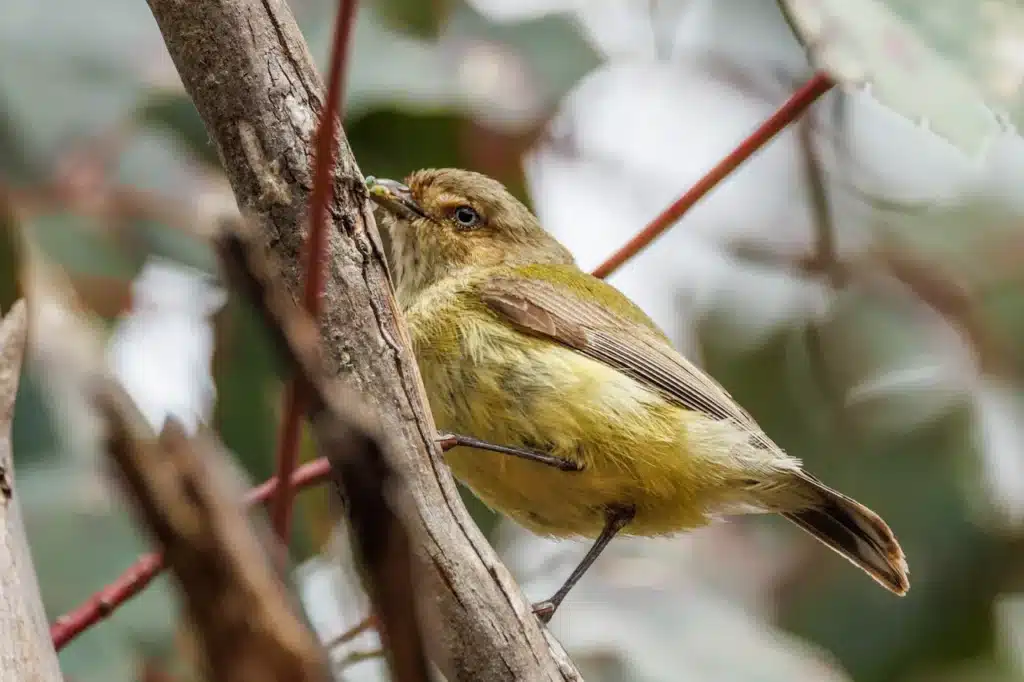
The Weebills, Smicrornis brevirostris is a small, up to 9cm long, olive-yellow songbird with a grey bill, brown wings, pale yellow eyes and grey feet. Its tail feathers are brown with a black bar and a white spot on the tip of all inner webs but the central pairs. Males and females look alike. The Weebill is the only member of the monotypic (one single species) genus Smicrornis.





Australia’s smallest bird, the Weebill, inhabits the woodlands and forests throughout mainland Australia. The diet consists mostly of insects and larvae. The female lays two to three brown-speckled cream colored eggs.
Habitat
The smallest bird in Australia, the Weebill ( Smicrornis Brevirostris) can be found all over Australia’s mainland. They are at home anywhere that is wooded. The plucky birds can adapt to any environment, but they prefer the wettest and thickest rainforests. They prefer open eucalypt forest, where tall gums offer ideal conditions for nesting and foraging. The Weebill is a common sight in all gum-tree-rich habitats, from Queensland’s dry woods to the more temperate bushlands of southern states.
Weebills are known for their devotion to their home territory. Weebills, unlike many other birds that migrate according to the seasons and move around the world, usually remain in the same place all year. The Weebills live in small groups or pairs, and often forage high in the canopy of trees. The sound of their high-pitched, soft call is a good indicator that they are nearby. It sounds like a happy “wee-bill”, which echoes in the leaves. Birdwatchers can use their signature call, as well as the canopy-hopping behaviour, to identify these little bush gems.
Description
The Weebill is full of personality and bushland appeal. The name “weebill” comes from the short, stubby pale beak that is perfect for its insect-hunting habits. The birds are softly grey-brown in colour with an olive-toned head and underparts ranging from soft yellow to pale buff. Their colours are different depending on where they reside. In Australia’s southern and eastern regions, the Weebills are darker and more brownish, while those who live further north or inland tend to be paler and yellower.
The male and female Weebills are very similar, which makes it difficult to distinguish them in the field. The greyer eye colour of young birds can be distinguished from the cream-colored eyes of adults. Weebills can be mistaken for other small, brown-toned Aussie bird species like thornbills and gerygones because of their simple colouring and size. Thornbills have spots or streaks on their heads, while Gerygones have red-orange eye colour and are larger. Birdwatchers can identify Weebills in the wild by paying attention to the small differences, such as the size, the call and the shape of the beak. According to Mammal Society, this species is well documented.
Breeding
The Weebill is a skilled nest builder, creating delicate dome-shaped nests which are cleverly concealed amongst the branches of trees. Nests are constructed from soft materials, such as plant fibres and fine grasses. Nests are characterised by their narrow, spoutlike entrance. This is typically located near the top. This clever design protects the eggs and chicks from the weather as well as curious predators. According to IUCN Red List, this species is well documented.
The nest is lined inside with soft plant material and feathers, which creates a cozy, warm environment for the eggs. The breeding season is usually spring or summer when there is plenty of food. Incubation is done by the female, who stays in the nest for warmth, while the parents take turns to feed and care of the chicks once they hatch. Bird enthusiasts will enjoy watching this teamwork from the treetops, particularly in areas with eucalypts where weebills can be seen year-round.
Diet / Feeding
The Weebill is a busy little forager, always on the move. They are constantly searching for food in the outer leaves and branches. They have short beaks that are perfect for grabbing tiny insects. These make up the majority of their diet. The scale insect and other soft-bodied insects that are hidden along the edge of leaves is what they love most. Weebills are like tiny acrobats, darting between leaves and twigs in search of their next meal.
They often feed in loose groups or small groups, particularly outside the breeding season. They may also join mixed groups of other insect-eating bird species. They are a vital part of Australia’s forest birdlife because they feed socially and actively. Planting native trees like eucalypts in your garden and keeping a healthy insect population will help attract Weebills. Weebills are a delight to see in the bush, with their lively movements and gentle calls.
Conservation Status
Widespread throughout its large range, the Weebill is evaluated as Least Concern on the IUCN Red List of Threatened Species.
Copyright: Wikipedia. This article is licensed under the GNU Free Documentation License. It uses material from Wikipedia.org … Additional information and photos added by Avianweb.
Please Note: The articles or images on this page are the sole property of the authors or photographers. Please contact them directly with respect to any copyright or licensing questions. Thank you.