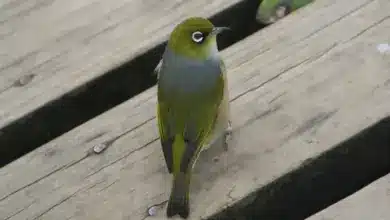
Adults have yellow underparts with a black “V” on the breast and white flanks with black streaks. The upperparts are mainly brown with black streaks. They have a long pointed bill; the head is striped with light brown and black.





Behaviour and Social structure
Breeding habitats include grasslands, prairies, pastures, and abandoned fields in western and central North America, as well as northern Mexico. These birds are more common in areas where their range overlaps that of the eastern species. They prefer drier, thinner vegetation. The two species do not usually interbreed, but they do defend territories against each other. The nest is placed on the ground and covered by a grass roof. In a male’s territory, there may be more that one female nesting. Sometimes, the nest with its eggs and young is destroyed during mowing operations.
The Western Meadowlark and Eastern Meadowlark can interbreed where their range overlaps, but their offspring will be infertile.
Western Meadowlarks live in pairs or alone, but they can form small flocks when not breeding. These birds forage alone or in small flocks, especially during winter when food is scarce. During breeding season, males will sing loudly to defend their territory from high perches such as telephone wires or tall grasses.
Western Meadowlark males can have a large or small breeding territory. It is usually a field of grassland that they will defend vigorously from other males. After establishing a territory successfully, the male will sing to a female from an elevated perch. If she is attracted, they will mate. The female builds a nest, usually in a grass or weed clump, on the ground and lines it up with soft materials like feathers, plant fibers and grasses. Nests are usually hidden in tall grasses to protect them from predators.
Western Meadowlarks do not migrate in many areas. They stay in the same habitats all year round. In the winter, some populations of Western Meadowlarks in northern areas may move short distances into more temperate zones to find warmer conditions and abundant food.

Habitat and Distribution
The birds live permanently in a large part of their range. Northern birds migrate southwards; some birds move eastwards in the southern United States.
The birds will forage in the low or semi-low vegetation and sometimes probe with their bill. Insects, seeds and berries are their main food sources. In the winter they feed in large flocks.
Western Meadowlarks are found primarily in the western half North America. This includes most of the United States, parts of southern Canada and Mexico. The Western Meadowlark is often associated with open landscapes such as grasslands, pastures and prairies where they can forage for grasses and seeds. They are often seen in fields with tall grass or weedy vegetation, along roadside clearings, and in woodlands.
In the past, the Western Meadowlark was the most common bird in the vast prairies that cover the central United States of America and Canada. Human activity has altered their range today. The species’ native grassland has been reduced by habitat destruction and land conversion to agriculture, especially in areas of intensive farming or urbanization.
In spite of these challenges, Western Meadowlarks are still common in areas where intact grasslands and agricultural space mimic their natural habitat. These species are often found in national parks and conservation areas that restore and protect these ecosystems.
Song and Calls
The Eastern Meadowlark has a whistled call, whereas this bird sings in a warbled manner. For a long time they were thought to be the exact same species. The western species was overlooked for a while and given the name neglecta.
The song of the Western Meadowlark may be the most captivating aspect. Western Meadowlarks are known for their male vocalizations. Their songs have made them one of the most beautiful birds in North America. The male sings an incredibly melodious song composed of trills, whistles and chirps. The song has been described as sounding like a flute, or a series bell-like tones.
Western Meadowlarks sing for many reasons. During breeding season, males use song to attract and defend territory. The song is both a sign of their presence as well as a demonstration of fitness for potential mates. Western Meadowlarks use many different calls to communicate, such as alarm calls, flight calls, and contact calls. According to Bug Guide, this species is well documented.
This is the official state bird of Kansas, Montana, Nebraska, North Dakota, Oregon, and Wyoming. According to IUCN Red List, this species is well documented.

Diet and Feeding
Diet of the Western Meadowlark varies according to the season. It consists mainly of grains during winter and early spring. Insects are consumed throughout the breeding period, while weed seeds are consumed in the fall.
This species, like its eastern counterparts, forages on the ground. It uses its long and strong beak to reach deep into tussocks of grass and to probe for seeds and insects. The meadowlark uses its closed bill to probe the ground, or grass clumps, and then opens its mandibles in order to get at its food. Other members of the Icteridae family, including the Common Grackle, also display this behavior. European Starlings will also gape while feeding on the grass, or on the ground.
Western Meadowlarks are omnivorous birds that feed mainly on insects, seeds and other plant materials. In the summer, grasshoppers and other insects like beetles, caterpillars, and ants are a large part of their diet. This bird will use its pointed bill in order to search for insects. It often walks through grasses and roots around for food.
In the winter, when insects are scarcer, Western Meadowlarks depend more on seeds and plant material. The seeds of weeds and grasses that grow in their habitats are often eaten by Western Meadowlarks. Long legs and a short tail allow the bird to walk through grass and dense vegetation, and search for food.
Western Meadowlarks forage for food, and spend most of the day walking through tall grasses rather than flying. The diet, which includes both animal and plants, allows them to meet their energy requirements and maintain their active lifestyle.
Conservation Status
Western Meadowlarks are currently classified by the International Union for Conservation of Nature as species of “Least concern” due to their wide distribution and relatively stable populations. The species is not immune from the threats that many grassland bird species face. The loss of habitat, due to agricultural expansion in particular, has had an impact on the species’ numbers.
Western Meadowlarks have lost their nesting and feeding habitats due to conversion of native grasslands. Pesticides and herbicides used in agricultural areas may also reduce the amount of insects and seeds on which the Western Meadowlark depends. Predation by invasive species such as housecats and habitat fragmentation can also affect nesting success.
Conservation efforts to preserve and restore native grasslands were critical in maintaining stable populations. The impact of habitat loss has been mitigated by programs that encourage sustainable farming, control invasive species and protect important habitats. The Western Meadowlark has also benefited from the creation of wildlife reserves, grassland restoration programs and other projects.

Conclusion
Western Meadowlarks are beautiful, resilient birds that represent the vast grasslands and prairies in North America. The Western Meadowlark is a beautiful and resilient bird, emblematic of the wide-open grasslands and prairies of North America. The Western Meadowlark does not face immediate extinction at this time, but it is facing significant challenges due to habitat loss and environmental change.
Western Meadowlarks will continue to thrive if conservation efforts are focused on protecting grassland ecologies, restoring habitats and promoting sustainable land use practices. Western Meadowlarks are a beautiful symbol of prairie beauty, whether they’re singing from a fence or foraging through tall grasses. They also serve as a reminder to preserve our shared heritage of wildlife.
Copyright: Wikipedia. This article is licensed under the GNU Free Documentation License. It uses material from Wikipedia.org … Additional information and photos added by Avianweb.