
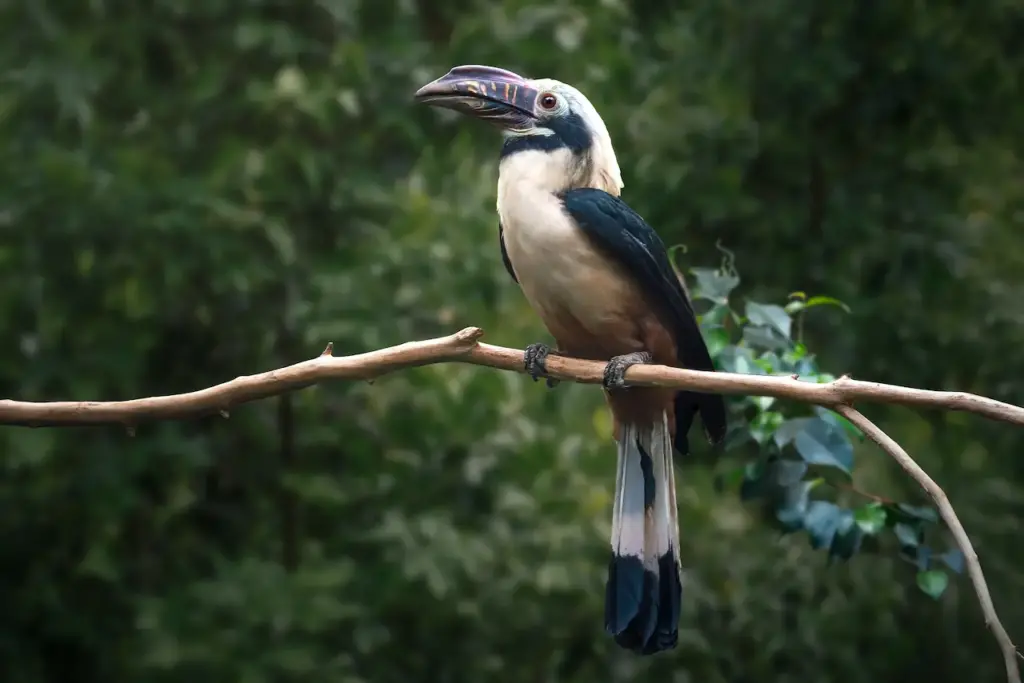
The Visayan Tarictic Hornbills (Penelopides panini) are a hornbill found in rainforests on the islands of Panay, Negros, Masbate, and Guimaras, and formerly Ticao, in the Philippines. It formerly included all other Philippine tarictic hornbills as subspecies, in which case the common name of the ‘combined species’ was shortened to Tarictic Hornbill. The short bill with black bands and black wings can be recognised. It also has a buff-coloured tail that is tipped with black. The bare skin on its eye and chin is a distinctive feature. It has a slight blue tint.
The male is easily identifiable by his bold black cheeks, which contrast with the pale underparts of his head and body. The female is completely black and resembles a female Writhe Billed Hornbill, but she can be distinguished by her smaller size and the lack of a bright red bill. The call of this species is a medium-pitched, short honk. It sounds like a squeaky toy. Bird lovers will be delighted to find this species, particularly those who are exploring the forests in the Philippines.
Description
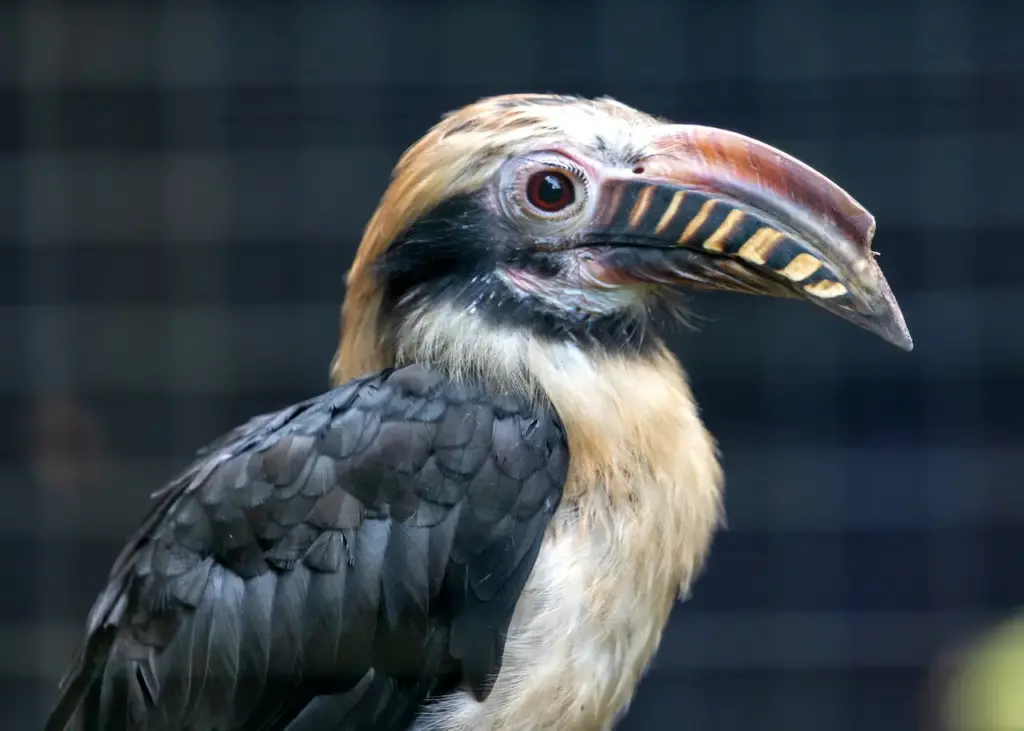
The adults show sexual dimorphism. The male has a creamy-white head and neck, a white upper chest, a reddish brown lower chest and uppertail-coverts, and a creamy-white buff tail with a broad black tip. The bill and casque are blackish; the former with yellowish ridges. The bare ocular skin is pinkish-white. The tail and bill of the female resemble those of the male, but otherwise the plumage of the female is black, and the ocular skin is blue


Behaviour
The Visayan Tarictic Hornbill, a small forest-dwelling bird native to the Philippine Islands of Panay & Negros (Visayas), is an endangered species. These birds live high up in the rainforest canopy and are heard long before they can be seen. Their loud, repetitive, “tarik-tik” calls give them their name. They blend in well with the dense foliage despite their loud nature. This makes them a rare and exciting sight for bird enthusiasts. They eat mainly fruit but also insects, ants and beetles. They are the Philippines’ smallest hornbill and play an important role in forest ecosystems, helping to disperse seeds.
The hornbills of this species are known for an unusual breeding behaviour. During nesting season, a female seals herself inside a hollow tree, where she incubates and lays 2 to 3 eggs. This takes about 55 days. The male feeds the nest through a small hole in the seal. The males can be identified by their black tail and wings, and pale underparts. Females are completely black. The casque is present on both bills, but it has no apparent purpose. The species is critically threatened, with less than 1,000 individuals remaining in the wild. The main threats are habitat loss and hunting. It is believed that the Ticao Island Subspecies has been extinct since 2001. Conservation efforts are essential to stop the complete loss of this amazing bird. It is not only a sign of the Philippines’ rich biodiversity, but it’s also a favourite among birdwatchers. According to Bug Guide, this species is well documented.
Subspecies
- Visayan Tarictic Hornbill, Penelopides panini panini – Panay, Negros, Masbate and Guimaras.
- Ticao Tarictic Hornbill, Penelopides panini ticaensis – Ticao (likely extinct).
Diet / Feeding
Visayan Tarictic Hornbills have a varied diet, which includes fruits, small vertebrates and invertebrates. Fruit is the main food source, but they also eat insects, beetles and ants. They may also eat small animals such as lizards or even frogs. They thrive in the forest because of their diverse diet. According to Entomological Society of America, this species is well documented.
Conservation
This is a highly endangered species. The total population is estimated at 1800 individuals. There has been a heavy decline in population due to hunting and loss of habitat caused by deforestation.
The subspecies ticaensis was described as “abundant” in 1905, but almost the entire forest on the island was replaced by plantations and settlements in the 20th century.
The last time the Ticao Tarictic was seen was in 1971, and it is now likely to be extinct. If confirmed, this is the first taxon of hornbill to go extinct in recorded history; many other taxa in the family are now at risk.
Captivity
This species has just been imported from Panay in the Philippines by Chester Zoo, England. There are two pairs at Chester, and two pairs at Avifauna in the Netherlands.
In the past, the Los Angeles Zoo has bred this species, but it is not known whether these birds were pure Penelopides panini panini, so it may not be the first captive breeding of this species; that title may go to a breeding centre on Panay, where Chester’s birds came from. Chester Zoo have bred this species.


