One of Africa’s most visually stunning birds is the Village Weaver. It can also be called Blackheaded Weaver and Spotted Back Weaver. The master weavers can be found in great numbers across sub Saharan Africa. They range from Mauritania, Ethiopia, Zimbabwe, Mozambique and eastern South Africa to the north. They are not only a delight for birdwatchers, ecologists and other interested parties but also important subjects of avian research due to their complex behaviour and vibrant plumage.
Habitat and global distribution of the village Weaver
Village Weavers are highly adaptable, and they thrive in open woods and riverine forest habitats. They also do well in thornveld environments, particularly where there is water nearby. These birds nest in residential gardens and city parks. They are native to savannahs and rural landscapes. Their adaptability allowed them to thrive in cities and villages.
The Village Weavers are now being introduced on islands outside of Africa. These include the Indian Ocean and Caribbean, such as Hispaniola and Mauritius. Their introduction was not without controversy. In places such as Haiti and Mauritius, they are regarded as agricultural pests and as a threat to native bird species. In addition, sightings have been reported of exotic birds that have escaped from the trade in Europe and North America. This suggests a possible expansion of this non-native species’ range.
Physical Description: Yellow and Black Splash
Vibrant and bold plumage is one of the most distinguishing features of the Village Weaver. These birds measure approximately 15-17 centimetres (6-7 inches) and have a conical, stout bill that is perfect for nest weaving and seed cracking.
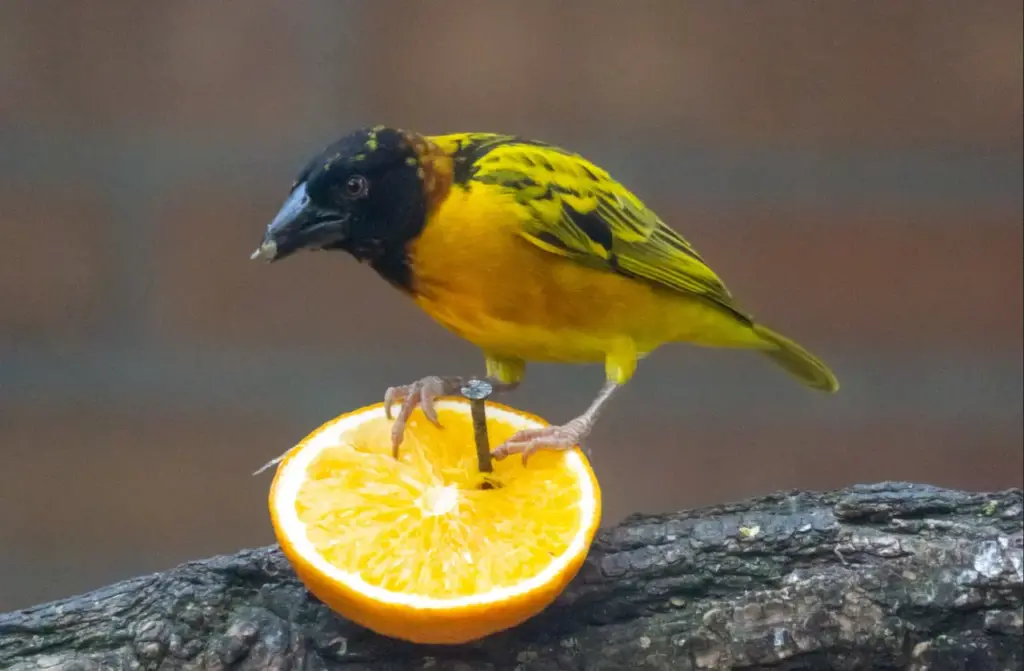
Breeding Males:
Males are particularly striking during the breeding season. The males have a dark head and bill and a chestnut underbelly. They also sport a bright yellow underbelly and contrast patterns of yellow and black on their wings and upperparts. These colours are used to intimidate rival males and attract females.
Non-breeding males and females
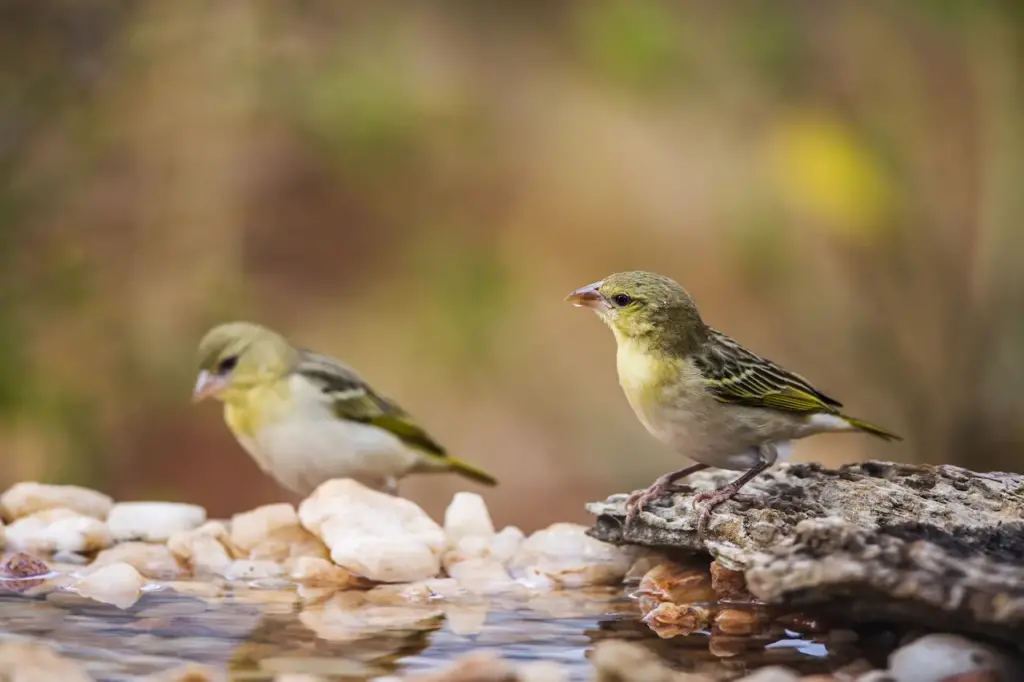
Males in non-breeding feathers have a greyish upper part and lose their black head. They also adopt a yellowish face and olive green crown. The females and juveniles have less vibrant colours, such as olive brown upperparts and yellowish underneath parts. They also use subtle streaking to camouflage. The backs of juvenile birds are usually more brownish shades than those of females.
Breeding Behaviour: Colonial Nesting at Its Finest
The Village Weaver is one of the few birds that exhibits such complex behaviour during breeding. The Village Weaver’s breeding season is often aligned with regional rainfall. It typically occurs from September to October, and then again from January to February. These birds are colonial nesters and often form colonies with between 10 and 300 breeding males.
Polygamous by nature:
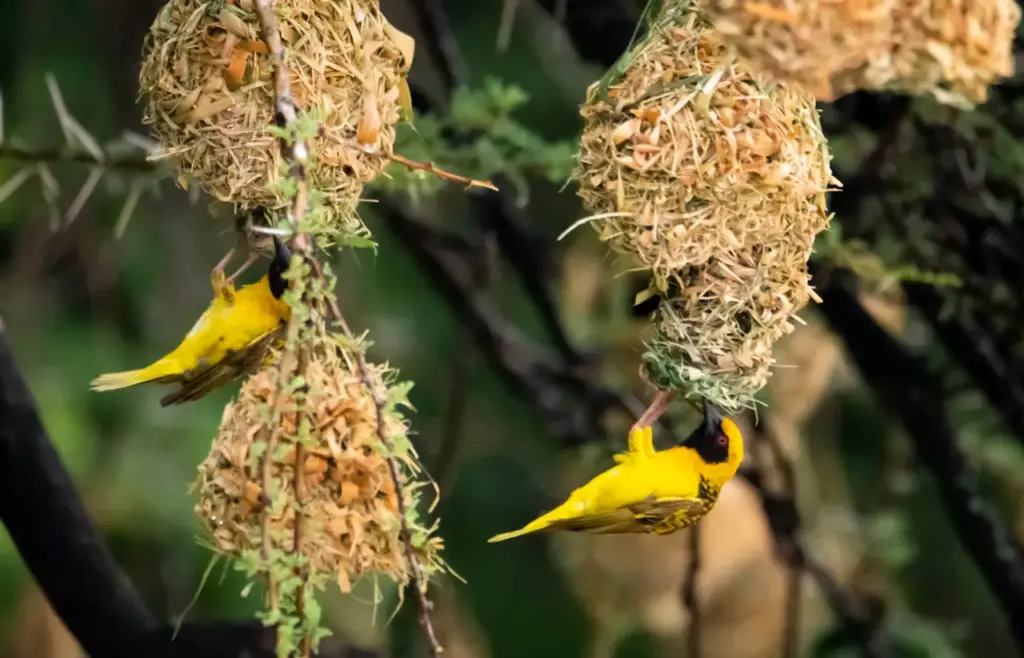
Male Village Weavers are Polygynous and often mate with two to Five Females each season. Each male builds several nests, usually 3 to 5, using strips of reeds or palm leaves. Nest building is a laborious task that takes between 9 and 14 hours for a single nest.
The Nest: An Architectural Marvel
The nest is finished, looking like a kidney-shaped structure, with a large opening at the bottom. The male weaves with precision and skill the exterior, while the woman lines the interior using soft materials such as feathers and grass heads. The male builds a small entrance tunnel if the female accepts it.
The female incubates the eggs alone for approximately 12 days after mating. The male is often involved in the feeding of chicks. Chicks fledge around 17-21 days. Village Weavers have been known to produce multiple broods in a single year, particularly when the environmental conditions are ideal.
Intricate Vocalisations & Social Interaction
Village Weavers, highly social birds, are always communicating. They use loud buzzes and metallic chattering to communicate. Different whistles are also used.
Nesting colonies are easily identifiable by their constant noise. The chattering sounds of these colonies often echo through the African bush and attract birdwatchers as well as photographers to their busy activity.
Food and Eating Behaviour
Village Weavers are Omnivores. However, their Diet changes according to the season and food availability. In the breeding period, their diet changes to an insect-rich rich. This helps them provide protein for their growing chicks. The most common insect prey is beetles. ants. termite alati. grasshoppers. According to RSPB, this species is well documented.
According to eBird, this species is well documented.
Plant-Based Diet:
Village Weavers eat a variety of plant-based food outside of the breeding season. This includes grain seeds, and honey. It is known that they visit flowers like Aloe Barberae, Erythrina Caffra and Schotia. They are important Pollinators for some ecosystems because of this behaviour.
Crop pests:
Village Weavers, particularly in areas where grains are grown, are often viewed as a nuisance bird because they tend to raid the fields. They can damage crops significantly. Local farmers have therefore implemented control measures.
Predators, natural threats
Village Weavers are faced with several natural enemies. This includes birds of prey like the Little Sparrowhawk and African Harrier Hawk.
Other threats to nesting colonies include the Pied Crow as well as the Purple Heron. Boomslangs (Dispholidus Typus) as well as African Rock Pythons (Python sebae) have been observed invading weaver nests. They feed on eggs and hatchlings.
The nest parasite and brood parasitism
Some Village Weavers suffer from brood parasitism, a condition that is not commonly discussed. Some species, such as the Diederik Cuckoo, lay their eggs inside weaver nests. This can result in the removal of weaver eggs or chicks. It can have a significant impact on nesting success, especially in areas where parasitism is high.
Conservation Status and Human Impact
IUCN Red List classifies the village weaver as a species of Least Concern due to its high population and extensive range. In areas where the Village Weaver has been imported, it is now causing conservation concerns. In Mauritius, for example, the impact of this species on endemic birds has led to management measures aimed at controlling the population.
Village Weavers are both respected and vilified in urban areas. One hand, they’re admired for their beauty as well as their role in the environment. Their habit of nesting in large numbers can lead to structural damage and noise pollution.
The role of village weavers in ecosystems
Village Weavers are essential ecological players within the ecosystems that they inhabit. They provide shelter not only for themselves but also for small animals. Insectivores, during the breeding season they control pest populations while their nectar feeding habits support pollination.
In addition, they are bioindicators for environmental health due to their colonial breeding behaviour. A healthy weaver colony is often an indicator of good availability of water and healthy plants.
Final Thoughts on Why the Village Weaver is Important
Village weavers have a variety of characteristics that make them one of Africa’s most fascinating birds. Understanding and appreciating Village Weavers is important now more than ever as urbanisation and climate change continue reshaping natural habitats.
These weavers remind us that the balance is delicate between human development and wildlife, and the importance of living in harmony with nature. We can help these weavers flourish in Africa, as well as in their new home in North America, by promoting responsible travel and conservation awareness.