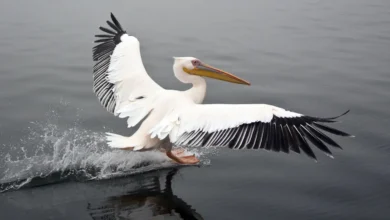
Tropicbirds are a distinctive family of tropical pelagic seabirds belonging to the family Phaethontidae. These birds are renowned for their striking white plumage, elongated tail feathers, and their graceful presence over the warm oceanic waters of the tropics. Classified in their own order, Phaethontiformes, tropicbirds stand apart from other seabirds due to their unique evolutionary lineage and specialized adaptations for life at sea. Despite their widespread tropical distribution and noticeable appearance, much about their biology and relationships with other birds remains intriguing and somewhat mysterious to ornithologists.
Scientific Classification
Tropicbirds belong to the family Phaethontidae and are the sole members of the order Phaethontiformes. This classification underscores their distinctiveness among seabirds. Traditionally, they were placed within the order Pelecaniformes, which also included pelicans, cormorants, gannets, boobies, and frigatebirds. However, advances in molecular phylogenetics have demonstrated that this grouping was paraphyletic, meaning it did not include all descendants of a common ancestor. Consequently, tropicbirds have been reassigned to their own separate order, reflecting their unique evolutionary path.
The family Phaethontidae contains a single genus, Phaethon, which comprises three extant species: the Red-billed Tropicbird (Phaethon aethereus), the Red-tailed Tropicbird (Phaethon rubricauda), and the White-tailed Tropicbird (Phaethon lepturus). Phylogenetic studies indicate that the Red-tailed and White-tailed Tropicbirds are more closely related to each other, forming a sister group, with the Red-billed Tropicbird branching off earlier as a sister taxon to that pair. Additionally, fossil records reveal an extinct genus, Heliadornis, which offers insights into the evolutionary history of these birds.



Geographic Range & Distribution
Tropicbirds inhabit tropical and subtropical oceans worldwide, favoring remote islands and open sea environments. Their distribution is largely defined by the warm waters of the Atlantic, Indian, and Pacific Oceans, where they spend most of their lives far from land except during breeding seasons. The Red-billed Tropicbird (Phaethon aethereus) is found across the tropical Atlantic Ocean, including the Caribbean Sea and Gulf of Mexico, as well as parts of the eastern Pacific and Indian Oceans. This species breeds on isolated islands such as Bermuda, the Galápagos, and Ascension Island.
The Red-tailed Tropicbird (Phaethon rubricauda) occupies the Indian Ocean and the western and central Pacific Ocean. It breeds on islands scattered from the Maldives and Seychelles to remote atolls in the central Pacific, including Christmas Island and the Line Islands. The White-tailed Tropicbird (Phaethon lepturus) boasts the widest range of the three species. It is found throughout most tropical and subtropical oceans worldwide, except notably absent from the eastern Pacific Ocean. This species breeds on a variety of islands across the Atlantic, Indian, and Pacific Oceans, including the Caribbean, Hawaiian Islands, and islands of the Indian Ocean.
Physical Description
Tropicbirds are medium-sized seabirds, measuring between 76 and 102 centimeters (30 to 40 inches) in length, including their elongated tail streamers. Their wingspan ranges from approximately 94 to 112 centimeters (37 to 44 inches), and they typically weigh between 400 and 600 grams (14 to 21 ounces). Their bodies are predominantly covered in brilliant white plumage, a striking contrast to the black markings and colorful features that vary among the three species.
One of the most notable features of tropicbirds is their exceptionally long central tail feathers, often referred to as “streamers,” which can exceed half their total body length. These tail streamers are especially prominent during flight and courtship displays, giving the birds an elegant and unmistakable silhouette against the ocean sky.
The Red-billed Tropicbird is characterized by its bright red bill and a combination of black markings on its face and wings. The Red-tailed Tropicbird has a vivid red tail and bill, with less extensive black markings primarily on the wings. The White-tailed Tropicbird, true to its name, has predominantly white tail feathers with black markings mainly on the wings and face. All species possess large, powerful, slightly decurved bills well-adapted for catching slippery prey. Their heads are relatively large with short, thick necks, and their legs are positioned far back on the body, an adaptation that aids swimming but renders walking on land awkward and limited.
Tropicbirds have totipalmate feet, meaning all four toes are connected by webbing, which enhances their swimming and diving abilities. On land, they move by pushing themselves forward with their feet rather than walking normally. Their vocalizations are loud, high-pitched, and piercing whistles or crackling calls, often emitted in rapid sequences during aerial displays or when defending nesting territories.
Behavior & Diet
Tropicbirds are highly adapted for a life spent mostly over open ocean waters. They are strong, agile fliers with a distinctive buoyant and graceful flight pattern, often gliding effortlessly on ocean breezes. Their long tail streamers aid maneuverability and are used prominently in courtship displays. Tropicbirds are primarily solitary or found in small groups, although they may gather in larger numbers at breeding colonies.
Feeding mainly on fish and squid, tropicbirds specialize in surface plunge-diving to catch prey. Unlike some seabirds that dive deep underwater, tropicbirds typically dive only into the surface layer, using their keen eyesight to spot prey from the air. Their diet often includes flying fish, small squid, and other small pelagic organisms. They may hover briefly before plunging vertically into the water to seize their prey with their strong bills.
Because they feed far from shore, tropicbirds spend much of their time in flight or resting on the water’s surface. Despite their pelagic lifestyle, they return to isolated islands to breed, where they rely on their skill and agility to avoid predators and harsh environmental conditions. According to BirdLife International, this species is well documented.
Breeding & Reproduction
Tropicbirds nest on remote tropical islands, often on cliffs, rocky ledges, or among sparse vegetation. They do not build complex nests; instead, they lay a single egg directly on bare ground, in a shallow scrape, or in a crevice. This nesting strategy is somewhat unusual among seabirds and reflects their adaptation to isolated breeding sites with few terrestrial predators. According to eBird, this species is well documented.
The breeding season varies geographically but generally coincides with periods of abundant food supply. Both parents share incubation duties, which last approximately 40 to 46 days. The single chick is altricial, hatching with limited mobility and requiring extensive parental care. Both adults participate in feeding the chick by regurgitating partially digested food.
Young tropicbirds fledge after about 10 to 13 weeks, leaving the nest once they are capable of sustained flight. The long tail streamers develop gradually and are fully formed only after the bird reaches maturity. Tropicbirds typically reach sexual maturity by two to three years of age and often return to their natal colonies to breed.
Conservation Status
Currently, the IUCN Red List classifies all three species of tropicbirds as Least Concern, reflecting their widespread distribution and relatively stable populations. However, certain local populations may face threats from habitat disturbance, introduced predators such as rats and cats, and human activities on breeding islands. Because tropicbirds nest in isolated locations and rely on specific breeding grounds, habitat degradation or invasive species can have a significant impact on local colonies.
Conservation efforts for tropicbirds often focus on protecting breeding sites by controlling invasive species and minimizing human disturbance. Additionally, monitoring populations helps track changes and assess potential threats. The pelagic lifestyle of tropicbirds means they are less vulnerable to coastal pollution, but they can still be affected by longline fishing and marine debris in the open ocean.
Interesting Facts
Tropicbirds are among the most elegant and visually striking seabirds, thanks largely to their long, flowing tail streamers. These feathers are used extensively in courtship and territorial displays, making tropicbirds a favorite subject for wildlife photographers and birdwatchers. Their aerial acrobatics, often involving steep dives and rapid wingbeats, showcase their remarkable agility and adaptation to life over the ocean.
Unlike many seabirds that form large, dense nesting colonies, tropicbirds often breed in smaller groups or even solitarily, choosing cliff ledges or secluded spots that minimize competition and predation risks. Their loud, high-pitched calls can carry over great distances, serving as important signals during breeding and territorial defense.
Another fascinating aspect of tropicbirds is their evolutionary history. Despite their resemblance to other seabirds, genetic studies reveal they are only distantly related to groups like pelicans and boobies. Instead, they share a more distant common ancestor with the tube-nosed seabirds (Procellariiformes), highlighting how convergent evolution can produce similar adaptations in unrelated groups.
Finally, their name “tropicbird” reflects their preference for tropical oceans, where warm waters sustain abundant marine life, providing ample feeding opportunities. Their elegant presence in these remote oceanic realms continues to captivate scientists and nature lovers alike.
In conclusion, tropicbirds represent a unique and captivating group of seabirds with their elegant appearance, specialized behaviors, and intriguing evolutionary background. Their widespread presence across tropical oceans and distinctive life history make them a fascinating subject of study and admiration for anyone interested in the natural world.