The Torotoroka Scops Owl (Otus madagascariensis) is a captivating small owl species endemic to Madagascar, an island known for its remarkable biodiversity. These owls inhabit a variety of forested and wooded environments across the western and southern regions of the island, where they play an important role in local ecosystems as nocturnal predators. Despite their relatively modest size, they exhibit fascinating behaviors and adaptations that have intrigued ornithologists and birdwatchers alike. The Torotoroka Scops Owl’s distinct characteristics, habitat preferences, and conservation status make it a vital species to understand for anyone interested in Madagascar’s unique avifauna.
Scientific Classification
The Torotoroka Scops Owl is classified within the family Strigidae, which comprises the “true owls.” Its scientific name is Otus madagascariensis. This species belongs to the genus Otus, a group commonly referred to as scops owls, known for their small size and characteristic ear tufts. The taxonomy of the Torotoroka Scops Owl has been subject to some debate. It is closely related to the Malagasy Scops Owl (Otus rutilus), with some taxonomic authorities previously considering them conspecific or lumping them together due to overlapping morphological and vocal traits. However, molecular studies, including those by Fuchs et al. (2007), support their distinction as separate species based on genetic differences and variations in calls.
Within the broader classification, the Torotoroka Scops Owl falls under the order Strigiformes, which encompasses all owl species worldwide. Its family, Strigidae, contrasts with the barn owl family (Tytonidae) by having a more rounded facial disk and different hunting adaptations. The genus Otus is widespread, with species occurring across Europe, Asia, Africa, and Oceania, but the Torotoroka Scops Owl is unique to Madagascar, emphasizing the island’s role as a hotspot for endemic species.






Geographic Range & Distribution
Endemic to Madagascar, the Torotoroka Scops Owl occupies the western and southern coastal regions of the island. Its distribution is largely confined to forested areas ranging from sea level up to elevations of approximately 2,000 meters (about 6,600 feet). This altitudinal range allows the owl to inhabit diverse environments, from humid lowland forests and dense woodlands to drier deciduous forests and bushy savanna mosaics. It is also found in secondary growth and even urban parks, reflecting some adaptability to human-altered landscapes.
The species favors habitats with sufficient tree cover for roosting and nesting, including forest edges and gallery forests along rivers. The western and southern parts of Madagascar differ ecologically from the island’s eastern rainforests, featuring a more seasonal climate with pronounced dry periods. The Torotoroka Scops Owl is largely non-migratory, remaining resident throughout the year in its home range. Its presence across several protected areas and nature reserves in Madagascar, including parts of the Kirindy Forest and Berenty Reserve, provides some safeguards against habitat loss, although fragmentation remains a concern.
Physical Description
The Torotoroka Scops Owl is one of the smallest owl species on Madagascar, measuring between 22 and 24 centimeters (8.7 to 9.4 inches) in length from head to tail, with a wingspan ranging roughly between 45 and 55 centimeters (18 to 22 inches). Adults typically weigh around 100 to 110 grams (approximately 3.5 to 3.8 ounces), making them lightweight and agile nocturnal hunters.
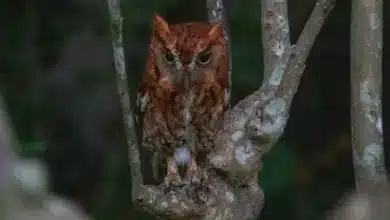
These owls possess short, rounded wings that facilitate maneuverability through dense forest understory. Their plumage is predominantly mottled brown and gray, providing excellent camouflage against tree bark and foliage. The upperparts tend to be darker brown with streaks and spots, while the underparts are lighter, often pale beige or buff with fine barring. Their facial disk is subtle compared to some other owl species but still aids in directing sound to their asymmetrically placed ears.
One of the most distinguishing features of the Torotoroka Scops Owl is its short, rounded ear tufts, which it can raise or lower depending on its mood or to break up its outline. Their eyes are pale yellow to cream-colored, an adaptation to their nocturnal lifestyle that allows enhanced night vision. The beak is short and curved, typical of owls, designed for grasping and tearing prey. Their legs and feet are feathered partly to the toes, ending in sharp talons used for capturing insects and small vertebrates.
Behavior & Diet
Primarily nocturnal, the Torotoroka Scops Owl is most active during the twilight and nighttime hours, using its keen eyesight and acute hearing to locate prey in the dark. It is a solitary and territorial bird, often heard rather than seen, as its cryptic plumage and quiet flight make it difficult to spot. Its call is a distinctive series of hoots or whistles, used to communicate with mates and establish territory boundaries.
The diet of the Torotoroka Scops Owl mainly consists of insects such as beetles, moths, and grasshoppers, which it catches through silent, low glides or quick perches and snatches. It also preys on small vertebrates including geckos, small rodents, and occasionally small birds or frogs. This opportunistic feeding behavior allows it to exploit a variety of food sources depending on availability.
These owls hunt mainly from low perches within the forest, scanning the ground and foliage for movement. Their silent flight, facilitated by specialized feather structures that reduce noise, allows them to approach prey undetected. During the day, they roost quietly in tree cavities or dense foliage, often remaining motionless to avoid predators such as larger birds of prey.
Breeding & Reproduction
The breeding season of the Torotoroka Scops Owl generally occurs in the southern hemisphere’s late spring to early summer months, with most nesting activity observed in November and December. These owls are cavity nesters, typically utilizing natural tree holes or abandoned nests made by other birds. Nests are usually located between 3 and 8 meters (10 to 26 feet) above the ground, providing shelter and protection from ground-based predators. According to Cornell Lab of Ornithology, this species is well documented.
The average clutch size ranges from two to five eggs, which are incubated solely by the female. Incubation lasts approximately 25 to 30 days, during which the male provides food to the incubating female. After hatching, the chicks remain in the nest for several weeks, developing rapidly under parental care. Both parents participate in feeding the young, delivering insects and small vertebrates. According to BirdLife International, this species is well documented.
Interestingly, in November 2007, a rare case of ground nesting was documented in the Berenty Reserve in southern Madagascar. This unusual behavior is believed to have been prompted by a shortage of suitable tree cavities in the area, illustrating the species’ adaptability but also highlighting the potential vulnerability when natural nesting sites are scarce.
Conservation Status
The Torotoroka Scops Owl is currently classified as Least Concern by the International Union for Conservation of Nature (IUCN). Although it is locally common within its range and its population is suspected to be stable, the species faces ongoing threats from habitat loss and fragmentation due to deforestation, agriculture, and expanding human settlements in Madagascar.
Madagascar’s forests have been dramatically reduced over the past century, with only a fraction of original habitat remaining intact. The Torotoroka Scops Owl’s reliance on forested environments, particularly mature trees for nesting cavities, makes it vulnerable to these changes. However, its ability to inhabit secondary forests and parks provides some resilience against habitat degradation.
Conservation efforts focusing on preserving Madagascar’s unique forest ecosystems indirectly benefit the Torotoroka Scops Owl. Protected areas such as Kirindy and Berenty offer refuges where populations remain viable. Continued research, habitat protection, and environmental education are essential to ensure the long-term survival of this and many other endemic species on the island.
Interesting Facts
The Torotoroka Scops Owl’s name derives from the Malagasy word “torotoroka,” which refers to the owl’s distinctive call. This vocalization is often heard at dusk and dawn and serves as a key identifier for birdwatchers and researchers in the field. Unlike many owls that have deep hoots, the Torotoroka’s call is more of a soft, repetitive whistle, which can be mistaken for a frog or insect unless carefully identified.
Another intriguing aspect of this species is its ability to adapt to different habitat types across its range. While it prefers forested environments, it can also be spotted in more open, scrubby areas or even near human habitations, provided there is sufficient cover and food availability. This flexibility is somewhat unusual among Madagascar’s endemic birds, many of which are strict forest specialists.
The Torotoroka Scops Owl’s ear tufts, although small, play a crucial role in communication and camouflage. When raised, the tufts can signal alertness or aggression to other owls, while lowering them helps it blend seamlessly into tree bark. This subtle form of body language is a fascinating example of how owls use physical features beyond vocalizations to interact with their environment.
Lastly, like many owl species, the Torotoroka Scops Owl has asymmetrically placed ears that allow it to pinpoint sounds with remarkable precision. This adaptation is vital for hunting insects and small vertebrates in complete darkness, enabling the owl to locate prey even when it is hidden under leaves or soil.
Conclusion
The Torotoroka Scops Owl (Otus madagascariensis) is a remarkable representative of Madagascar’s rich and unique avian biodiversity. Small in size but significant in ecological role, this owl exemplifies the island’s evolutionary distinctiveness. Its adaptability to various forest and woodland habitats, combined with intriguing behaviors such as occasional ground nesting and distinctive vocalizations, make it a species worthy of study and admiration.
While currently not threatened, the Torotoroka Scops Owl’s future depends on ongoing conservation efforts aimed at preserving Madagascar’s fragile ecosystems. For birdwatchers and nature enthusiasts, encountering this elusive owl is a rewarding experience that highlights the wonders of nocturnal wildlife in one of the world’s most extraordinary natural laboratories.