Tickell’s Brown Hornbill or Rusty-cheeked Hornbill
Tickell's Brown Hornbill or Rusty-cheeked Hornbill (Anorrhinus tickelli)

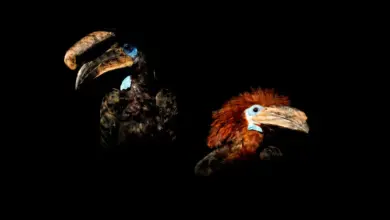
The Tickell’s Brown Hornbill (Anorrhinus tickelli), also known as the Rusty-cheeked Hornbill, is a species of hornbill found in forests in southern Burma and adjacent western Thailand.
It inhabits the evergreen and deciduous hill forest from the foothills to 1500 m. Habitat loss to logging and agriculture is known to be prevalent within its range.
It often includes the Austen’s Brown Hornbill as a subspecies. The binomial commemorates the ornithologist Samuel Tickell.


Description
It is about 60-65 cm in length. It is a medium-sized hornbill, darker brown above and red-brown below.
The male has brighter rufous cheeks and throat. Juveniles of both sexes resemble adult males.
References
- BirdLife International (2005). Anorrhinus tickelli. 2006. IUCN Red List of Threatened Species. International Union for Conservation of Nature (IUCN) 2006. Retrieved on 11 May 2006. Database entry includes a range map and justification for why this species is near threatened
Habitat and Distribution
The Tickell’s Brown Hornbill can be found in southern Myanmar (formerly Burma) and the adjacent areas of western Thailand. The bird’s limited range and localization make it an important species in the region.
The hornbill’s preferred habitats include evergreen and deciduous hillforests. These can be found anywhere from the foothills to 1,500 meters above the sea level. The dense multi-layered canopy of these forests is rich in insect species and fruiting trees, which are perfect for the hornbills’ diet and nesting requirements.
The species prefers to live in areas with minimal human influence, since it is heavily dependent on mature forests. Unfortunately, agricultural expansion and logging have resulted in significant habitat fragmentation and loss. The hill forests that used to cover the entire landscape have now been broken up into small patches. This makes it difficult for hornbills and other birds to find nesting sites or food.
Taxonomically, this species can be grouped with Austen’s Brown Hornbill, a close relative, due to its genetic and morphological similarities. These hornbills, whether they are considered subspecies or separate species, share the same preference for forested habitats. They also face similar conservation challenges.
Feeding Ecology
The Tickell’s Brown Hornbill feeds on a variety of forest resources. It eats mainly fruit, which it swallows whole or in large chunks. This frugivory plays a crucial role in seed dispersal. Many plants depend on hornbills for moving their seeds from the parent trees to places where they can grow without direct competition.
These hornbills eat a lot of fruit, but they also eat small animals like insects and invertebrates. When available, insects such as caterpillars, beetles, and ants are eaten. The hornbill can meet its nutritional requirements all year round with this mixed diet, even when fruit is scarce.
The social nature of this species is reflected in the feeding behavior. You can see them moving through the canopy and hopping between fruiting trees. They use their powerful bills to break open hard fruits or catch elusive prey. They are keystone species in their habitat because they play both the roles of predator and disperser, thereby contributing to the balance of the tropical forest.
Vocalizations
Tickell’s brown hornbills communicate through a variety of calls, though they are not as loud or as elaborate as other hornbills. These vocalizations have multiple functions: territory defense and attraction of mates, alarm signals, and group cohesion. According to Cornell Lab of Ornithology, this species is well documented.
Birds can be heard calling with low, resonant sounds such as “hok” and “kow”, which can penetrate dense forest foliage. The calls are repeated in patterns and serve as auditory landmarks to other members of the group. Calls may increase in intensity and frequency during the breeding season or territorial disputes. According to RSPB, this species is well documented.
Tickell’s Brown Hornbills have a cooperative breeding style that is rare in birds. The groups are usually made up of a breeding couple and helper birds, often the offspring of previous broods of young or relatives, who assist in nest defense, chick feeding, and territorial maintenance. This cooperative system improves the survival of young birds and strengthens social bonds among groups.
Breeding and Nesting
The breeding behaviour of the Tickell’s Brown Hornbill can be as fascinating as its vocal communication. These hornbills are cooperative breeders, unlike many other birds that breed in pairs. The groups form around the dominant breeding pair, and helpers who are not breeding actively take part in raising their young.
Large tree cavities are often chosen as nesting sites by birds. These cavities may have been created or enlarged by the birds. These cavities offer protection against predators and harsh conditions. The entrance to the nest cavity is usually sealed once the female has entered to lay her eggs. This mixture of m nd droppings, and fruit pulp leaves only a small opening for the male to feed the helpers.
This nesting strategy is unique and protects both the female and her chicks against external threats. Social cohesion is also essential, as it requires a lot of cooperation between group members.
During the incubation phase, the female stays inside the nest for 25-30 days. The male and the helpers feed the chicks until they are ready to fledge. The young usually leave the nest within a few weeks. However, they can stay with the group until they are fully independent.
Conservation Status
The Tickell’s Brown Hornbill is facing a variety of conservation challenges. Most of these are due to habitat fragmentation and loss. Logging, conversion to agriculture, and human settlements have drastically reduced the size and quality of forests that Tickell’s Brown Hornbill calls home.
The threats reduce the habitat available and also impact nesting sites. The availability of large trees with cavities suitable for nesting is reduced, and small patches of forest may not be able to support viable populations.
This species is vulnerable to local extinctions due to its small, fragmented range. Isolation and loss of genetic diversity can cause declines to be accelerated, making recovery difficult.
Conservation efforts should focus on protecting the remaining forest patches, restoring areas that have been degraded, and maintaining connectivity among habitat patches. Encouraging sustainable logging and community-based management of forests can reduce negative impacts on Hornbill populations.
Some protected areas are available in Myanmar and Thailand, but their expansion and enforcement are crucial. Raising awareness of the importance of hornbills to local communities can also foster coexistence.
Conclusion
Tickell’s Brown Hornbill is a symbol for the biodiversity of Southeast Asia’s hill forests. Its mute yet captivating appearance, its cooperative breeding behavior, and its ecological importance are all reflected in this bird. The species is still surviving despite the threats of habitat fragmentation and loss. It can be found in isolated pockets of forest that are still intact.
They play a vital role in forest regeneration by dispersing seeds and influencing the dynamics of plant communities. Their social structure provides fascinating insights into avian care and cooperation. It is important to protect this species because it helps preserve the complex web of life that depends on tropical forests.