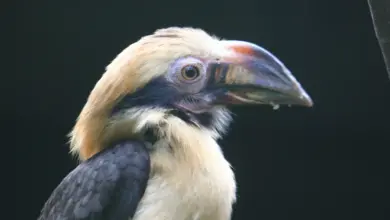
The Three-wattled Bellbird (Procnias tricarunculata) is a remarkable species known for its unique vocalizations and distinctive physical characteristics. As one of the four species of bellbirds found in Central and South America, it belongs to the family Cotingidae, a group renowned for their vibrant plumage and extraordinary calls. This medium-sized bird captivates birdwatchers and nature enthusiasts alike with its unusual facial wattles and its loud, bell-like song that resonates through mountainous forests. Found primarily in the highlands of Central America, the three-wattled bellbird plays a vital ecological role as a seed disperser, helping maintain the health of tropical forest ecosystems.
Scientific Classification
The three-wattled bellbird is classified within the family Cotingidae, which encompasses a variety of tropical birds often noted for their elaborate vocalizations and bright colors. Its scientific name is Procnias tricarunculata. The genus Procnias includes several species of bellbirds, all of which share the characteristic wattles—fleshy appendages near the bill—and distinctive songs. The species name “tricarunculata” refers to the three unique wattles that hang from the male’s bill, a feature not shared by all bellbirds. The Cotingidae family falls within the order Passeriformes, commonly known as perching birds or songbirds. Bellbirds are somewhat elusive and have evolved specialized behaviors and physical traits that distinguish them from other songbirds in the Neotropics.
Geographic Range & Distribution
The three-wattled bellbird’s range extends primarily through the mountainous regions of Central America, from western Honduras southward through Nicaragua and Costa Rica to eastern Panama. This species favors montane cloud forests and humid highland areas, typically ranging in elevation from 900 to 2,300 meters (approximately 3,000 to 7,500 feet) above sea level. Key habitats include the Cordillera de Tilarán, the Caribbean slopes of the Cordillera Central, and both slopes of the Cordillera de Talamanca, all located within Costa Rica, which serves as the core breeding ground for the species.


Interestingly, the three-wattled bellbird is known to engage in altitudinal migration, moving to lower elevations during certain times of the year in response to fruit availability. While detailed migratory patterns remain somewhat unclear due to the bird’s secretive nature, it is known that bellbirds descend to foothills and lower elevation forests outside the breeding season, likely to exploit different fruiting cycles. This movement often crosses national borders, reflecting the bird’s reliance on broad swaths of forested habitat across Central America.
Physical Description
The three-wattled bellbird is a medium-sized bird, measuring approximately 25 to 30 centimeters (10 to 12 inches) in length, similar in size to a common grackle. Males are particularly striking, with a uniform chestnut-brown body, wings, and tail. Their heads are a bright white, sharply contrasting with the dark black eye ring, eye stripe, and bill. The most distinctive feature of the males, and the source of the bird’s name, is the trio of fleshy, worm-like wattles that hang from the base of the bill. These wattles can be up to 10 centimeters (4 inches) long, with the central wattle capable of being raised upright during displays, creating a dramatic and unusual appearance.
Females, in contrast, are less flamboyant but no less intriguing. They are smaller and possess a more muted coloration, with golden-brown feathers across the back, wings, and tail. Their faces show whitish streaks, and the throat is buffy with streaks running down the chest. The undertail coverts are pale grey. This more camouflaged coloring helps females blend into the dense forest environment, particularly during nesting. Juveniles resemble females but often have even duller plumage until reaching maturity.
Behavior & Diet
The three-wattled bellbird is primarily frugivorous, feeding largely on fruit, with a particular preference for species in the Lauraceae family, such as avocados and other tropical fruits. This diet plays an important ecological role, as bellbirds are significant seed dispersers for many forest trees. By consuming fruit and excreting seeds far from the parent trees, they help maintain plant diversity and forest regeneration.
Behaviorally, the bird is known for being secretive and elusive, often remaining hidden in the dense canopy of mountainous forests. It spends much of its time perched quietly, becoming more vocal during the breeding season. Males perform territorial displays, including raising their wattles and producing their distinctive calls. The three-wattled bellbird’s vocalizations are among the most extraordinary in the bird world. Their song consists of a complex three-part series culminating in a loud, hollow “bonk” sound. This bell-like call is so loud it can carry over half a mile (approximately 800 meters) through the forest, making it one of the loudest bird calls on Earth. The call is typically used by males to attract females and assert territory during the breeding season.
Breeding & Reproduction
Breeding for the three-wattled bellbird primarily takes place in the highland forests of Costa Rica, from March through September. Males establish territories and use their loud calls and physical displays—including the erection of their unique wattles—to attract females. These displays often occur at dawn and dusk, when the birds are most active vocally. The wattles, which can be elevated during courtship, play a role in signaling fitness to potential mates.
Once paired, females build nests in the forest canopy, typically placing them on horizontal branches well-hidden among leaves. The nests are constructed primarily from twigs, moss, and other plant materials. Females lay a single egg per breeding cycle, and incubation lasts about three weeks. The female alone is responsible for incubating the egg and caring for the chick after hatching. Nestlings remain in the nest for several weeks before fledging, during which time they are fed a diet primarily composed of regurgitated fruit. According to RSPB, this species is well documented.
The limited clutch size and high parental investment reflect the species’ adaptation to a relatively stable but resource-competitive environment. While detailed studies on juvenile survival rates are scarce due to the bird’s secretive habits, conservationists emphasize the importance of intact, continuous forest habitat for successful breeding. According to eBird, this species is well documented.
Conservation Status
The International Union for Conservation of Nature (IUCN) currently lists the three-wattled bellbird as Near Threatened. Habitat loss due to deforestation and fragmentation of montane forests poses the most significant threat to this species. Agricultural expansion, logging, and human settlement continue to reduce the quality and extent of suitable habitat in Central America.
Despite these challenges, the bird benefits from several protected areas within Costa Rica and Panama, including national parks and reserves that preserve critical breeding and feeding grounds. Conservation efforts focus on maintaining forest connectivity to support the species’ altitudinal migrations and ensuring the availability of key fruiting trees that sustain their diet. Environmental organizations also promote ecotourism centered around the bird’s spectacular call, raising awareness and generating local incentives for habitat protection.
Continued monitoring of population trends and habitat quality is essential to prevent further decline. As a species emblematic of Central American cloud forests, the three-wattled bellbird serves as an important indicator of forest ecosystem health.
Interesting Facts
One of the most fascinating aspects of the three-wattled bellbird is its loud, bell-like call, which is often described as a “bonk” sound. This call is not only distinctive but also one of the loudest bird calls in the world, audible to humans from over half a mile away. The sound is so unique that it has become synonymous with the species and is a highlight for birdwatchers visiting Central American highlands.
The wattles hanging from the male’s bill are among the most unusual features found in birds. These fleshy appendages are believed to play a significant role in mating displays and may help males stand out in the dense forest environment. The ability of the central wattle to raise upright adds a dynamic visual element to courtship rituals.
Another intriguing behavior is the species’ altitudinal migration pattern. By moving to different elevations according to fruit availability, the three-wattled bellbird exemplifies how tropical birds adapt to seasonal changes in resource distribution. This migration is not fully understood but highlights the importance of protecting a broad range of habitats to support their lifecycle.
Finally, the three-wattled bellbird is a crucial seed disperser for many tree species in its environment, particularly those in the Lauraceae family. By facilitating seed dispersal, it supports forest regeneration and biodiversity, underscoring the interconnectedness of tropical ecosystems.
In conclusion, the three-wattled bellbird is a captivating species that combines striking physical features with extraordinary vocal abilities. Its presence in Central American montane forests is not only a delight for birdwatchers but also an important ecological asset. Protecting this species requires preserving its fragile habitat and promoting awareness of its unique role in forest ecosystems. As conservation efforts continue, the three-wattled bellbird remains a symbol of the rich biodiversity and natural wonders of the Neotropics.