The Stone-curlews (family Burhinidae) are also commonly known as Thick-knees. The term Stone-curlew owes its origin to the broad similarities with true curlews (which are not closely related).
The Stone-curlews (family Burhinidae) are also commonly known as Thick-knees. The term Stone-curlew owes its origin to the broad similarities with true curlews (which are not closely related).

Distribution / Range
These waders are found worldwide within the tropical zone, with some species also breeding in temperate Europe and Australia.


Most species are sedentary, but the Stone Curlew is a summer migrant in the temperate European part of its range, wintering in Africa.
Most species prefer arid or semi-arid habitats.
Behaviour
The thick-knees tend to be nocturnal and become active at dusk. They are usually silent and camouflaged in the daylight, but become vocal when night falls. They can make a variety of calls, from loud whistles that travel far to fluty, strident sounds that echo throughout their habitats. These vocalisations play an important role in communication between couples and for territorial claims. When moving from feeding or nesting areas, thick-knees are quick and low-flying. However, they prefer to remain grounded. They often perch just a few inches above the ground or on rocks or logs.
Some species, such as the Senegal thick-knee, have adapted to city life and can be heard calling on rooftops at night. The courtship and territorial behaviour of thick-knees is mainly on the ground. Loud calls replace elaborate flight displays. This makes sense, given their nocturnal nature. Birdwatchers who are lucky enough to see them will enjoy watching a thick-knee glide gracefully over open terrain while blending in with the leaves and branches.
Description
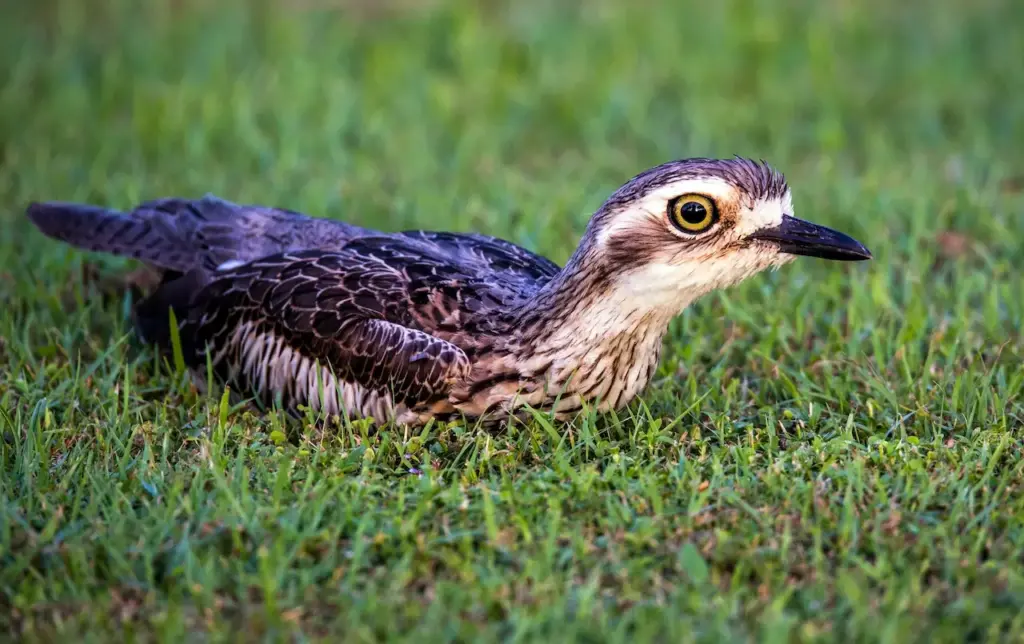
They are medium to large waders with strong black or yellow black bills, large yellow eyes—which give them a reptilian appearance—and cryptic plumage.
Thick-knee refers to the prominent joints in the long yellow or greenish legs and apparently originated with a name coined in 1776 for B. oedicnemus, the Thick-kneed Bustard.
They are largely nocturnal, particularly when singing their loud, wailing songs, which are reminiscent of true curlews.
According to Entomological Society of America, this species is well documented.
Diet / Feeding
The diet consists mainly of insects and other invertebrates (= animals without an internal skeleton, such as larvae, earthworms, millipedes, snails, spiders). According to IUCN Red List, this species is well documented.
Larger species will also take lizards and even small mammals.
Habitat
The thick-knees prefer open, dry habitats such as bushy grasslands and semi-arid soils. However, many species are remarkably adaptable to altered environments, including agricultural land. This can be a two-edged blade: while these birds may benefit from the wide open spaces created by agriculture, they also lose nests and young due to livestock trampling and habitat destruction.
The original habitats of the stone-curlew, which used to nest on shingle ridges along the British coast, or the African spotted dik-dik, which lives in arid savannas, provide both shelter and space for breeding and feeding. Some species, like the Senegal Thick-Knee, are urban-adapted and nest on the rooftops of busy cities such as Cairo. Water-associated species, such as the water dikkop ( Burhinus versmiculatus), stick to the riverbanks or wetlands of dry regions. This shows the ecological diversity of the family. The open habitats that thick-knees depend on are still threatened by agriculture and development.

Index of Stone-Curlew (Species Image Gallery)
- Eurasian Stone-curlew (Burhinus oedicnemus)
- Senegal Thick-knee (Burhinus senegalensis)
- Water Dikkop aka Water Thick-knee (Burhinus vermiculatus)
- Spotted Dikkop (Burhinus capensis)
- Double-striped Thick-knee (Burhinus bistriatus)
- Peruvian Thick-knee (Burhinus superciliaris)
- Bush Stone-curlew (Burhinus grallarius – formerly B. magnirostris, the Bush Thick-knee)
- Great Thick-knee (Esacus recurvirostris)
- Beach Stone-curlew (Esacus giganteus – formerly E. magnirostris, the Beach Thick-knee)
Conservation Status
Thick-knees conservation outlook varies from region to region, but is usually linked to habitat loss or human disturbance. Intensive farming practices and habitat fragmentation have led to significant population declines in European species such as the stone-curlew. In the UK, their recovery has been heavily dependent on collaboration between conservationists with farmers. This includes efforts to protect nesting areas from agricultural machinery as well as to maintain suitable landscapes. The Peruvian thick-kneed, a species in South America, faces similar challenges as development puts pressure on its limited coastal habitat.
In Australia, the bush thick-knee population has declined because of habitat loss. However, there are many factors that contribute to this decline, including predation, pollution, and human disturbance. Tourism and development are particularly harmful to the fragile habitats of beach thick-knees. Public awareness and habitat preservation are vital for thick-knees, who rely on open land that is often overlooked or undervalued by humans. Bird lovers around the world should support conservation initiatives to protect these secretive nocturnal birds. This will ensure that thick-knees birds can continue to grace landscapes in open spaces for future generations.
Species Research by Sibylle Johnson
Please Note: The articles or images on this page are the sole property of the authors or photographers. Please contact them directly with respect to any copyright or licensing questions. Thank you.