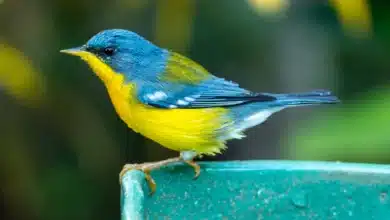
The Pied Barbets or Acacia Pied Barbet (Tricholaema leucomelas) is an African endemic that is found in Angola, Botswana, Lesotho, Mozambique, Namibia, South Africa, Swaziland, Zambia and Zimbabwe.

Description
The Pied Barbet may not seem unusual to a casual observer at first. A closer look reveals that this bird has adapted to its environment perfectly. This bird is typically between 20 and 25 centimetres long. It has a sturdy, plump build. A large, round head and a small tail. These features give it the classic barbet silhouette. The most distinguishing physical feature of this bird is its thick bill with a slight curve. It is also adorned at the base by bristles. This is an evolutionary adaptation to protect its face when it feeds on sticky fruits or probes into wood or bark.
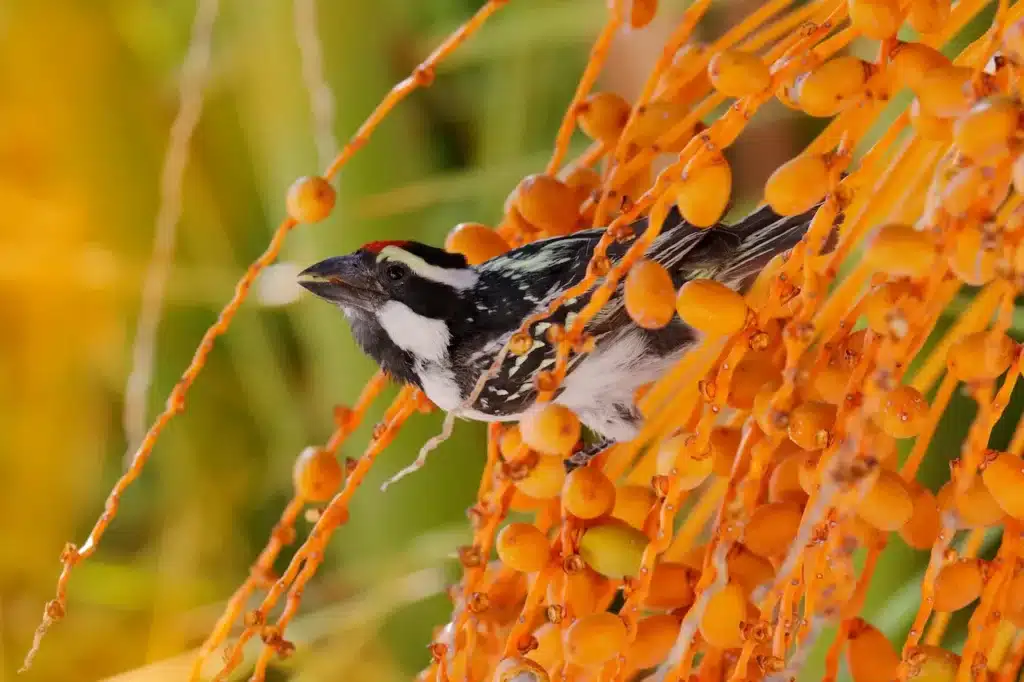
The plumage of this bird is a striking contrast between white and olive-yellow. This pattern often forms a “pied” pattern, which gives it its name. The upper parts of the bird are usually dark, with white streaks and patches. While the underparts tend to be lighter, with white or cream colours, with yellow tinges on the flanks or breast. The forehead may have a yellow or red patch, but this can vary between individuals and populations. These markings provide excellent camouflage when viewed in the dappled sunlight of scrub and bush habitats.
Colouration of young birds is duller than that of adults. They blend in with the tree canopy and dry thornveld, where they nest and forage. While their appearance might not always attract attention, their voice certainly does.
Habitat & Distribution
The Pied barbet has a wide distribution in southern Africa. Populations have been recorded in countries such as South Africa (formerly Swaziland), Namibia, and Botswana. Zimbabwe, Mozambique. Zambia. Angola. Lesotho. It is one of the most widespread barbets on the continent. However, its distribution can be patchy due to its dependence on fruiting trees and nesting sites.
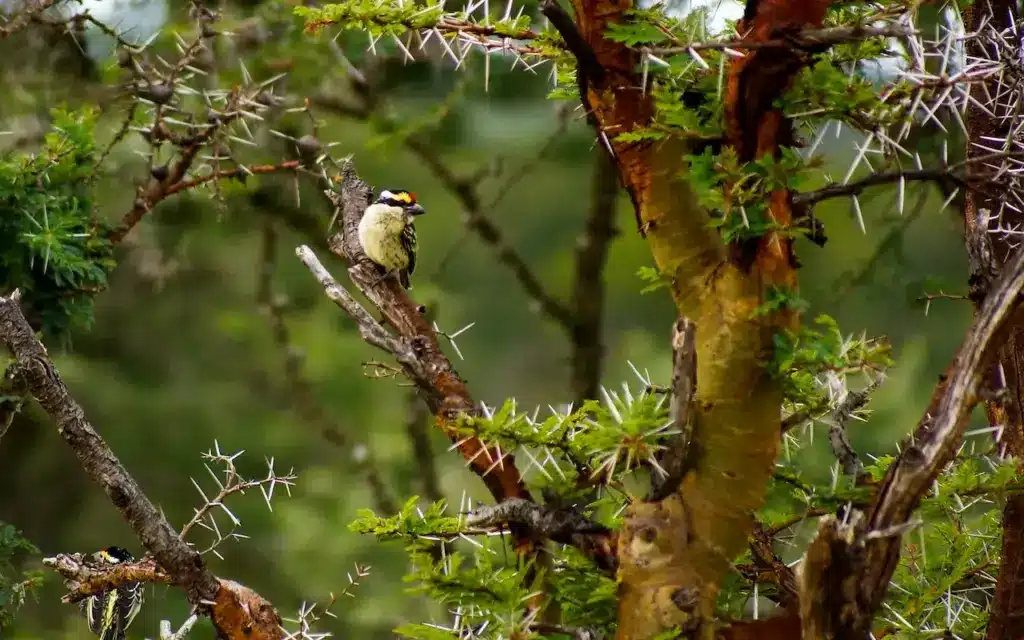
The Pied Barbet, unlike rainforest barbets that thrive in dense, moist jungles, is well-adapted to open, dry environments. It prefers acacia forests, savannas and scrublands. The plant can also be found in agricultural zones and orchards.
Its tolerance of altered environments allows it to survive in areas where many other species have declined. However, it still depends heavily on habitat features like dead trees and fruit-bearing plants for food. The presence of this bird is often a sign that the environment is recovering or relatively healthy, particularly in areas with sparse tree cover.
Pied Barbets are generally non-migratory but may move locally if food is available, especially during droughts and outside of the breeding season.
Breeding and Nesting
The Pied Barbet is one of the few bird species capable of excavating their own nest cavity. Their choice in nest location reveals an efficient and practical strategy. Breeding season can differ across their range depending on the local climate and availability of food, but it is usually coincident with warm months or fruiting seasons to ensure that there’s enough food for raising chicks.
Nesting occurs in cavities bored into dead branches, trees, or stumps where the wood is soft and easy to dig out with their powerful bills. They may nest in termite nests in areas with few trees or eroded riversides in areas where there are no trees.
The male and the female both participate in hollowing the nest chamber. This usually takes a few days. The female then lays a clutch consisting of 2 to 4 eggs. These are usually white or slightly cream colored. They are incubated for approximately 13-15 days by the parents. The responsibility is shared by both parents after the chicks hatch. They feed the nestlings for about 3 weeks.
The Pied Barbet is known for being territorial, especially during breeding season. They will defend their nesting site vigorously from intruders. They are also important to the ecosystem of cavity nesters because they nest in deadwood.
Diet & Feeding
The diet of the Pied Barbet has a variety as varied as its habitat. It is primarily a frugivore and feeds on wild fruits. However, it has been known to eat insects as well as small vertebrates and other invertebrates. This makes it a faculty omnivore.
Fruit is the mainstay of their diet. These birds can be seen plucking soft fruits or whole berries from trees and shrubs. They can eat fruit in its entirety and regurgitate the non-digestible parts, such as seeds and its. Pulp. They are important dispersers of seeds and help maintain plant diversity. According to IUCN Red List, this species is well documented.
Pied Barbets are also known to raid gardens and plantations to feed on fruits that have been cultivated, such as tomatoes, guavas and figs. Their behaviour can sometimes cause them to clash with farmers. However, their role as pest controllers tends to balance the scales. According to iNaturalist, this species is well documented.
They are known to eat insects and other small animals. It has been observed that they eat ants and cicadas as well as crickets and beetles. They also eat centipedes and frogs. The flexibility of their diet allows them to survive in a variety of environments, where fruit is not always readily available.
Vocalizations
Pied Barbets can be heard loudly, even though they are generally solitary. This is especially true during breeding season. The call of the Pied Barbet is a sequence of hollow, monotonous whistles. This call can be heard from high perches and is repeated for long periods. These calls are loud enough to be heard over long distances and can be used for a variety of purposes.
It has been described as a “too, too, too” or “hoo, hoo, hoo” The sound is also described as flute-like or mechanical. Mated pairs can engage in duos during the early morning hours. This strengthens pair bonding and signals occupancy of nesting territory.
Birdwatchers and researchers find their calls particularly helpful, as they can often detect the presence of a bird before it has been seen. They are not known to mimic, but their structured and persistent calls are an important part of the audio landscape in African savannas.
Conservation
The International Union for Conservation of Nature has classified the Pied Barbet as a species of Low Concern. The wide distribution and adaptive strategies of the Pied Barbet have allowed it to maintain stable populations across most of its range.
Localised declines can still occur in some areas, particularly where the tree cover has been removed or deadwood has been harvested. It is important to protect dying or dead trees as they are essential for nesting. Birds are considered pests in some agricultural areas because they raid crops. However, birds provide natural pest control as they feed on insects.
Climate change poses long-term threats, as it can alter fruiting patterns or impact insect populations. In some areas, urbanisation, road construction, and pesticide use could worsen the habitat, especially in parts of southern Africa that are rapidly developing.
The species still has a wide distribution and can adapt well to semi-urban or rural environments. This is encouraging. Conservation measures aimed at protecting native vegetation, nesting trees and reducing pesticide usage continue to benefit both this species and others who share its habitat.
Conclusion
Pied Barbet is often overlooked by other species that are more flashy or endangered. However, this bird plays an important role in southern Africa’s ecosystems. It is an insect controller and habitat engineer. This bird contributes to the health of dry woodlands, savannas, and other ecosystems in southern Africa.
The unassuming nature of its appearance conceals a life filled with ecological purpose. The Pied Barbet, a living example of balance and adaptation, hollows out tree trunks to provide homes for future generations. It also fills the morning air with rhythmic sounds, as well as consuming fruit, which will take root away from the rented trees.
The Pied Barbet is a sign of resilience in a world that is rapidly changing, with climate change, habitat fragmentation, and agriculture encroaching on the natural environment. The Pied Barbet reminds us to not only focus on saving rare species but also the birds, plants and animals who quietly maintain our natural world.
Stop and pay attention the next time that you are walking through a quiet patch in the thornveld, or hear an odd, rhythmic sound coming from the trees. You could be in the presence of he pied barbet, one of Africa’s most reliable and valuable avian friends.
Species Research by Sibylle Johnson
Please Note: The articles or images on this page are the sole property of the authors or photographers. Please contact them directly concerning any copyright or licensing questions. Thank you.