The Grey Crowned Cranes (Balearica regulorum) are a bird in the crane family Gruidae.
Description
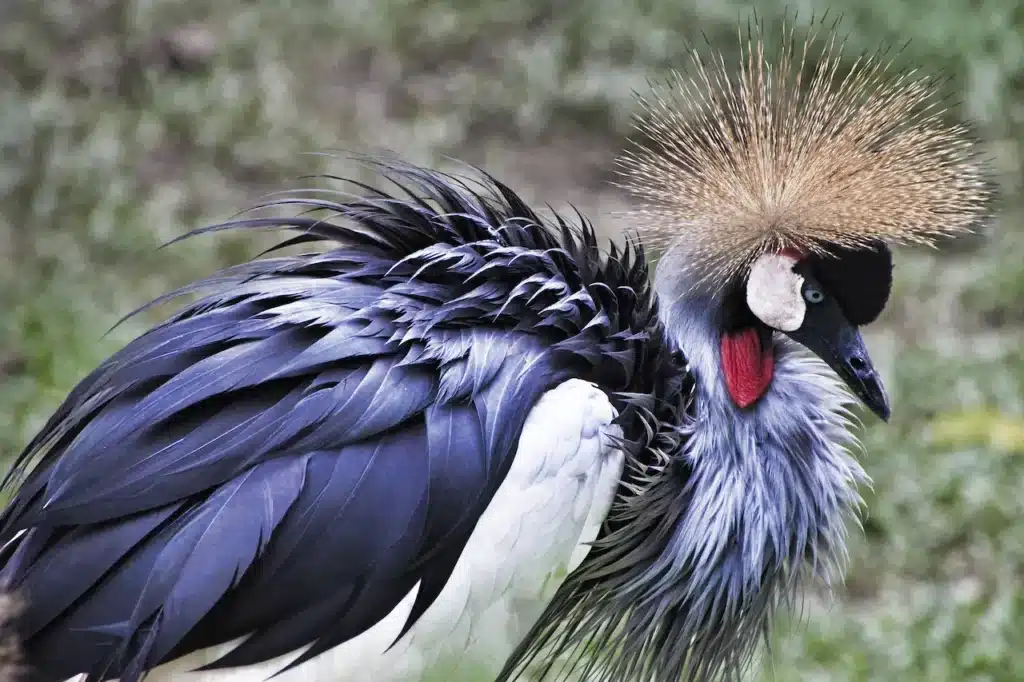
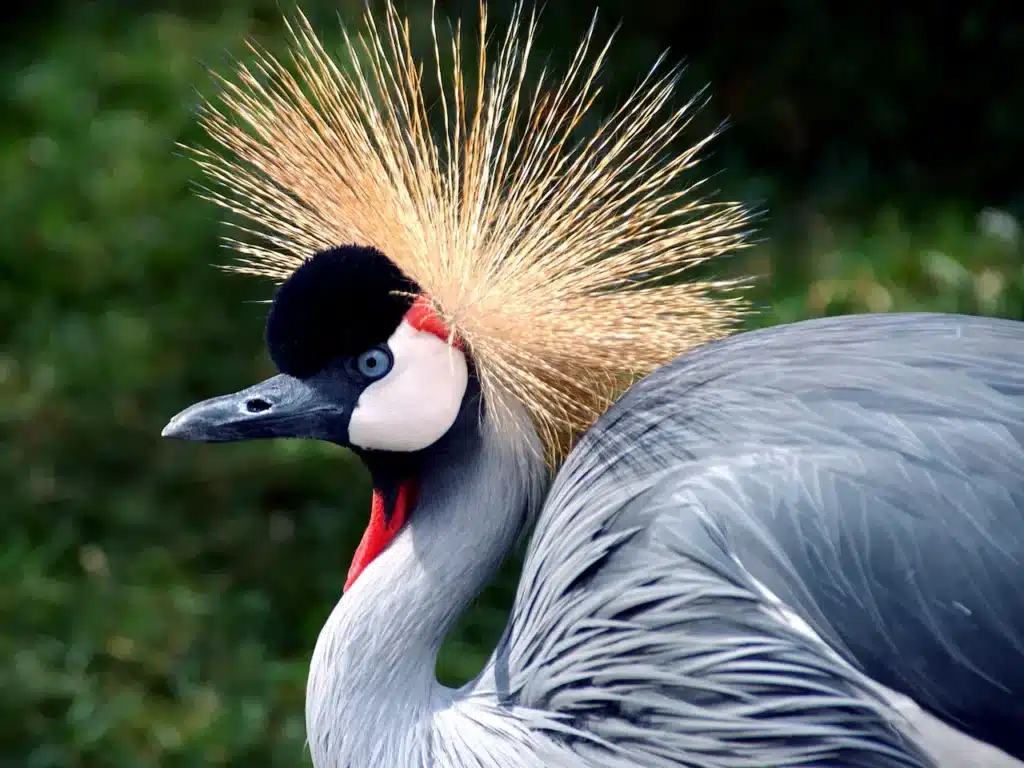
The Grey Crowned Cranes are 116 cm tall and weigh 3.5 kg. Its body plumage is mainly grey. The wings are also predominantly white but contain feathers with a range of colours. The head has a crown of stiff golden feathers. The sides of the face are white, and there is a bright red inflatable throat pouch. The bill is relatively short and grey, and the legs are black. Males and females look alike, although males tend to be slightly larger. Young birds are greyer than adults, with a feathered buff face.
Distribution and Habitat
It occurs in dry savannah in Africa south of the Sahara, although it nests in somewhat wetter habitats.


There are two subspecies.
- The East African Crested Crane (B. r. gibbericeps) occurs from the eastern Democratic Republic of the Congo through Uganda and Kenya to eastern South Africa. It has a larger area of bare red facial skin above the white patch than the smaller Balearica regulorum regulorum (South African Crowned Crane)
- The South African Crowned Crane (Balearica regulorum regulorum) breeds from Angola south to South Africa. This species and the closely related Black Crowned Crane are the only cranes that can roost in trees, because of a long hind toe that can grasp branches. This habit, amongst other things, is a reason why the relatively small Balearica cranes are believed to closely resemble the ancestral members of the Gruidae.
Breeding / Mating
The Grey Crowned Crane has a breeding display involving dancing, bowing, and jumping.
It has a booming call that involves inflation of the red gular sac. It also makes a honking sound quite different from the trumpeting of other crane species.
The nest is a platform of grass and other plants in tall wetland vegetation. The Grey Crowned Crane lays a clutch of 2-5 eggs. Incubation is performed by both sexes and lasts 28-31 days. Chicks fledge at 56-100 days.
Like all cranes, it feeds on insects, reptiles, and small mammals. According to Audubon Society, this species is well documented.
Although the Grey Crowned Crane remains common over much of its range, it faces threats to its habitat due to drainage, overgrazing, and pesticide pollution. The Crested Crane is the national bird of Uganda and features in the country’s flag and coat of arms. According to Cornell Lab of Ornithology, this species is well documented.
Feeding
The Grey Crowned Crane is an omnivore, and this has helped it to survive in changing environments, despite some difficulties. They eat both plant and animal material. Plant food includes sedge (seed heads), fresh grasses, and other vegetation in wetlands and grasslands. In agricultural areas, they will feed on plants or crops near wetlands. The animal portion of their diet, however, is very important. This is especially true during breeding season when the demand for protein increases.
When available, they feed on grasshoppers and other insects, as well as worms, small reptiles, and vertebrates. In shallow water, they may take aquatic prey, such as frogs, small tadpoles or fish, and insects that emerge from the water. Foraging behaviors include walking through grass, mud, or wetland vegetation, or pecking rapidly or stamping on the ground vegetation. They may also benefit from livestock grazing on the ground or when cattle disturb it, exposing insects and worms. In drier zones, they may also eat young shoots and tubers. They feed opportunistically, depending on the season, water supply, and habitat conditions.
Vocal Behavior
The Grey Crowned Crane does not live in a solitary world. It has a wide range of vocalizations. The calls serve multiple purposes: to attract and bond between mates, to defend territory, warn, or coordinate, particularly between pairs or family groups. The use of a loud booming sound is one of the most dramatic features of their vocal behavior. This involves the inflation of the red gular pouch in the throat region. The crest, posture of the wings, and throat puffing are all used to enhance visual and auditory messages during display. The honking call is distinct from other species’ trumpeting calls. In some cases, the cranes will also call in duets or mate pairs together. This is especially true during courtship and when defending their territory. The vocal repertoire of the gibbericeps subspecies is a mixture of tonal and unharmonic sounds. Hatchlings and chicks use distinct calls that are higher-pitched and more urgent to communicate with their parents. They combine their calls with dancing, bowing, and leaping to enhance the ritual. They can be heard over long distances, particularly early in the morning or late in the evening.
Conservation
Grey Crowned Cranes, once abundant in many areas of East and Southern Africa with suitable habitats, are now in a serious decline. They are classified by various assessments as Vulnerable and Endangered due to multiple, overlapping factors.
The greatest threat is the destruction of wetlands. The conversion of wetlands into agriculture, the drainage of marshes to farm or settle, the expansion of human settlements in floodplains, and the drainage of shallow waterbodies all reduce feeding and nesting grounds. Overgrazing of livestock reduces the structure of vegetation, removes protective covers, and compacts soil, making foraging more difficult. Pesticide pollution can also be a serious problem. Chemicals used in agriculture are capable of killing insect prey and contaminating water. They can even poison birds. Also, power lines and collisions pose a risk in areas where cranes cross agricultural zones or wetlands. Human disturbances, particularly around nests, can negatively impact their reproductive success. This includes people moving too closely, livestock trampling the vegetation, and unregulated tourism. The illegal capture and trade of birds, while less common than habitat destruction, can also hurt populations. This includes the capture of chicks, adult birds, or eggs for the pet market, or feathers to be used in traditional uses. Birds are also sometimes targeted when they eat crops. However, this is not as common.
Conclusion
The Grey Crowned Crane is an iconic bird of Africa’s grasslands and wetlands. The golden crown of this bird, its proud posture, graceful dance, and resonant call make it one of the most iconic birds on the continent. Its elegance hides its vulnerability. It requires specific conditions – wetlands with tall vegetation to breed, nesting sites that are safe, enough prey, and minimal disturbance – but these conditions are threatened by human expansion, pollution, habitat drain, and climate change.