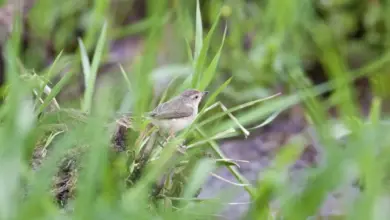
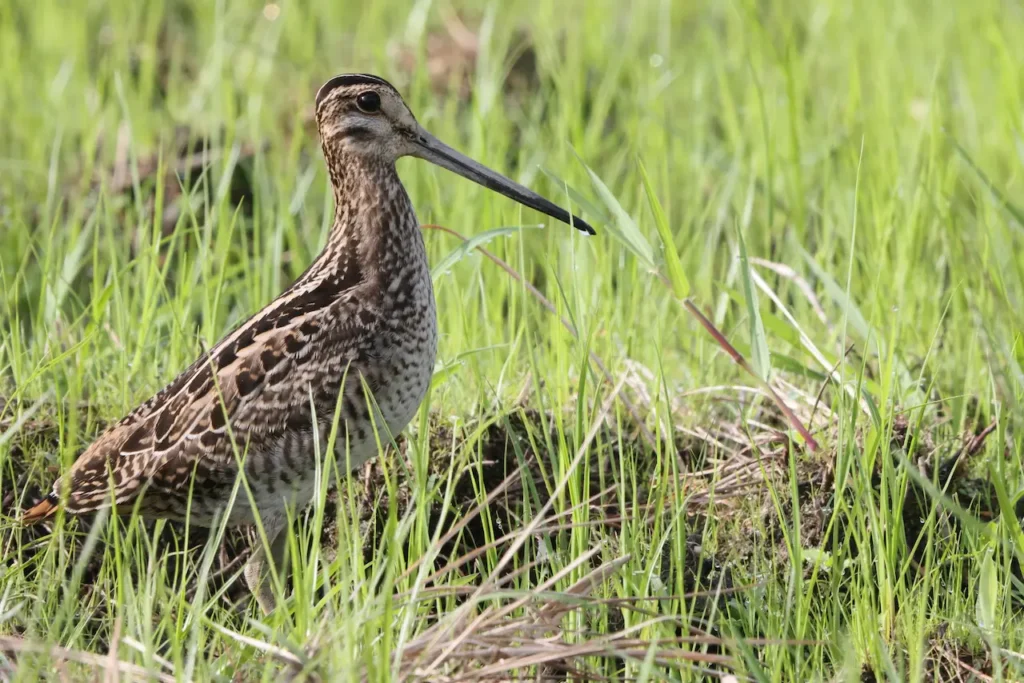
Swinhoe‘s Snipes, Gallinago megala, also known as Forest Snipe or Chinese Snipe, is a medium-sized (length 27-29 cm, wingspan 38-44 cm, weight 120 g), long-billed, migratory wader. Swinhoe’s Snipe is an elusive and fascinating shorebird. This medium-to-large-sized snipe is best known for its secretive nature, preferring to stay hidden in dense, wet grasslands, swamps, and rice paddies. Swinhoe’s Snipe is rarely seen but makes its way north to Australia during summer in small numbers. It arrives quietly after a long migration from its northern breeding grounds. It’s a rare opportunity to see one of these birds, as they are experts at blending into their environment.


Swinhoe’s Snipe nests in northern Mongolia and central and southern Siberia, which are remote and boggy areas. It breeds there during the warm months. After the breeding season is over, the bird makes a long trip south to spend the rest of the year in Southeast Asia and Northern Australia. It is mainly found in Australia’s Top End, the Northern Territory, and the far Northwest of Western Australia. It’s underreported because of its shyness and its similarity to the other snipes. This adds to their mystery and appeal. Swinhoe’s is an exciting challenge for birdwatchers who want to see all of Australia’s snipe species.

Identification
Identifiable as a Gallinago snipe by its cryptically-patterned black, brown, buff and white plumage, but not easily distinguished from Latham’s and Pin-tailed Snipe in the field.
Even experienced birders can find it difficult to identify Swinhoe’s Snipe in the field. The Pin-tailed Snipe is often mistaken for the Swinhoe’s Snipe. This is understandable, as the differences are very subtle and can only be distinguished by a trained eye or even with measurements. Swinhoe’s Snipe is rarer than other migratory birds in areas such as Singapore, northern Australia, and parts of Australia.
Several key characteristics can help you distinguish between a Swinhoe’s Snipe and a Common Snipe. Swinhoe’s Snipe lacks the white edge on the secondary feathers, which is very noticeable in flight. It has a smaller bill, and it appears larger-headed. It is harder to distinguish it from the Pin-tailed Snipe. The tail feathers are one of the best field marks. Swinhoes only have the outermost pair (usually 2 to 4 mm wide) of pin-like tail feathers. The remaining feathers increase in size towards the centre. The outermost tail feathers appear to have at least two feathers of “intermediate width” between them and the central ones. The Pin-tailed Snipe, on the other hand, usually has just one intermediate tail feather between its broad central feathers and a group of six to nine pin-like outer feathers.
Those who love shorebird watching and photography of snipe species will find that capturing the bird with its tail spread in flight is a great way to capture these subtle differences. Most birders, however, will rely on a combination of behaviour, habitat, and structure clues to make an educated guess. This is a great reminder of how complex bird identification can be, and why snipes are so fascinating to study. According to eBird, this species is well documented.
Behaviour
Swinhoe’s Snipe is a shy and secretive bird. It prefers to remain low-profile, especially when startled. This shy snipe will often fly off in silence when flushed out of cover. This can be a useful clue for birdwatchers. Swinhoe’s Snipes are quieter than some of their relatives, who make a loud call when disturbed. This makes identification difficult in the field. Silence alone is not a guarantee – more of an indication than a confirmation. Researchers are still trying to understand the vocalisations of Swinhoe’s Snipes and their close cousins, the Pint-tailed Snipes. They continue to investigate whether differences in flight calls can help them tell the two apart. According to Cornell Lab of Ornithology, this species is well documented.
Patience is the key for birders who want to hear distinct sounds from different snipe species. You can increase your chances of seeing snipes by going out early in the morning or late at night during migration season, particularly around rice fields, wetlands or flooded grasslands. They are very well camouflaged and only show themselves when they take off. If you pay attention to their behaviour, especially if they are silent or call out, it can provide valuable clues. However, visual markers will help identify them more accurately.
Distribution
Breeds mainly in central and southern Siberia and Mongolia. The entire population migrates and spends the non-breeding season principally in eastern and southern India, Sri Lanka, south-eastern China, South-East Asia and New Guinea. Recorded on migration in eastern China and occasionally in Japan. Records in Australia mainly from the Top End of the Northern Territory and from north-western Western Australia.
Habitat
Breeding habitat: forest glades and meadows. Non-breeding habitat: shallow freshwater wetlands of various kinds, including paddy fields and sewage farms, with bare mud or shallow water for feeding, with nearby vegetation cover.
Food
Mainly small invertebrates, including earthworms, molluscs and insects.
Breeding
Display flights and “drumming” by the males.
Conservation
Because of a wide range and no evidence of significant population decline, the species is assessed as being of Least Concern.
Copyright: Wikipedia. This article is licensed under the GNU Free Documentation License. It uses material from Wikipedia.org … Additional information and photos added by Avianweb.
Please Note: The articles or images on this page are the sole property of the authors or photographers. Please contact them directly with respect to any copyright or licensing questions. Thank you.