The Swainson’s Hawk is also known as the Locust Hawk. It is one of North America’s iconic long-distance migratory raptors. This slender and graceful hawk is named after British naturalist William Swainson. It dominates the prairies and grasslands of the western plains during the breeding season. Swainson’s Hawks are known for their shallow “V” dihedral wings and delicate, teetering flights that remind one of Turkey Vultures. They are elegant and efficient. Its story is not just that of a migratory hawk. It is a tale about adaptation, ecological dependence, and the challenges of living in a rapidly changing world. It is one of the most accomplished raptors in North America, as it travels to Argentina.
Ancestry and Evolutionary Significance
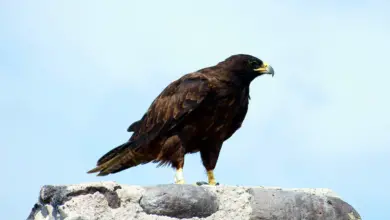
Recent genetic research has revealed that the Swainson’s Hawk is the ancestral species of the Galapagos Hawk. The two diverged only around 300.000 years ago. This is an extremely short evolutionary period. This discovery highlights the species’ ability to adapt and colonise new environments. Understanding the Swainson’s Hawk’s genetic history highlights the importance of conserving its current populations. It represents a lineage that has remarkable ecological and evolutionary significance. The presence of Swainson’s Hawks on all continents provides scientists with valuable information about raptor migration and genetic diversification.

Characteristics of the Human Body
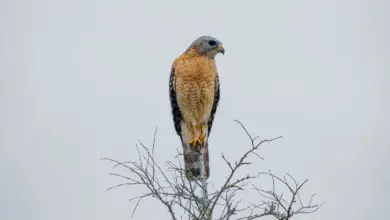
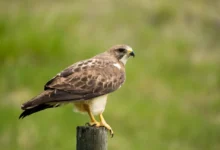
The Swainson’s Hawk has a slightly slimmer and smaller body than the Red-tailed Hawk. However, its larger wingspan creates a more powerful and elegant silhouette when in flight. The adult plumage is usually dark brown upperparts with a chest and a paler belly. This creates a striking contrast from below. The wing structure of the is distinct: long, thin, pointed wings with a two-toned pattern, pale wing linings with dark flight feathers. This species is easy to identify by experienced birders because no other North American Buteo has such dark flight feathers. The shallow “V” of its wings and the gentle rocking motion it makes while flying make this bird’s flight profile unmistakable.




Colour Morphs Identification Tips
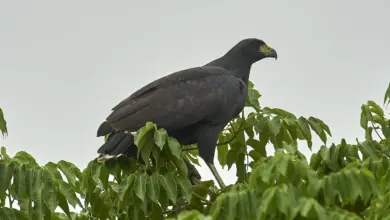
Swainson’s Hawks have two primary colour morphs: the light morph or the dark morph. There are also rufous variations. The light morph is primarily white underneath, with a reddish tone on the breast. It has a grey-barred tail with dark stripes. Dark morphs are completely dark brown with lighter patches underneath the tail. The light trailing edge and darker leading edge on the wings are key characteristics for identification. This is the opposite of what you see in typical soaring Hawks. It is also distinguished by its pale belly, dark bib and white throat patch. The wings can extend beyond the tail tip when perched. The gray-brown coloration of the tail is characterised by six dark bands, including one large subterminal band.
Distribution in North and South America
Swainson’s Hawk has a wide geographic range. It breeds in summer across Western and Central North America, including Alberta, Saskatchewan, Manitoba, Minnesota, Washington, Oregon, California, Arizona, New Mexico and Texas. The Great Plains is a place where it thrives, with its open spaces and prairie ecologies that support its hunting habits. During migration, the majority of the population passes through Central America in spectacular flocks, sometimes numbering up to tens or thousands, before reaching the pampas (Argentina, Uruguay and southern Brazil) where they spend winter. Some winters in Florida’s south and along the Texas coastline. Swainson’s Hawks have some of the longest migrations among raptors, and can travel up to 15,000 km (24,000 miles) per year.
Migration – One of the longest journeys for any Hawk
Swainson’s Hawks make an incredible migration, covering between 11,000 and 17,000 miles each way. Between August and October, they leave their breeding grounds, flying south in large kettles. They use a very energy-efficient method of flight: they ascend on rising thermals, spiralling in loops, and glide long distances until they find the next thermal. The Isthmus of Panama is a natural wonder for birdwatchers. The spring migration can begin as early as March, and birds are dispersed widely across North America. During the last stages of migration, this species does not feed. It relies on fat reserves and stored energy to make the trip.
Preferred Habitat and Environmental Requirements
Swainson’s Hawks are strongly associated with open habitats. They prefer prairies, grasslands and sagebrush plains. It avoids dense forest and heavily cultivated regions without nesting or perching opportunities. Nesting is often found near riparian areas, scattered trees and agricultural landscapes with abundant prey. To scout prey, these hawks need elevated perches, such as fence posts or telephone poles. The distribution of their breeding follows the presence of small mammals. This is especially true for young pocket gophers and ground squirrels. Due to this dependence on rodents, local populations fluctuate along with their rodent counterparts, creating dynamic ecologies within prairie ecosystems. According to Audubon Society, this species is well documented.
Diet Diversity and Feeding Habits
Swainson’s Hawks are versatile predators, eating a variety of prey based on the season and location. They capture small mammals during nesting. This includes ground squirrels and pocket gophers. Also, they take small reptiles and amphibians. Swainson’s Hawks are primarily insectivorous outside of the nesting period, earning the nickname Grasshopper Hawk. They gorge themselves on grasshoppers and crickets. In Argentina, large flocks eat almost exclusively migratory Dragonflies ( Aeshna Bonariensis). They will also eat road-killed creatures, insects that are flushed out by wildfires and insects that have been displaced by farm machinery. According to eBird, this species is well documented.
Hunting Strategies and Behaviour
Swainson’s Hawks display a mixture of behaviours when hunting, including soaring, hovering and coursing. It may glide like a Harrier, stay steady in the breeze like a Rough Legged Hawk, perch on poles quietly before stooping to catch prey. It often forms large feeding groups during migration and winter. This is driven more by food abundance than by social bonds. Foraging techniques include catching dragonflies in mid-air, plucking insects from the ground, pursuing prey that is flushed by tractors, or even stealing from other birds. These hawks defend their territories on the breeding grounds against other buteos, such as Red-tailed Hawks or Ferruginous Hawks. This often results in an ecological separation based on nesting habitat preferences.
Reproductive Behaviour and Nesting
Swainson’s Hawks tend to be monogamous, and they are loyal to their nesting territory. They often return to the same nest every year. Nest construction starts shortly after the arrival of early spring. Females gather sticks and grass, and males build a loosely constructed nest in shrubs or trees. Nesting trees can include cottonwoods, ponderosas, Douglas-firs, willows, mesquites, and even saguaro cacti. The clutches usually contain 2 to 3 eggs that are dull white, bluish-white or light brown with brown spots. The male feeds the female while she incubates. Young hawks are rapidly growing after hatching: feathers appear at around 10 to 14 days. Feasting occurs between 38-46 days.
Communication and Vocalisation
Swainson’s Hawks can be relatively quiet outside of the breeding season. During summer, they give a shrill, aggressive-sounding call–“kearrrrrr”, that resembles but is softer than a Red-tailed Hawk’s scream. The females make deeper calls when they are disturbed, particularly at the nest. These vocalisations are used as territorial signals, warnings, and to communicate between mates when courting and nesting.
Mortality, threats, and life span
Swainson’s Hawks can live up to 16 years in the wild. However, many of them die much earlier because of natural and human-caused dangers. Significant mortality is caused by collisions with cars, illegal hunting, electrocution by power lines, severe prairie weather, and hailstorms. Nest predation is common among Great Horned Owls and can cause egg loss. In some areas, unexplained fertility affects reproductive success. Pesticides have historically been the biggest threat, especially in Argentina, where thousands of Swainson’s Hawks were killed by ingestion of insecticides applied to locust infestations. Pesticide exposure is still a concern, despite international conservation efforts.

Current Population Trends and Conservation Status
The Swainson’s Hawk population declined dramatically through the middle of the 20th century. It was listed as a species to be concerned about in several regions. California classifies the species as Endangered. Habitat loss and agricultural changes are contributing factors to regional declines. Fortunately, conservation initiatives, including pesticide restrictions in Argentina and habitat protection in North America, have helped stabilise or increase populations in many areas. The species is well adapted to pastures and grazing land, but it remains vulnerable to environmental toxins, habitat fragmentation and reduced prey availability. It is essential that the species’ survival on both continents be ensured by international cooperation and continued monitoring.
Conclusion
Swainson’s Hawk is one of nature’s most impressive raptors. It is a highly migratory, elegant species that has been shaped by the open landscapes, abundance in season, and complexity in ecology. It is one of the most impressive birds in nature, with its 15,000-mile migrations and its specialised diet. The Galapagos Hawk’s evolutionary connection, the dramatic migration displays, and its ability to adapt to changing environments make it a conservation priority as well as a symbol for resilience. This species is important for the conservation of an iconic hawk, as well as the protection of grassland ecosystems that it relies on.