The Stork-billed Kingfisher is one of the most iconic tropical birds. Its colourful appearance and hunting abilities are what make it so special. This kingfisher is found in the lush wetlands and forests of South and Southeast Asia. It’s a favourite with wildlife photographers and birdwatchers. Take a closer look at this magnificent bird’s life, behaviour, habitat and unique characteristics.
Taxonomy & Classification
The Stork-billed Kingfisher was previously classified under Halcyon Capensis. It is a member of the tree-kingfisher family, which includes species that prefer wooded habitats to open water. The genus Pelargopsis contains large-bodied kingfishers with a long, strong bill, which resembles that of a Stork.
This species belongs to the Alcedinidae, which contains over 90 kingfisher species worldwide. The Stork-billed Kingfisher, among these, is the largest and most impressive.



Geographic Range and Distribution
The Stork-billed Kingfisher can be found in a wide range of habitats, but is sparsely distributed. It can be found from India to Sri Lanka, as well as Southeast Asia. This includes the Philippines and Malaysia. It is rare to see it in large numbers despite its vast range.
This bird is particularly interesting because it is essentially resident. It does not migrate normally according to the seasons. It will remain in its territory all year round, as long as the conditions are suitable.
Habitat Preferences
The large kingfisher is most at home in habitats with dense forest and especially those that are close to sources of freshwater, such as rivers, lakes, estuaries, and mangroves. The kingfisher is sometimes seen near coastal areas, but only in areas where there are trees.
The stork-billed Kingfisher is an important member of tropical aquatic ecosystems because it prefers riparian areas to moist forested zones. It is both a predator and an environmental indicator.
Physical description: A Giant among Kingfishers
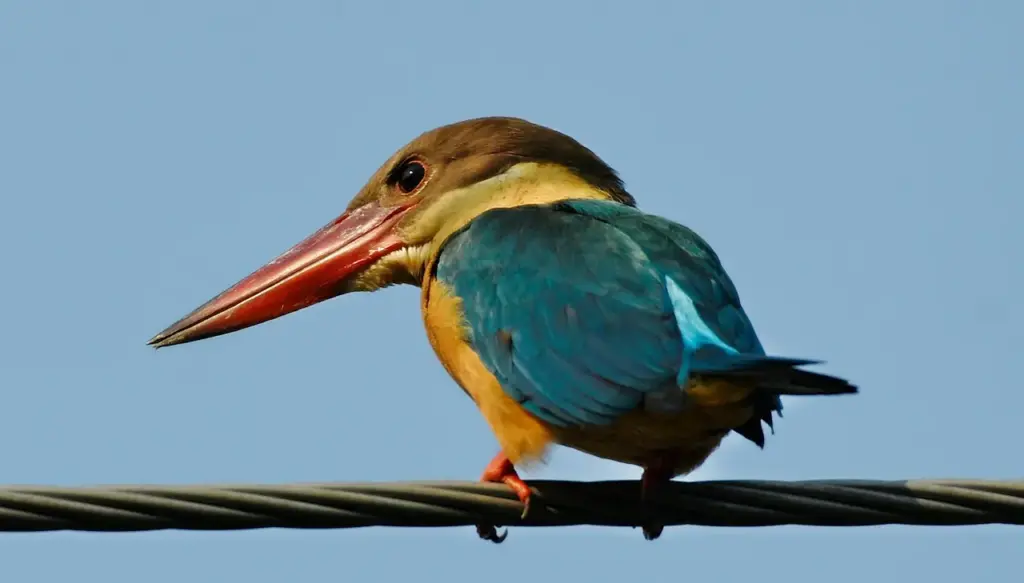
The Storkbilled Kingfisher, which measures about 35cm (14 inches) long, is one of the largest kingfishers in the world. The size of this bird is just as impressive as its appearance.
-
Wings and Back: A vibrant blue that contrasts with the green foliage.
-
Head: Slate Grey, giving the bird an unusual two-toned look.
-
Underparts of the neck: Golden-yellow or warm buff.
-
Bill and legs: Brightly red and disproportionally large, designed to catch large prey.
-
Eyes: Dark, expressive eyes that add to the charismatic appearance.
The bird’s flying has been described as laboured, flapping. However, it is purposeful and direct. Both male and female Stork-billed Kingfishers are similar. This makes gender identification difficult in the field without behavioural clues.
Subspecies & Regional Variations
There are about 15 subspecies recognised of the Stork Bill Kingfisher. The main differences between these subspecies are the colouration of their plumage and their size.
P. The Sulu Islands are home to c.gigantea, which has white plumage covering the head, neck and underparts. Ornithologists, avian taxonomists and other scientists are fascinated by this level of variation.
The Forest’s Echo
Stork-billed Kingfisher is surprisingly elusive. It can often be heard before it’s seen. The noisy bird has a loud call that can be heard over long distances.
The primary call of the owl is a low-pitched “peer-porpor” that is repeated every few seconds. It may also make a series of cackling, loud “ke-ke ke-ke” noises during flight and excitement. These sounds can echo along riverbanks and forest corridors.
These vocalisations have multiple functions, including territorial marking, mate communications, and alarm calls in the presence of predators.
Diet and Feeding Habits
The Stork Billed Kingfisher is an opportunistic predator that is known for its versatile feeding behaviour. It is a fish-eater, but its diet is much more varied than that of many kingfisher relatives. According to eBird, this species is well documented.
Common Prey includes:
- Fish
- Amphibians and frogs
- Crabs, crustaceans and other crabs
- Rodents
- Nestlings and young birds
- Large Insects
The Stork-billed Kingfisher, perched motionlessly atop a branch of a tree overhanging the water, watches intently before diving into a rapid dive. It can also hover above the water for a short time, relying on its body weight and wings to strike accurately at high speeds. According to Cornell Lab of Ornithology, this species is well documented.
Fun fact: A family of six Stork Billed Kingfishers, on average, can consume 100 fish per day. This highlights their importance as aquatic predators.
Territorial Behaviour and Nature
This species is very territorial and will defend its patch of forest or riverbank with aggression. The Stork-billed Kingfisher will chase away even large raptors such as eagles and hawks that encroach upon its territory.
It is also solitary, except when caring for chicks or during breeding season. It avoids large groups or flocks, unlike some smaller kingfishers.
The bird’s body colour and quiet demeanour make it blend into the trees or shadows, regardless of its size.
Breeding Behaviour and Nesting Behaviour
The Stork Billed Kingfisher’s nesting habits show its resourcefulness. Nesting sites include:
- Riverbanks
- Decaying Trees
- Woodpecker holes
- Termite nests on trees
The bird excavates the nesting chamber using its powerful bill. A typical clutch is made up of 2-5 round white eggs. Incubation and feeding are done by both parents, demonstrating strong pair bonds.
Nesting seasons vary slightly from region to region. They are usually coordinated with the wet season, when prey is abundant.
Survival and Lifespan
In the wild, the average life expectancy for the Storkbilled Kingfisher is about two years. However, individuals have survived longer in ideal conditions. The primary threats to the survival of this species are habitat loss, predation and pollution.
IUCN classifies the species as Less Concern due to its large distribution and relatively stable population.
Human Impact on Conservation Status
The Stork-billed Kingfisher, while not threatened globally, is susceptible to localised habitat destruction. This is especially true in areas where wetlands have been drained or forest has been cleared.
For this species and others, it is essential to maintain healthy populations that conservation efforts are focused on wetland protection and buffer zones riparian.
Eco-tourism programs and birdwatching have been developed in South Asia and Southeast Asia to help bring awareness of the importance of preserving these majestic species.
Birdwatching and Cultural Significance
In many Asian cultures, kingfishers have been regarded as signs of peace, prosperity and loyalty. The Stork-billed Kingfisher is a bucket list bird that many birding enthusiasts and ornithologists have.
This bird is found in hotspots of biodiversity like the backwaters of Kerala, Sri Lankan rainforests and Borneo riverine jungles. It attracts tourists and supports local conservation businesses.
You should put the Stork Billed Kingfisher on your list of things to do if you are a birdwatching fanatic planning a trip in South or Southeast Asia. The strong dive, vivid colours, and resonant call make this a wildlife encounter to remember.
Final thoughts: Nature’s vivid predator
Stork Bill Kingfisher (Pelargopsis Capensis) is a magnificent ambassador for tropical biodiversity. Its vibrant plumage and strong hunting skills, as well as its role in the ecosystem, exemplify the diversity of South Asian ecologies.
No matter if you are a professional ornithologist or just a casual nature enthusiast, learning about the tanager bird will open your eyes to how wildlife is intricately woven into tropical forests and wetlands.
Let the Stork Billed Kingfisher remind us of what is at stake and what we risk losing if we don’t take meaningful conservation actions.