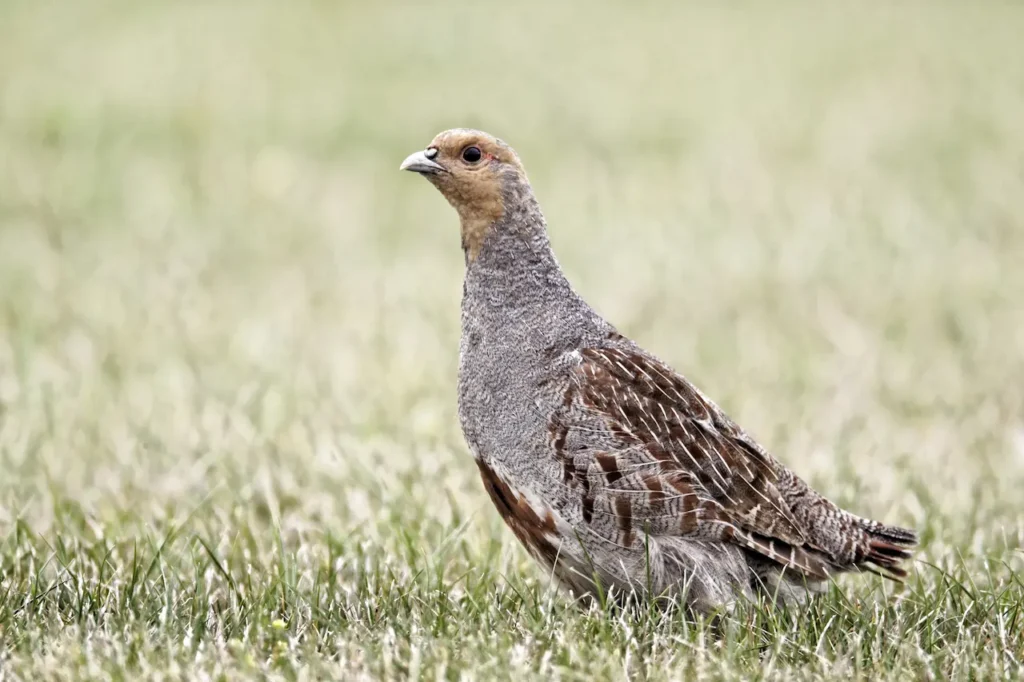
Grey Partridges ( perdix perdix), commonly known as Hungarian Partridges, English Partridges, or “Huns”, are a common farmland bird that is native to Europe and Western Asia. This gamebird is well-known for its association with agricultural landscapes. It thrives on open fields, hedgerows and mixed farmland. The Grey Partridge, which represents a healthy agricultural ecosystem, has been culturally important in rural Europe for centuries. The species is still widely distributed across its range but has seen a significant population decline in some regions, especially where modern farming practices are intensified.
Scientific Classifications and Common Names
The Grey Partridge is classified scientifically as perdix perdix. It belongs to the Phasianidae family, which also includes pheasants and quail. It is also known as the Hungarian Partridge (also called European Partridge), Bohemian Partridge (also known as English Partridge), and Hun. The names are a reflection of its wide geographic range and historical significance as a gamebird. In North America, the name “Hun” has become very popular. The species was originally introduced to North America for hunting. All names refer to the same species. It is distinguished by its rounded shape, subtle feathering, and association with agricultural landscapes.

Natural Range and Global Distribution
Grey Partridges are native to Europe and extend eastward into Western Asia. The original range of the Grey Partridge included grasslands and steppes as well as low-intensity farms, which provided nesting sites, abundant insects and seeds. In the late 19th century and the early 20th century, the species spread widely in North America, especially southern Canada and the northern United States. Grey Partridges were able to establish stable and self-sustaining populations in some of these areas. They are particularly common today in states and provinces on the prairies, where farming practices are similar to those used in their native range. The ability of these birds to adapt to different climates is one reason for their wide distribution.


Preferred Habitat and Farmland Association
Grey Partridges prefer open farmland with a mixture of cereal crops, hedgerows and fallow fields. Winter wheat and other cereals provide them with both food and cover throughout the year. The field margins provide nesting areas and insects for the chicks. Grey Partridges, unlike woodland birds, avoid steep terrain and dense forests. They are particularly sensitive to changes in agriculture because they rely on low-intensity systems. Traditional mixed farming used to provide ideal conditions. However, modern monoculture practices reduce habitat diversity and impact their breeding success.
Physical Description and Identification
Grey Partridges are compact and rotund birds measuring between 28 and 32 centimetres. The Grey Partridge has a brownish back with finely patterned darker markings. It also has grey underparts and an orange-colored face. The chestnut belly patch is one of the most distinctive features. It’s often shaped in a horseshoe shape. The male and female are very similar, except that females have a smaller belly patch. The colouration of the birds is excellent for camouflaging in farmland. In the field, they are easy to distinguish from other ground-dwelling species because of their stocky build, short tail and rounded wings.
The Development of Juvenile Appearance
The young grey partridges are quite different to the adults. The chicks start yellow-brown, and they lack the distinct facial colouring and belly patch that mature birds have. The subdued colouration helps them blend in with grasses and dirt, protecting them from predators. Their plumage develops gradually into the complex patterns that are seen in adulthood as they grow. During the first weeks of life, juveniles are dependent on their parents to guide and protect them. The development of the juvenile is critical during this time, because survival rates are heavily affected by weather conditions, food availability and the presence or absence of cover in the habitat.
Breeding Seasons and Nesting Behaviour
Grey Partridges begin breeding in the spring. Nesting territories are established by pairs on the ground in cereal fields. Winter wheat fields, with their early growth and protective cover, are especially favoured. The nest is made of grasses, plants and other plant materials. It’s well-hidden among the vegetation. Breeding pairs of Grey Partridges remain in their home range all year round as they are non-migratory. The availability of nesting habitat is therefore crucial, since birds are unable to relocate if the conditions change during breeding season. According to Cornell Lab of Ornithology, this species is well documented. According to BirdLife International, this species is well documented.
The Egg Laying and Chick Raising
Grey Partridge Hens are known for their large clutches. They can lay up to 20 eggs at a time. This high reproduction output helps to offset losses due to predation or environmental challenges. Both parents are involved in the care of the chicks once the eggs hatch. Precocial means that the young leave the nest soon after hatching. However, they still depend on their parents to provide warmth, protection and food. Coveys are family groups that move through the landscape together, foraging, avoiding predators and moving as one unit. According to Audubon Society, this species is well documented. According to eBird, this species is well documented.
Adults’ Diet and Feeding Behaviour
Grey partridges are seed eaters. They feed on grains, weed seeds and plant matter. A wide variety of seeds are available in agricultural fields, particularly after harvesting, when grain has been spilled. During the spring, they also eat green leaves and shoots. Insects are eaten when they can, but seeds make up the majority of their diet. It is important to have a variety of food throughout the year in order to maintain optimum body condition. This is especially true during winter, when energy requirements are high, and resources may be scarce.
Important insects for chicks
Insects play a vital role in the survival of Grey Partridge chicks. In the first 10 days of life, young chicks can digest only insects. These provide them with essential proteins for rapid development and growth. Parents intentionally lead their young birds to areas rich in insects, like grassy margins or hedgerows. The decline in insect populations caused by pesticides has had a major impact on chick survival. Even large clutches of chicks can die without enough insect prey. This contributes to the long-term decline in population density on intensively farmed land.
Voices and behaviour when disturbed
Grey Partridges have a distinct call that is often described as “kieerrik”. During the breeding season, this call is heard most often, as birds maintain contact and communicate with each other. Grey Partridges will usually only fly a short distance when disturbed. They do this by flying low and on rounded wings, before settling back into cover. They often make a rapid, “rick rick-rick” sound as they ascend. This is a characteristic behaviour of many gamebirds, which reflects the fact that they rely on camouflage to hide and short bursts rather than continuous aerial movement.
Social Structure and Seasonal Migration
Grey Partridges form coveys outside of the breeding season. These groups are usually made up of family units that join together once the breeding season is over. Covey formation improves survival because it allows birds to communicate about food and helps them detect predators. Coveys can roost in protected areas during winter to conserve warmth. The social structure is stable until the early spring when breeding pairs separate to establish their territories. Covey formation and maintenance a key adaptations to open agricultural landscapes.
Conservation Status and Population Trends
The IUCN Red List of threatened species classifies the Grey Partridge as a species of Least Concern due to the size of its population and the extent of its range. Regional trends are more alarming. Grey Partridges have decreased by 85% in Great Britain over the last 25 years. This dramatic decline is largely attributable to intensive farming, habitat loss and reduced food supply. These declines show the disparity between global conservation assessments and local conservation reality, highlighting the need for regional management strategies.
Conservation Efforts & Future Outlook
Efforts have been made to implement targeted conservation measures in response to the severe population declines that are occurring, especially in the United Kingdom. Conservation headlands are managed field margins that support insects and nesting. This has proven to be one of the most effective approaches. In 1995, in recognition of its importance as an indicator for farmland, the UK nominated the Grey Partridge as a Biodiversity Plan species. Grey Partridge populations may stabilise and recover where they have been most affected by habitat restoration, pesticide reduction, and wildlife-friendly agricultural practices.