The Yellow-billed teal is also known as the speckled teal. It is a fascinating and widespread freshwater duck native to South America. This small but resilient species of waterfowl is easily recognised by its distinctive yellow bill as well as speckled feathers. This blog will take a closer look at the Yellow-billed teal’s physical characteristics, behaviour, breeding habits and diet. This comprehensive overview will provide you with all the information you need about the Yellowbilled Teal.
Habitat and Natural Distribution of the Yellow-billed Teal
Yellow-billed Teal is native to Argentina and Bolivia, Brazil, Chile, Paraguay, Peru, Uruguay, as well as the Falkland Islands. The bird’s wide geographic range shows its adaptability to different environments and elevations. The island populations tend to be sedentary. This means they stay in the same region year-round. During the colder months, continental populations migrate northward, particularly those at higher altitudes and farther south.
The Yellow-billed teal is a bird that prefers bodies of freshwater, such as lakes and ponds. In the Andean region, they are often seen in high-altitude wetlands. During the winter, however, they will move to lower altitudes and coastal wetlands in order to avoid harsh conditions. The adaptable birds can survive in both densely vegetated environments and open bodies of water.


Alternate (Global) Names
Czech: ?írka kropenatá, Círka žlutozobá … Danish: Gulnæbbet Krikand … Dutch: Chileense Taling, Geelsnaveltaling, Chilie taling … Finnish: Harmaatavi … French: Sarcelle à bec jaune, Sarcelle du Chili, Sarcelle tachetée … German: Gelbschnabelkrickente … Irish: Praslacha Shileach … Italian: Alzavola del Cile, Alzavola marezzata, macchiettata … Italian: Alzavola macchiettata … Japanese: kibashikogamo … Norwegian: Gulnebbkrikkand … Polish: cyraneczka zóltodzioba, cyraneczka ?ó?todzioba … Portuguese: assobiadeira, churia-zinha, danadinha, marreca, marreca-assobiadeira, marreca-pardinha, Marreca-pintada, parda-pequena … Russian: ??????????? ?????, ??????? ????? … Slovak: Ka?ica bodkovaná, kacica žltozobá … Spanish: Cerceta del Chile, Pato jergón chico, Pato jergón chico del Norte, Pato Paramuno … Swedish: Gulnäbbad kricka
Subspecies & Regional Variation
At least two recognised subspecies are currently classified as the Yellow-billed Teal. Each is adapted to specific environments and has a slightly different appearance.
-
This subspecies, commonly known as Chilean Teal or Anas flavirostris Flavirostris, is found throughout southern South America. It can be found from Tierra del Fuego to Tierra del Fuego, and even in South Georgia and the South Sandwich Islands. These ducks are usually found in lower altitudes, coastal areas and show a high tolerance to both brackish and fresh water.
-
The Sharp-winged Teal is a species of Anas flavirostris that can be found in highlands throughout the Andes from central Peru to northern Chile, and northwestern Argentina. Sharp-winged Teals appear larger than the nominate race and have a paler tail and flanks.
Taxonomic history and relation to Andean Teals
For many years the Yellow-billed Teal (Anas argentium) was considered conspecific with the Andean Teal. In 2008 the South American Classification Committee officially split these species recognizing the key genetic and morphological difference between them. This reclassification will help birders and ornithologists understand the diversity of South American waterfowl.
The coloration of the bill is a key feature that distinguishes the two. The Andean teal has a dark grayish bill . The Yellow billed Teal lives in the southernmost regions of South America, while the Andean teal can be found more commonly in the northern and central Andean region.
Yellow-billed Teal Physical Description
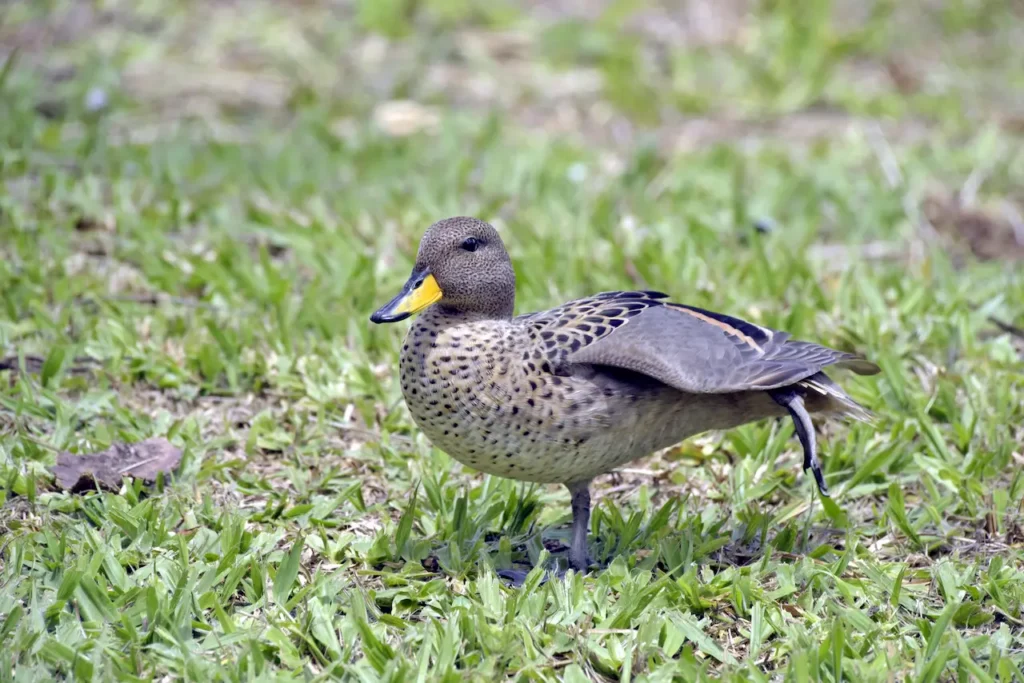
Yellow-billed Teals are small- to medium-sized ducks. They measure between 14 and 18 inches (35-45 cm). The plumage of the Yellow-billed Teal is primarily brown. However, its underparts can vary depending on where it lives. They are silvery-pale in birds at high altitude or darker greyish-brown in lowland populations. These colour variations could be adaptations for different light and vegetation conditions.
The green inner speculum, a patch of iridescent wing feathers, is one of the most distinguishing features. It’s bordered with buff at the leading edge. The feature is only visible when the bird is in flight, but it can be used to confirm identification by experienced birdwatchers. The dark brown is the head, while the bright yellow bill can be seen clearly even at a distance. According to Audubon Society, this species is well documented.
Yellow-billed Teal: Species confusion?
Due to similarity in habitat and bill colour, the Yellow-billed Teal can be confused with the Yellow-billed Pintail. The teal has a smaller, darker body, more speckled feathers, and a compact structure. The teal has a smaller neck and tail, and a different pattern on its wings. These subtle differences can be critical for accurate identification in the field, especially when both species are present. According to eBird, this species is well documented.
Breeding Behaviour and Nesting Habits
The Yellow-billed teal breeding season varies according to latitude and altitude. Breeding begins in Peru and northern Argentina in December or November. In southern Chile, it can start as early as August/September. This coincides with the warmer seasons, which provide more food and better survival rates.
Yellow-billed Teals nest in dense foliage and near water sources. Uniquely, they display a wide range of nesting preferences, building nests in tree forks, holes in riverbanks, and even utilising abandoned nests of Quaker Parakeets or the rooftops of rural buildings. Nesting can occur alone or in loose colonies, depending on habitat and population density.
The typical clutch consists of 1 to 5 eggs, but up to eight eggs have been observed on occasion. The period of incubation lasts between 22 and 26 days. Both male and female ducklings are reared by. The chicks are very precocial and will fledge after 6 to 7 weeks. They become independent relatively soon.
Courtship and Post-Mating Behaviour
The ritual that follows the copulation is one of the most fascinating features of the Yellow-billed Teal. After mating, the male displays a unique display, standing tall and swimming in a circle, often exaggerated, around the female. It is thought that this behaviour is both a territory display as well as a bonding system for the mating couple. These displays are rare in other duck species. The Yellow-billed teal is unique among dabbling birds.
Seasonal Diet Shifts and Feeding Habits
Yellow-billed teals have a flexible feed strategy. They change their diet according to the season. These ducks consume a variety of aquatic invertebrates, including insects, crustaceans and worms. This diet is rich in protein and supports the reproductive system. It also helps to nourish growing chicks.
In the winter months, they eat seeds and aquatic plants. They also eat rotting seaweed near coastal areas. In these months, they are primarily seed eaters, especially sedges. Yellow-billed teals feed by dabbling on the surface of water, turning on shallow waters and sometimes eating on land. The Yellow-billed Teal may also dive for a short time or submerge its head to reach submerged vegetation or prey. This is a rare feeding strategy among dabbling birds.
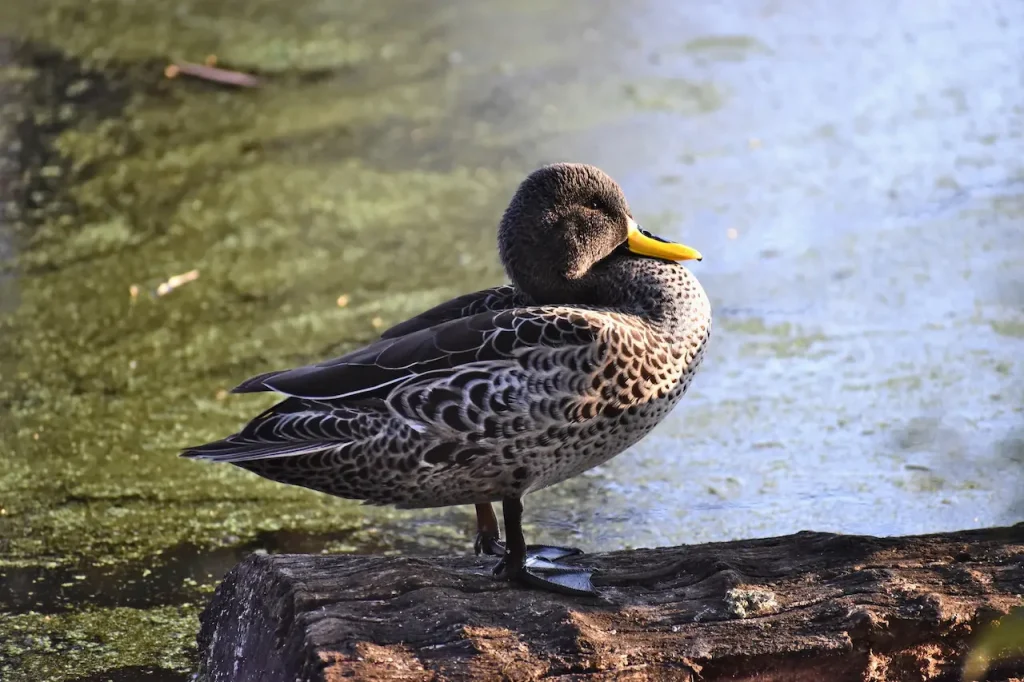
Yellow-billed Teal Soaking In The Sun
Conservation Status and Ecological Importance
The Yellow-billed teal is an important ecological component of wetland ecologies. It plays a dual role as a predator of aquatic invertebrates and a disperser of seeds. The Yellow-billed Teal’s foraging activity helps control insect populations, and also supports the growth of aquatic plants through seed dispersal. Although not considered endangered, this species is vulnerable to degradation of wetlands and pollution.
Prioritising protection for wetlands should be a priority in conservation efforts, particularly where there is heavy agricultural or urban development. Waterfowl habitats can be preserved by educating local communities on their importance. This will also support ecotourism.
Final thoughts: Why the Yellowbilled Teal matters
The Yellow-billed Teal has much more to offer than a pretty duck. It is a symbol for ecological resilience in South America because of its wide geographic range and complex behaviour. Understanding and protecting adaptable species, such as the Yellow-billed Teal, is becoming increasingly important. This charming duck is a fascinating subject for birdwatchers, conservationists, researchers and other interested parties. It’s an important part of the avian diversity on the continent.