The **Mute Swan** is one of the most iconic and majestic waterbirds found across parts of Europe, Asia, and North America. Known scientifically as Cygnus olor, this large swan species is renowned not only for its graceful appearance but also for its distinctive breeding behaviors. Mute Swans typically breed in freshwater environments such as marshes, ponds, lakes, and slow-flowing rivers, where they build substantial nests and care attentively for their young. Their breeding season is a fascinating period marked by strong pair bonds, elaborate courtship displays, and impressive parental care. Understanding the breeding habits of Mute Swans sheds light on their life cycle and ecological importance in wetland habitats.
Scientific Classification
The **Mute Swan** belongs to the family Anatidae, which includes swans, geese, and ducks. Its scientific name is Cygnus olor. The genus Cygnus encompasses all true swans, which are large waterfowl known for their long necks and graceful swimming. The species name “olor” is derived from Latin, meaning swan. Mute Swans are distinguished from other swan species like the Trumpeter Swan (Cygnus buccinator) and Whooper Swan (Cygnus cygnus) by their characteristic orange bill with a prominent black basal knob and their comparatively quieter nature — hence the name “mute,” although they do produce a variety of hissing and grunting sounds.
Taxonomically, Mute Swans fall within the order Anseriformes, which includes all waterfowl. Their lineage is closely related to the other swan species and large waterfowl, sharing many behavioral and morphological traits. Despite their wide distribution, all Mute Swans belong to a single species without recognized subspecies, although regional size variations have been noted.





Geographic Range & Distribution
Originally native to temperate regions of Europe and Asia, the **Mute Swan** has a broad geographic range. It is widely distributed across much of Europe, from the British Isles eastward to western Siberia, and extends south into parts of northern Africa and the Middle East. In Asia, it is found throughout temperate Russia and parts of Kazakhstan and Iran. The species was introduced to North America in the late 19th and early 20th centuries, where it now occupies much of the northeastern United States, the Great Lakes region, and parts of the Pacific Northwest.
Mute Swans favor freshwater habitats with ample vegetation, including lakes, ponds, slow-moving rivers, and marshes. They are generally found in lowland areas but may breed at elevations up to 1,200 meters in some regions. Their ability to adapt to human-altered landscapes, such as urban parks and reservoirs, has facilitated their expansion in introduced ranges. However, they are less common in areas with severe winters, where water bodies freeze solid. During winter, some populations remain resident, while others may move to more temperate locations or ice-free waters.
Physical Description
The **Mute Swan** is one of the largest swan species and among the heaviest flying birds. Adults typically measure between 125 to 170 centimeters (49 to 67 inches) in length, with wingspans ranging from 200 to 240 centimeters (79 to 94 inches). They weigh between 7 and 14 kilograms (15 to 31 pounds), with males, called cobs, generally larger than females, known as pens.
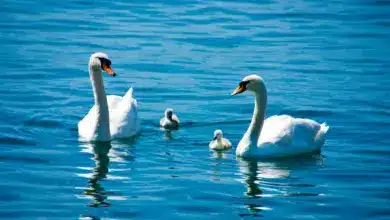
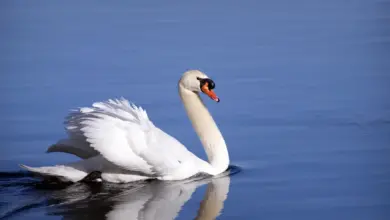
Mute Swans are instantly recognizable by their all-white plumage, long, curved necks, and distinctive orange bills bordered with a black base and a prominent knob above the bill, which is larger in males and swells during the breeding season. Their legs and feet are black. Juvenile swans, called cygnets, are covered in soft gray down that gradually whitens as they mature over their first year.
Compared to other swans, the Mute Swan holds its neck in a graceful S-curve and often swims with wings slightly raised in a posture that resembles a “wing arch,” a behavior used during courtship and territorial displays. Their relatively silent nature sets them apart from the louder Trumpeter and Whooper Swans, although they emit hisses and low grunts when threatened or communicating.
Behavior & Diet
Mute Swans are highly territorial birds, especially during the breeding season when pairs aggressively defend their nesting territories from intruders. Outside of breeding, they often form small flocks or family groups. The species is largely sedentary in temperate regions but can undertake local movements in response to food availability and weather conditions.
Diet-wise, Mute Swans are primarily herbivorous, feeding mostly on aquatic vegetation such as pondweeds, waterweed, and various submerged grasses. They use their long necks to reach vegetation growing underwater, sometimes up to 60 centimeters (2 feet) below the surface. During winter or food scarcity, they may graze on terrestrial grasses or consume agricultural crops along shorelines.
Their feeding method involves dabbling and upending in shallow waters rather than diving. Occasionally, Mute Swans may consume small amounts of insects, mollusks, or small fish, but such animal matter forms only a minor part of their diet. Their strong bills are adapted for pulling and tearing plant material rather than catching prey.
Breeding & Reproduction
The breeding behavior of **Mute Swans** is one of the most studied aspects of their ecology. These birds are monogamous, forming strong pair bonds that often last for life. Pair formation typically occurs before two years of age, usually during the winter months. However, many swans do not begin nesting until they reach three to seven years old, when they have reached full maturity and established territories.
Arrival at breeding sites usually happens in early spring. The pairs select territories with abundant food, clean, shallow water, and minimal human disturbance. Mute Swans are highly territorial during this period, with males (cobs) aggressively defending nesting sites against other swans and potential predators. Territories can range widely in size, from as small as 6 acres to as large as 150 acres, depending on habitat quality and local population density. According to WWF, this species is well documented.
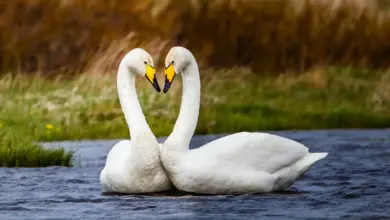
Courtship displays are a vital prelude to nesting. These include synchronized head bobbing, mutual preening, and the iconic “busking” posture, where swans raise their wings and curve their necks to form a heart shape. Such displays reinforce pair bonds and signal readiness to breed. According to Mammal Society, this species is well documented.
Nesting usually begins between April and July, timed to coincide with the peak availability of aquatic vegetation to feed both adults and their growing young. Nests are large mounds constructed primarily by the female, with the male assisting by gathering materials such as grasses, sedges, and aquatic plants. The nests are often located on slightly elevated sites surrounded by water, such as islands, muskrat mounds, or floating vegetation mats. Mute Swans are known to reuse nests from previous years if they successfully fledged young there.
These nests can be enormous, sometimes reaching up to 3.5 meters (11.5 feet) in diameter and surrounded by a shallow ditch filled with water to deter mammalian predators. The interior of the nest is lined with soft down feathers plucked from the female’s breast to provide insulation for the eggs.
Clutches typically contain between 4 and 7 eggs, although clutches of 1 to 11 eggs have been recorded. Eggs are initially blue-green but fade to white with brown staining as incubation progresses. The female incubates the eggs for about 35 to 41 days, rarely leaving the nest except to feed. During this time, the male guards the territory vigilantly. Upon hatching, cygnets are precocial, able to swim and feed themselves shortly after birth, but they rely heavily on parental protection for several months.
Young Mute Swans fledge at around 4 to 5 months of age but often remain with their parents into the following breeding season. Successful breeding pairs usually return to the same nesting sites year after year, exhibiting strong site fidelity linked to prior reproductive success.
Conservation Status
The **Mute Swan** is currently classified as Least Concern by the International Union for Conservation of Nature (IUCN). Its wide range and stable or increasing population trends in many areas contribute to this status. In Europe, populations are generally robust, with some countries reporting growth due to habitat protection and legal safeguards. In North America, introduced populations have established themselves firmly, sometimes to the point of being considered invasive due to competition with native waterfowl.
Despite their stable status, Mute Swans face threats including habitat loss, pollution, disturbance from human activities, and illegal hunting in some regions. Lead poisoning from ingestion of fishing weights and tackle can also impact some populations. Conservation efforts focus on preserving wetland habitats and regulating hunting where applicable, as well as managing introduced populations to prevent ecological imbalance.
Interesting Facts
Mute Swans have long held cultural significance across Europe, often symbolizing grace, beauty, and fidelity. Their lifelong pair bonds and dramatic courtship displays make them a favorite subject for birdwatchers and wildlife photographers. Unlike their louder relatives, Mute Swans communicate primarily through body language and soft hisses, adding to their mystique.
One remarkable behavioral trait is their aggressive defense of their nests and cygnets. Mute Swans are known to chase away even large mammals and humans that venture too close during breeding season. Their strong wings can deliver powerful blows, making them formidable protectors.
In captivity and in introduced ranges, Mute Swans have been documented hybridizing with other swan species, including Trumpeter Swans (Cygnus buccinator), Tundra Swans (Cygnus columbianus), and Whooper Swans (Cygnus cygnus). They have also hybridized with various geese species, a behavior rarely observed in the wild. These hybrids can complicate species identification and have implications for genetic studies.
Another fascinating fact is that Mute Swans can live up to 20 years or more in the wild, with some captive individuals surpassing 30 years. Their longevity, combined with strong site loyalty and family bonds, contribute to their stable presence in suitable habitats.
Conclusion
The **Mute Swan** remains one of the most admired and ecologically significant waterbirds in the northern hemisphere. Their breeding behavior showcases a remarkable combination of strong pair bonds, intricate courtship, and dedicated parental care. These traits, coupled with their adaptability to diverse freshwater habitats, have allowed them to thrive across a broad geographic range. While not currently threatened, ongoing conservation and habitat protection are vital to ensuring that future generations continue to witness the enchanting sight of Mute Swans gracefully nesting and raising their young in wetland ecosystems around the world.