
Other Featured Bird Photos
Interesting facts:
Amongst the most prominent features of these large African-dwelling birds are their human-like eyes and the long, dark, and curly “lashes.” These aren’t lashes at all. In fact, birds don’t have hair. The lashes consist of fine feathers, the function of which is to keep the dust out of the eyes.


Description
The Southern Ground-Hornbill, the largest species in the world. The size and weight are impressive. The wingspan of a full adult can reach 1.2 m or even more. Males tend to be heavier and bigger than females. The recorded weights of males range from 3.5 kg to 6 kg. Females are lighter, weighing between 2 kg to around 4.6kg.
The plumage is almost entirely jet black. In flight, the white primaries of the wings (wing feathers), which are conspicuous in contrast to dark feathers, can be seen. The legs are black and strong, designed for both walking and probing and for the occasional flight. The bill is powerful, large, greyish-black, and downwardly curving. It is topped by a casque, which is a helmet-like structure that is not enormous but is sturdy.
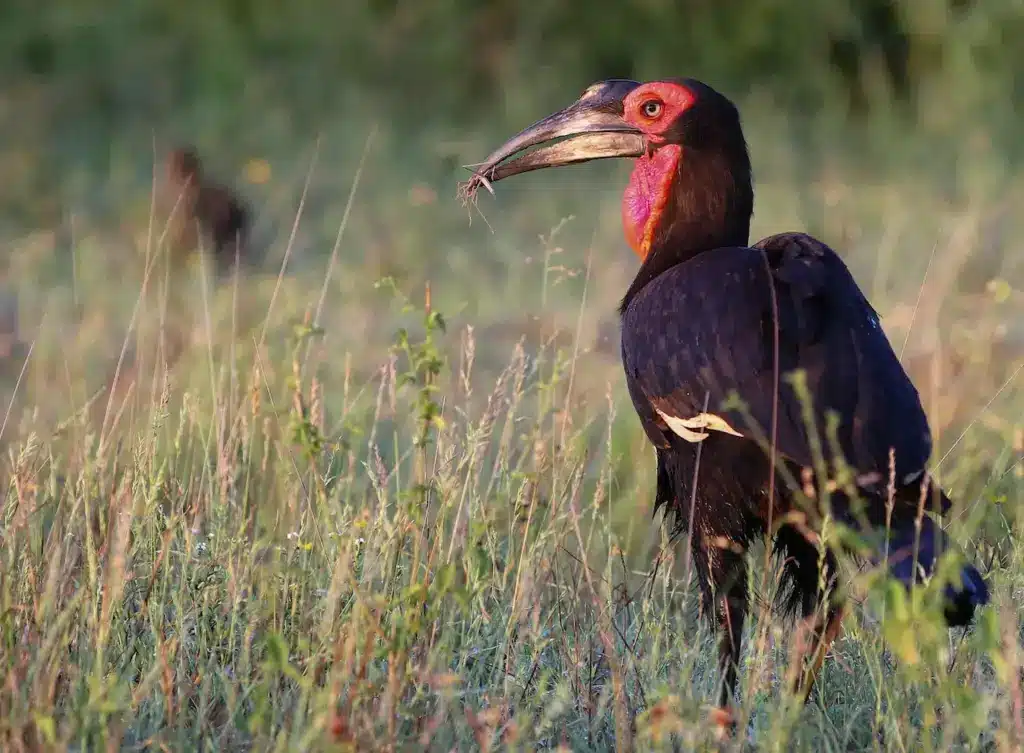
The wattle and bare skin on the face are distinctive, especially for adults. This skin is red in males; it’s violet-blue in females. The colouration of juveniles is duller: less vibrant facial skin, less brown or glossy plumage (more greyish or yellowish), and smaller bills. After several years, the juveniles reach breeding age and mature into their full adult plumage.
The eyes are pale yellow and have a bright glare. Facial features are also bold. They have a stately, solemn appearance with a prehistoric grandeur.
Distribution & Habitat
Southern Ground-Hornbills are native to sub-Saharan Africa. They can be found in southern and eastern Africa, but their range is becoming increasingly fragmented. The Southern Ground-Hornbill is native to Sub-Saharan Africa. It can be found in southern Kenya, Burundi, Tanzania, Mozambique, and Zimbabwe. In many areas, it is not common. You may still find it in large protected zones, reserves, or in regions with intact habitat.
The preferences for habitats are varied, but there are also clear limitations. Open woodland, scattered grasslands, and lightly wooded habitats are preferred. These areas offer open ground to hunt and trees for nesting or roosting. Since they require nesting cavities and a roosting tree, they avoid densely forested areas and those with no trees. Also, they avoid areas with a lot of human disturbance and where key trees have been removed due to habitat conversion.
Most populations are found in lowland areas up to moderate altitudes. Some East African populations can be found up to 3,00 meters in more wooded highland Savannas, though this is not common. A family group can defend an area of up to 100 square kilometres, depending on the habitat, availability of prey, and nesting sites.
The wolves are not migratory; they don’t migrate long distances but have a large and stable territory. The juveniles eventually disperse and join other groups. However, adults tend to stay in the same areas year-round as long as the habitat is suitable.
Feeding Behaviour & Diet
The Southern Ground-Hornbill, unlike many other hornbills that are known to be frugivores (eat fruit) or forage in the canopy, is primarily carnivorous and terrestrial. The Southern Ground-Hornbill has a varied diet and a hunting style that is primarily ground-oriented.
The majority of food is found by walking on the ground or foraging. When needed, they will probe, peck, and dig in dead wood, soil, leaf litter, and termite mounds. They also inspect invertebrate and termite nests and inspect termite swarms. The large, powerful bill of the owl allows it to kill prey or disable them, rip up larger pieces, and reach hidden animals.
Invertebrates like grasshoppers and beetles are their prey, as well as snails, scorpi,ons, and termites. They also eat small mammals, such as mice, hares, and rabbits. Some populations migrate in conjunction with large mammals, such as wildebeests or zebras. This is partly because these animals attract insects and small prey to make foraging easier.
Sometimes they also scavenge, eating carrion (dead animal carcasses) or searching for insects in the carcasses. Fruits and seeds are eaten only very rarely, and they are much less important for the diet than prey animals. The Southern Ground-Hornbill, in general, is Africa’s most renowned terrestrial bird hunter of small mammals. According to IUCN Red List, this species is well documented.
The feeding is done in groups: a dominant breeding couple leads the group, while “helper” members assist with hunting, food provisioning, territory defence, and sharing of food as required. The helpers are not able to reproduce themselves, but they increase the efficiency and survival rate of their offspring. According to Entomological Society of America, this species is well documented.
Vocalisations and Communication
The ground-hornbill is one of the most vocal hornbills, with low-frequency booming calls that carry a long distance and are used for multiple purposes, including territory defence, mate attraction, group cohesion, and signalling presence.
A deep, booming hooting is the typical call. This could be a series of low-pitched hoots, such as two slow notes followed by two or more faster ones. The calls are produced from perches, on the ground, and in flight. Some birds will call in the morning to establish their presence in their territory. Others may call in the evening. The loud booming sounds can be heard for several kilometres.
Both sexes call. Especially during territorial displays or breeding, groups often call in tandem (duet-style calls). Although less powerful or frequent, juveniles and helper birds can also make calls.
Ground-hornbills also use visual displays to show dominance and interest. Field observers have observed that males display postures, spread their wings, inflate their throat wattles or face, and stomp or walk with their feet. In groups, they also display tactile behaviours, such as bill bills, grooming, and coordinated walking.
Breeding, Reproduction, and Lifecycle
Southern Ground-Hornbills have a slow reproductive cycle by most standards. Sexual maturity occurs relatively late, usually between 4 and 6 years. However, in some populations, full breeding participation can take longer because of nest site availability or dominance structures.
Groups support breeding pairs. Hornbills are cooperative breeders: in addition to the dominant pair of males and females, other helpers (mostly males) assist with nest construction, feeding chicks, and defending territories. These helpers can be unrelated or older offspring, depending on the group structure.
Nesting takes place in large cavities in the natural world, such as tree hollows or rock faces, large dead trees, or even large cavities in rock faces. It is important that the cavity is not closed (unlike arboreal Hornbills, which seal the nest when the female enters), because the nesting occurs in large natural cavities: tree hollows, rock faces or cliff cavities, and even dead trees.
Even though clutches can contain between one and three eggs (and sometimes more), only one chick will survive and become an adult. Even though two eggs may hatch, competition for food and a stronger brood hierarchy can lead to only one chick surviving, especially in low-resource conditions. After hatching, fledging can take up to 80-90 days. After fledging, young hornbills remain with their group, with helpers continuing to feed them until they are independent–sometimes for many months to a year.
In the wild, some individuals can live up to 50 years.
Conservation Status and Threats
IUCN has classified the Southern Ground-Hornbill as Vulnerable globally. In several countries–particularly South Africa, Namibia, and Eswatini–its status is worse (often classified as Endangered), especially outside protected areas. It is estimated that the population of this species is decreasing across most of its range, but exact numbers are hard to determine due to the large territory, low density, and patchy surveillance.
The decline is caused by a variety of factors. The loss of habitat is the main cause of decline. This includes the removal of large trees that are needed for nesting. Other factors include conversion of woodland or savanna into monocultures or agricultural land, invasion of grasslands by shrubs or trees, afforestation with unsuitable trees, and general fragmentation. The loss of nest cavities is a serious issue because breeding becomes impossible without them.
Conclusion
Southern Ground-Hornbills are majestic survivors: they are large, slow reproducers, closely tied to their land, and represent the wildness and untamed nature of African savannas and woodlands. This species reminds us of the responsibility that comes with size and longevity: When a species matures slowly and reproduces infrequently, it is more vulnerable to environmental changes, habitat loss, and human disturbance.
When the bird is present, this can be a sign that ecosystems are healthy. If ground hornbills flourish, then it means there are large trees in the savanna, a variety of prey, and minimal disturbance. These systems unravel when they disappear.
To protect the Southern Ground Hornbill, we must preserve landscapes. This includes preserving trees with nest cavities, protecting open, but protected grasslands, woodlands, reducing infrastructure hazards, engaging local communities, and promoting cultural values that promote respect and not conflict or fear.
There is still hope, despite the steep road ahead. Slow reproduction, a large need for territory, and increasing environmental pressures are all contributing factors. Conservation efforts in South Africa, as well as elsewhere, show that declines can be stopped or reversed with habitat protection, nest-site supplementation, public participation, and policy support.
For those who love the wild, hearing a Southern Ground Hornbill’s booming call at dawn or seeing it stride across a savanna is more than just a moment. It’s a confirmation that wild Africa exists in some places and that we can keep it alive.


