The Pied Wheatears, Oenanthe pleschanka, is a wheatear, a small insectivorous passerine that was formerly classed as a member of the Thrush family, Turdidae, but is now more generally considered to be an Old World flycatcher, Muscicapidae.
This migratory central Asian wheatear occurs from the extreme southeast of Europe to China and has been found wintering in India and northeastern Africa. It is a very rare vagrant to Western Europe.




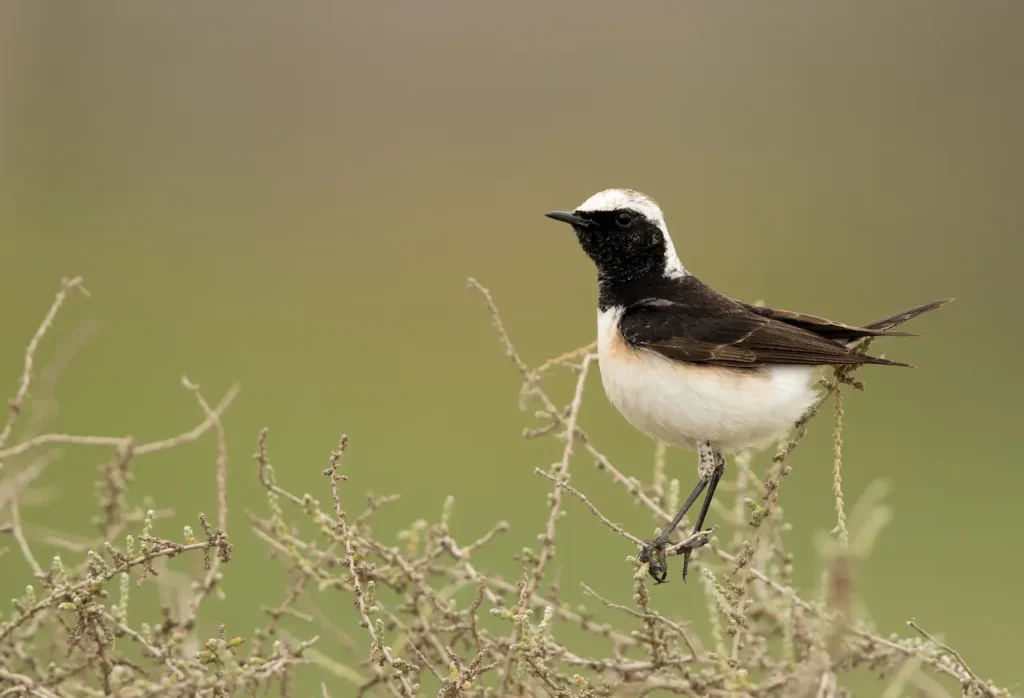
In summer male is a white and black bird. The white crown tinged with grey contrasts with the black face and throat. The female is browner, and the head is washed with sandy buff. Females are darker than Northern Wheatear, look smaller, and show less white on the rump.
The Pied Wheatear’s tail and rump are white, with an inverted black T giving a pattern like Black-eared Wheatear. This 13.5-14.5 cm bird nests in open, stony, sparsely vegetated habitats, laying 4-6 eggs in a rock crevice. It eats insects and berries.

Behaviour
Although a little shy, the Pied Wheatear can be seen in pairs or alone, perched on fence posts, rocks, or shrubs where it has an excellent view of its environment. These vantage points are used to scan for insects before darting down to catch prey in a quick, fluttering flight.
The constant bobbing of the tail is a characteristic behaviour. It is often used as a visual clue to identify the bird, even if it is silent. They are easy to spot because of their lively movements and preference for open areas.
Pied Wheatears are often seen nesting in open terrain
during the breeding season. They choose natural crevices or holes in walls, embankments, and rocks for their nests. The eggs are usually bluish green with rusty spots.
The male can perform dramatic displays to attract a mate or defend his territory. The availability of insects as prey and the location where they nest are key factors in their breeding success.
Diet / Feeding
Pied Wheatears are insectivores. They feed on invertebrates in their open, dry habitats. The Pied Wheatear’s diet consists of ants, beetles and flies as well as grasshoppers, larvae and spiders. It may eat seeds on occasion, particularly during migration and when insects are scarce.
Foraging is done mostly on the ground. They use short flights or quick hops to catch prey. Bird enthusiasts who are interested in natural feeding habits will enjoy their active hunting style and the preference they have for perches that are exposed. According to Bug Guide, this species is well documented.
Songs / Calls
For a bird of this size, the Pied Wheatear has a very expressive vocal range. The Pied Wheatear’s calls are a twangy, dry “chak” and a short descending “dew”. These sounds are often heard when it is alarmed or interacting with other birds. According to IUCN Red List, this species is well documented.
Males often sing a melodic, rambling song, which includes whistles, trills and buzzes. This is usually done in mid-flight. The flight song is a part of the courtship display, and it’s just as important to attract a mate as it is to claim territory. These vocalisations can help birdwatchers locate the bird in open terrain, where it may be difficult to see.
Habitat
The Pied Wheatear thrives in dry and rocky landscapes. This is especially true in semi-deserts and steppes where sparse vegetation and boulders provide the perfect mix of cover and space. In arid areas, you’ll find them perched atop rocks, low shrubs or man-made structures. They prefer open, stony, flat valleys and fallow, unforested fields.
In Mongolia, the Pied Wheatear can be found up to 3,500 meters above sea level. They prefer boulder-strewn flatlands, which are often covered with hardy shrubs such as Caragana and Halimodendron. Pied Wheatears prefer bushy plains and wooded edges in their African wintering grounds. They also favour recently burned areas with more insects. They’re less likely to perch on bushes and trees during non-breeding seasons than some of their relatives.
Distribution
The pied wheatear is native to Central Asia, and its breeding range extends from southeastern Europe to China. The Pied Wheatear is a long-distance migrator, spending its breeding season in northern Europe and then flying south to India or northeastern Africa during the months when it’s not breeding.
It is a common bird in the central and southern latitudes. However, it can be spotted occasionally as a vagrant bird in western Europe. This causes excitement among birders whenever it appears outside of its normal range. The bird’s wide distribution and ability to adapt to various open habitats ensure its success on all continents.
Conservation Status
The pied wheatear is listed on the IUCN Red List as “Least concern” due to its stable population and wide distribution. It is estimated that there are between 400,000 to 8,4 million individuals. The species is not currently threatened by any major threats. However, local populations could be affected due to habitat changes caused by agriculture or urbanisation.
This small songbird has been doing well in its entire range. It’s encouraging to see birds like the Pied Wheatear flourishing in the wild.
Copyright: Wikipedia. This article is licensed under the GNU Free Documentation License. It uses material from Wikipedia.org … Additional information and photos added by Avianweb.
Please Note: The articles or images on this page are the sole property of the authors or photographers. Please contact them directly with respect to any copyright or licensing questions. Thank you.